Bova’s “Please” Game Rules
StrikeBova’s “Please” Game Rules are a deliberately simple condition imposed on a prisoner: he must answer questions and carry out commands only when Bova says “please.” Bova presents the condition as a game about courtesy, but its application makes civility a weapon controlled entirely by the person holding power. In the scene, the rule moves from withholding water and forcing compliance to a lethal reversal, exposing the gap between its professed manners and its actual violence.
The Rule as a Game
Bova introduces the game with a broad smile, calling it one of his favorites and saying he used to play it with his parents. He then explains its terms to a kneeling prisoner: “You must answer my questions and do as I say . . . but only if I say please.” The rule is framed as a simple courtesy and a way to maintain civility even in difficult circumstances. Yet the prisoner has no meaningful choice about entering the game. When he does not agree, Bova announces agreement on his behalf.
That forced assent establishes the game’s central imbalance. Bova alone decides when the required word has been spoken; the prisoner must anticipate and follow the rule while under threat. The language of play makes the exchange sound consensual, but the prisoner is being held in place by a soldier, and Bova dictates both the terms and their consequences. Courtesy here is not mutual conduct. It is a test whose standard belongs to the person conducting it.
Water as the First Test
The game begins around the prisoner’s urgent need for water. Bova takes a canteen from the passenger seat of his jeep, holds it near the prisoner’s face, and says, “Take a drink.” When the prisoner reaches for it, Bova violently kicks his hand away. He then reminds him, “You’ve forgotten already? I didn’t say please.” A soldier wipes Bova’s boots with his sleeve, attending to the grime rather than helping the man who has fallen onto his elbows. The episode makes the rule physical: a missing word is answered not with correction but with pain and degradation.
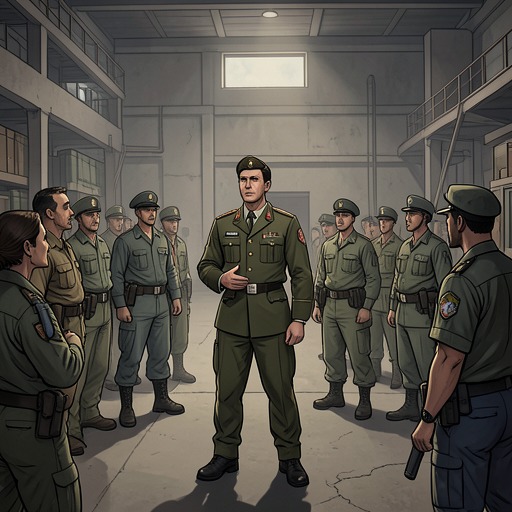
Bova offers the canteen again, and the exchange proceeds on his terms. He calls the game fun, while the watching prisoners remain confronted with a spectacle that the narration explicitly distinguishes from fun. He next says, “Now. Please lift your right arm.” After several painfully long seconds, the prisoner raises it barely. The smallness and delay of the movement register the cost of obedience: even a simple command has become a performance extracted from someone exhausted and under coercion.
Questions, Confession, and Conditional Reward
Bova uses the same formula to demand an account of the prisoner’s alleged offense. He asks what the man did “so naughty,” adding “please,” and then insists that the prisoner must answer because he has said the word. The prisoner, whose eyes appear unfocused, eventually explains that he tried to bring water to his unit. Bova identifies the offense as bringing extra water and asks whether the unit is his. The game has thus become an interrogation: the prisoner’s need to obey the courtesy rule supplies Bova with a route to a confession about the water.
Bova then presents compliance as a basis for reward. He says that when people follow the rules, they will be rewarded, and tells the prisoner that the incident was a silly misunderstanding before allowing him to drink and rejoin his unit. The reward is only a few swigs of warm water for the prisoners; the narrator notes that he receives none because he had not been working. The prisoner lunges for the Jerry Jug and drinks greedily. What appears to be the game’s resolution therefore remains precarious: Bova has restored access to water, but the prisoner’s safety still depends on Bova’s shifting interpretation of the exchange.
The Rule’s Lethal Reversal
Bova returns to the prisoner, takes a black baton-weapon from a guard’s belt, and approaches as the man holds the Jerry Jug aloft for its last drops. Bova says, “Sorry,” with what seems like genuine sympathy, then adds, “I didn’t say please.” He raises the weapon and aims at the prisoner’s chest. Nobody intervenes. Bova fires; the weapon makes no sound, but the prisoner does.
The ending reveals the rule’s decisive function. The language of courtesy has never protected the prisoner or established a stable agreement: Bova can turn the game into a means of eliciting answers, granting a brief reprieve, and then killing the man when the interaction resumes. The contrast between the quiet weapon and the prisoner’s cry closes the scene on the human consequence behind Bova’s polished vocabulary. “Please” is treated as a rule of etiquette, but under Bova’s control it serves as a pretext for domination rather than a limit on it.