Drone-Suppression Prerequisite for SYLO’s Ground Assault
StrikeThe Drone-Suppression Prerequisite for SYLO’s Ground Assault is the operational condition that SYLO forces must wait until the Retro drones are grounded before launching a ground advance against the dome. It gives Kenny Sokol’s team a decisive role in the wider assault: by seizing the drone command center, they are meant to remove the protection that has repeatedly stopped SYLO attacks and make a ground approach possible.
Definition and Strategic Context
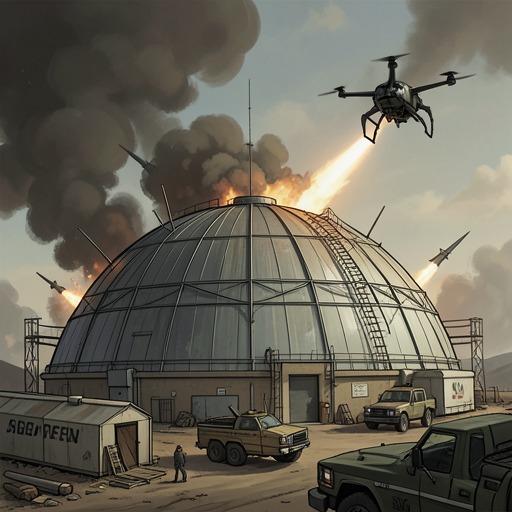
The prerequisite is not presented as a general military regulation but as the explicit condition governing this planned operation. The dome is protected by Retro drones, and previous attempts by SYLO to attack the camp have been turned back. Tucker questions whether SYLO can take the Bridge-side dome at all while the drones remain active, noting that the attackers have not been able to compete with them. The obstacle is therefore not merely a matter of troop strength. As long as the drones can strike at an advancing force, the ground assault cannot safely begin.
The defenses also have a specific command structure. Kenny Sokol explains that the drones are controlled from a bunker near the dome, and that his assignment is to take a team through the Bridge and seize the command center. The plan makes the suppression of the drones an objective in its own right, rather than treating their removal as an incidental result of the larger battle. Sokol’s team is to change the conditions of the fight before Captain Granger commits the ground troops.
The Conditional Assault Plan
Captain Granger describes a staged approach. Tucker, Tori Sleeper, and Kent Berringer will travel with him in his helicopter to the desert, while SYLO ground troops establish a broad perimeter around the base, beyond the Retros’ sight lines. They are to hold there until they are confident the drones have been grounded. The troops are not to advance simply because they are assembled and ready; the operation depends on receiving confirmation that the threat has been neutralized.
Tucker asks what will happen if that confirmation never comes. Captain Granger’s answer is unambiguous: SYLO will not attack. Without the signal, the force would be cut down before it reached within half a kilometer of the camp perimeter. Tucker recognizes that the commander is right: the ground force has no chance of securing the dome while the drones remain operational. The rule thus sets a firm limit on the assault, not just a preferred sequence. Waiting is part of the plan because advancing prematurely would expose the troops without giving them a viable way to reach their objective.
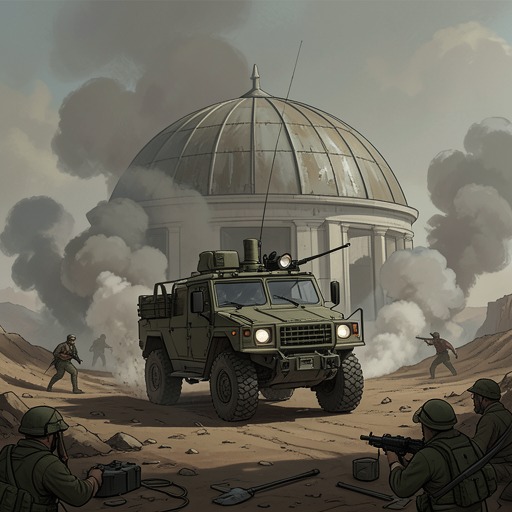
The operation’s next step is also conditional on verification. Once SYLO can confirm that the drones are no longer flying, its forces will advance toward the base, with commandos dropped ahead of them on zip lines. Kent compares this tactic with the earlier operation on Pemberwick Island. That reference situates the coming assault within SYLO’s prior experience, while the requirement to wait for confirmation marks what is distinctive about the current plan: the approach cannot begin until the air threat has been checked.
Signal and Execution
The need for confirmation shapes the characters’ actions at the perimeter. Captain Granger tells Tucker and Tori Sleeper that the force will go no farther until the drones are grounded and that they must notify him when the signal arrives. Tori checks her communicator, but its screen is still blank. Her uncertainty reflects the plan’s dependence on communication: the troops can be positioned and prepared, yet neither their readiness nor the passage of time substitutes for word from the team acting against the command center.
That word arrives through a concise signal. Tori takes a breath and reports, “We own the sky.” The drones begin making wide arcs in opposite directions, while Kent Berringer confirms that he has received the same message. Captain Granger then gives the order to start the strike, and the waiting SYLO soldiers, vehicles, and other forces move into action. The sequence confirms the prerequisite in practice: the ground attack begins only after the reported change in the air defenses.
The phrase is both a status report and a turning point in the operation. Before it, Captain Granger’s force remains stationary and exposed to the possibility of attack; after it, the commander treats the condition for advance as met. The signal does not itself capture the dome or establish the assault’s ultimate outcome. Its immediate consequence is narrower and specific: it releases the forces from the hold imposed by the drones and triggers the planned attack.
Tactical and Ethical Significance
The prerequisite makes coordination across the two sides of the Bridge essential. Kenny Sokol’s team is tasked with acting against the drone-control system, while Captain Granger’s SYLO force waits on the other side for confirmation before risking a ground advance. Neither part of the operation is sufficient by itself: suppressing the drones without a prepared ground force would not secure the dome, while moving the ground force before suppression would expose it to a defense that had already defeated earlier attacks. The rule joins these separate tasks into one dependent sequence.
It also distinguishes tactical necessity from moral justification. The characters are fighting an invasion, but the novel does not let the urgency of that struggle settle every question about violence. Tori Sleeper challenges the readiness to accept deaths in pursuit of the group’s aims, including deaths caused during the resistance’s own operations. Later, amid the fighting, Tucker reflects on how quickly he has come to shoot anyone he regards as an enemy and says that the killing has to stop somewhere before he runs toward Feit. Those moments do not alter the drone condition, but they place the military plan within the story’s wider concern: a necessary tactical safeguard can reduce the danger to an advancing force without, by itself, answering what the combatants owe to human life. The sequence from waiting, to confirmation, to attack gives that distinction a concrete form: careful coordination governs when SYLO moves, while the moral consequences of fighting remain unresolved.