Temporal Invariance Principle
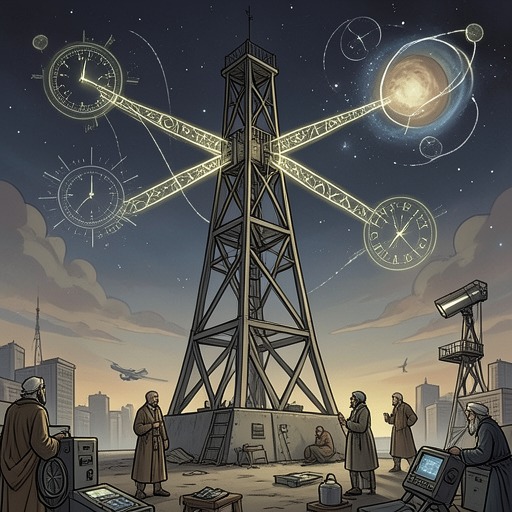
StrikeThe Temporal Invariance Principle is the rule that changing the past cannot alter a future that already exists. In the story, it separates the past and future into distinct realities: actions in one do not revise the other, even when the two are connected by the Bridge. The principle turns time travel from a means of repairing the future into a source of branching timelines—and helps explain both the invasion plan and the survivors’ final return to 1952.
Experiments and the Rule
The principle emerges from attempts by future scientists to test whether altering the past could change their own era. They planted time capsules for later recovery and placed newspaper articles in major publications of the 1950s and 1960s. When researchers searched for these interventions in the future, the capsules were absent and the articles no longer appeared in the archives. The experiments led them to conclude that an event, once it has happened, cannot be undone by changes made in the past.
That conclusion answers the fear Kent Berringer raises about the butterfly effect: even small changes might alter who was born, or cause people from the future to disappear. Olivia explains that the experiments did not produce such revisions. Instead, the two eras remain separate, like different worlds or dimensions. The distinction is not that the past cannot be acted upon; it is that those actions do not rewrite the already-existing future.
Political Consequences
The rule has consequences beyond time travel. Once the future government understood that intervention in the past could not improve its own condition, it prepared to invade. Captain Granger describes how the Sounders saw signs of a military buildup and encountered restrictions on scientists’ movements and refusals when they sought access to manufacturing areas. The government’s stated explanation was that it needed to defend itself against six countries with which it was at war; the invasion plan followed from the knowledge that changing the past would not rescue the future.
The principle also clarifies the limits of earlier efforts to avert ecological disaster. Scientists who studied the twenty-fourth century helped prompt renewable-energy development, emissions reduction, and recycling in the present. Yet those measures could not change the future that already existed. The account leaves open whether such efforts might prevent a comparable disaster in a different timeline: the characters acknowledge that they would not know until that future arrived. Temporal invariance therefore does not make present choices meaningless; it denies that those choices can retroactively transform a future already established.
The Bridge and Multiple Timelines
The survivors’ return to 1952 makes the apparent contradiction especially clear. After the bomb blast sends them back to the moment before the original test, they prevent the bomb from detonating. Kent concludes that the Bridge was never created and the Retros cannot have gone back to destroy people in the past. Olivia rejects that conclusion: the events did happen. The original future and the twenty-first century had been separate timelines connected by the Bridge, so stopping the test in 1952 does not erase the history the travelers have already experienced.
The return instead opens the possibility of another timeline. The narrator reasons that the travelers have started a new clock by preventing the test, while the past remains unchangeable in the sense established by the principle. These claims distinguish preserving the travelers’ existing history from creating a different historical course: the former remains real, while the latter can begin without revising it. The hydrogen-fuel research later described by the narrator belongs to this changed course, where the group spends decades seeking an alternative to fossil fuels and nuclear power and eventually develops a clean hydrogen fuel.
Significance
The Temporal Invariance Principle governs the story’s distinction between changing history and creating a new historical reality. It denies the familiar promise that a successful intervention will repair the world from which the intervention began, and it supplies the causal logic behind the future government’s invasion. At the same time, the return to 1952 gives the rule a more complicated consequence: preventing the original test matters, even though it cannot make the travelers’ prior history unhappen. The Bridge links realities without making them one mutable sequence; its destruction and the survivors’ actions leave the characters facing a future that must be built anew rather than recovered from the old one.