The Policy of Concealing and Resettling Visitors from the Future
StrikeThe Policy of Concealing and Resettling Visitors from the Future is the United States Army’s practical response to a group of people who arrive from a future with no usable place in the past’s records or family structure. Kept at Area 51 after the dome’s destruction, they are hidden from the public, assigned fabricated identities, and placed with adoptive families in Los Angeles. The arrangement offers safety and the possibility of an ordinary life, but it also requires the visitors to become strangers to their own origins. Its final measure is not simply concealment: the military dismantles the dome and abandons Project Alcatraz, cutting off the institutional connection that brought them into the past.
Origins and Political Background
The arrangement follows a catastrophe rooted in a future society’s failure to avert environmental and resource collapse. Olivia describes an Earth transformed by climate change: polar ice has melted, low-lying areas have flooded, Lower Manhattan and much of Los Angeles are underwater, New Orleans and other major cities are gone, and Pemberwick Island no longer exists. Population has continued to grow as livable land and farmland have diminished. In the cities that remain, residents live in government-controlled housing, while buildings made from recycled plastic and waste embody the scarcity that shapes everyday life.
The visitors’ account of the past’s earlier opportunity sharpens the policy’s moral context. Future leaders had seen what was coming, yet governments and military authorities failed to secure a transition away from fossil fuels or to overcome resistance to action on climate change. Olivia describes nearly seventy years of diplomacy between governments of different eras that did not prevent the disaster. The future government’s public account of those failed negotiations became part of a campaign to make people accept the invasion of the past. Its claims of noble purpose concealed a plan to conquer and colonize a new territory after conditions at home became untenable. The resettlement policy is therefore the aftermath of one historical intervention, while the story’s account of the future shows how state secrecy and official justification had already helped turn desperation into expansion.
Feit’s description of the future further establishes the pressures behind that expansion without making it a moral defense. He names seven countries—the United States, Newchin, Europa, Ambia, Brazilia, Australia, and the New Arctic—and describes persistent wars over space, water, energy, and survival. Against this background, the visitors’ own presence in the past becomes another problem for military authorities to manage: they have crossed into a world where they have no recognized histories, while the institution responsible for their protection is also dismantling the machinery that made their crossing possible.
Secrecy and Isolation at Area 51
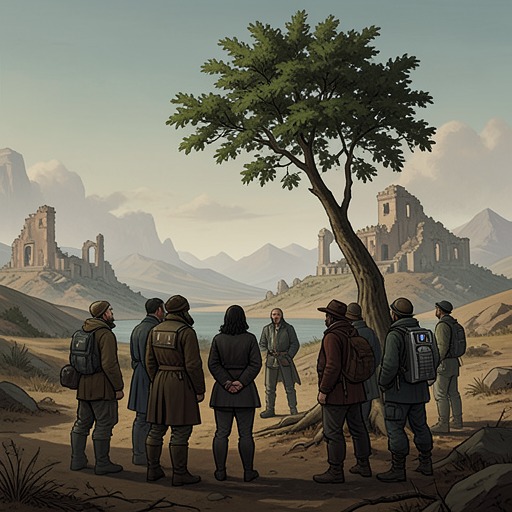
The group spends the next year at the military base sixty miles from the dome’s location. Only a small circle of senior military personnel, scientists, and government officials knows who they are. Even among those informed, contact is limited. Some people do not want to be influenced by knowledge of the future; others may simply be afraid. Rumors nonetheless circulate, producing headlines about something unusual at Area 51. The visitors are not identified as aliens, but the comparison captures their position: they are undeniably foreign to the society around them and are deliberately kept out of sight.
Their isolation is also practical. They have no families in this timeline whom they can safely approach, no birth certificates, and no personal histories that would withstand ordinary scrutiny. Contacting their grandparents would raise questions they have no way to answer. The Army faces a dilemma of its own: the visitors cannot simply be returned to a normal social world as if they had always belonged to it. One of them worries that they might be hidden in the desert for the rest of their lives, but that feared outcome does not occur. Secrecy instead becomes a means of arranging their separation from the base and entry into civilian life.
Fabricated Identities and Resettlement
The Army constructs new identities for each visitor. It fabricates records giving them histories in which they were abandoned at birth and raised in foster homes. These invented biographies address the immediate absence of verifiable origins by supplying a past that can fit within the institutions of the present. The arrangement does not restore the lives the group lost; it gives them histories that others can accept.
The Army also finds families willing to take them in. The placements are in different homes but in the same part of the country, Los Angeles, allowing the visitors to remain close to one another as their true family. That geographical choice matters: the plan separates them from the military base and assigns them new domestic identities without scattering the group beyond reach. The result is both an accommodation and a concealment. Each person receives a household and a fabricated background, while the relationships that connect the visitors to one another remain outside the official story.
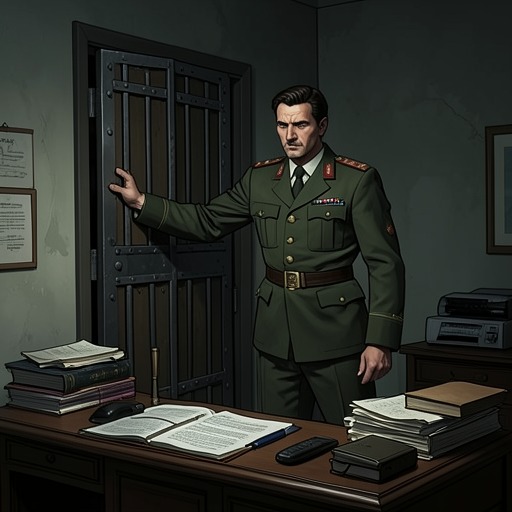
When the group leaves, a unit commander advises them to do their best to forget both the past and the future and to live as normally as possible. Their records, the commander says, will be sealed, and the Army will check on them from time to time. The promise of follow-up does not last: no one from the Army ever checks on them. The visitors have been given a route into civilian life, but not continuing support or a public account of why they exist. Their new normality depends on silence and on the absence of any institution willing to acknowledge their real identities.
The End of Official Contact
Leaving the base is the group’s final contact with anyone who knows that they came from the future. The narrator suspects that officials prefer pretending the visitors never existed to risking exposure of the truth. Possible dangers include other countries with atomic weapons trying to reproduce the Bridge and the visitors being continually questioned about the future. Either possibility could destroy the chance of an ordinary life that the resettlement plan is meant to provide. The narrator further suspects that the records were not merely sealed but destroyed; this is presented as a personal inference, not as confirmed knowledge.
The departure takes place in a vintage jeep, and the last visible sign of the government’s position is the dismantling of the dome. There will be no above-ground atomic test: Project Alcatraz is abandoned and not revived. The secret of the events in another dimension and another time is left to die with the people who encountered them, and eventually with the visitors themselves. Concealment thus operates at two levels. False records hide the travelers’ origins, while dismantling the dome removes the physical project associated with their arrival.
The policy gives the group a chance to survive in the past, but it cannot return them to their lost homes or reunite them with their families in the other timeline. The narrator reflects that his parents, in that other dimension, are mourning the loss of their son; they cannot know that their decision to move to Pemberwick Island helped protect him from the first Retro attack. That separation remains even as the visitors begin new lives. Their warning about fossil-fuel exhaustion, pollution, and overpopulation is heard by people in the past but does not seem to alarm them, repeating on a smaller scale the failure of earlier warnings described by Olivia. The resettlement therefore ends one secret without resolving the larger problem the visitors came from: the past has been protected from the immediate machinery of the Bridge, but the lessons carried back with the travelers may still go unheeded.