The Time Bridge’s Fixed-Destination Restriction
StrikeThe Time Bridge’s Fixed-Destination Restriction defines both the Bridge’s reach and its limits: it opens between the desert and one particular future era, not to a time chosen by its users. The passage is described as permanent and safe, but it offers no way to select another destination or travel into the past. Its fixed endpoint is a consequence of an accident whose physics remain uncertain even to researchers from both eras.
Origin of the Fixed Destination
Project Alcatraz was an effort to contain the force and radioactive material of a nuclear blast inside a dome. Its sole test took place on January 24, 1952. The dome held, and no radioactivity escaped, but concentrating the blast produced an unforeseen temporal anomaly: matter was accelerated so dramatically that a passage through time opened. Those who eventually entered found themselves still in the desert, but three hundred years later.
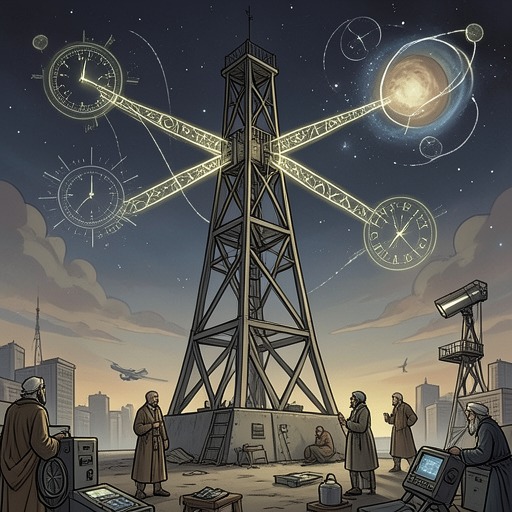
The Bridge was permanent and safe; the large frame built around it was merely a surrounding structure, not a mechanism for choosing when to arrive. Crossing it was likened to stepping through a doorway between eras. The doorway’s stability therefore did not imply control over its destination: the passage connected the two eras established by the accident.
Limits on Travel
Olivia explains that the Bridge is not a time machine. Travelers cannot choose a date or redirect the passage to a different point in history. The people who created or studied it do not know why it opened onto that particular time. Its destination is thus a property of the anomaly, not a setting that users can adjust.
This restriction also rules out opening a doorway into the past. Colonel Pike later says that physicists from both eras have studied the Bridge without finding a definitive explanation for the atomic blast that created it. Their shared conclusion is narrower: the explosion propelled matter faster than light, which would mean that the Bridge could open only toward the future. The claim about direction is therefore more settled than the account of how the phenomenon arose.
Significance and Uncertainty
The fixed destination makes the Bridge a passage between two specific eras rather than a route through time at will. That distinction limits the consequences of its discovery: travelers may reach the future, but they cannot use the Bridge to inspect arbitrary outcomes, avoid a chosen past event, or enter an earlier period. The passage’s existence is extraordinary; its operation remains constrained.
The rule is firm at the practical level but incomplete at the scientific one. The Bridge’s endpoint cannot be selected, and the evidence presented supports future-only travel; why the blast produced this particular connection remains a mystery. The contrast between a reliable doorway and an unexplained destination captures the anomaly’s central paradox: safe to cross does not mean possible to control.