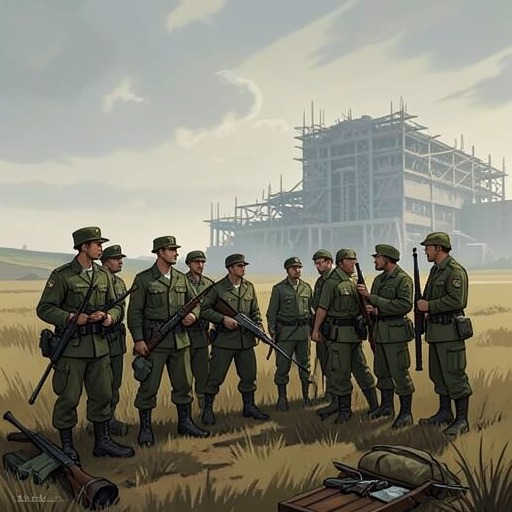
The Future Government’s Population-Replacement and Colonization Policy
StrikeThe Future Government’s Population-Replacement and Colonization Policy transformed a crisis of survival into a plan to conquer and settle the past. Rather than merely seek refuge from a ruined future, its architects aimed to displace the people already living in the twenty-first century and establish a society shaped for the needs of the invaders. The policy’s defining contradiction is that it presents the future’s suffering as a reason for action while making an uninvolved population bear the cost of that action.
Crisis and Failed Reform
The policy’s background is a future damaged by environmental and resource failures. Climate change raised sea levels, submerging Lower Manhattan and much of Los Angeles, while other major cities and Pemberwick Island disappeared. Population continued to grow as habitable land and farmland contracted. Fossil fuels were exhausted, contributing to economic collapse and instability; nuclear power became the main energy source, but its rapid adoption brought a sharp increase in cancer cases.
According to Olivia, people in the past had received a glimpse of what was coming, but that foreknowledge did not produce effective change. Governments failed to secure the development of safe alternative fuels or persuade enough people to act on climate change. Commercial interests and public resistance helped preserve the patterns driving the crisis. The resulting suffering in the future therefore carried a political charge: its people regarded the earlier society not only as the source of catastrophe, but as a society that had been warned and had failed to respond.
From Diplomacy to Invasion
The decision to invade followed a long effort at negotiation. For nearly seventy years, United States governments from the two eras attempted to avert the disaster, but those efforts failed. The 1952 bomb test presented an opportunity to change course, yet the future government and military eventually concluded that reforming the past would not save the people already living in their own time.
The invasion was also framed as an answer to overcrowding. With no colonies on other planets and the future’s population having grown dramatically, the past appeared to the expansionists as available territory. Olivia explains that continued efforts to persuade the people of the past to change their behavior no longer aimed to rescue the future from its crisis. Instead, they were intended to leave the conquered and colonized past in a condition better suited to the future population that would occupy it.
The government’s public account concealed this change of purpose. It disclosed the Bridge and described the failed negotiations, using the past’s record of inaction to cultivate hostility toward its people and prepare public opinion to accept the invasion. In this account, diplomacy became part of the political preparation for conquest: the public was shown the history of failure, but not the full purpose for which that history was being deployed.
Colonization and Population Replacement
The policy’s intended outcome was explicit: replace the twenty-first-century population with the population of the twenty-fourth century. This was not an improvised military maneuver but a large undertaking planned over years by the United States government and military. Colonization required more than gaining territory; it required preparing the infrastructure and labor systems that would make settlement possible.
A lecture to prospective colonists describes assignments to critical water-filtration plants, where their work would keep supplies flowing. The instructor says they should learn to maintain and repair the systems without depending on local expertise, while allowing that surviving natives could be pressed into service. The language reduces the existing population to a resource for the project, and the lesson presents technical self-sufficiency as part of the settlement plan. The colonists are being prepared to operate the past, not to share it on equal terms with its inhabitants.
The treatment of workers in the camp reflects the same logic at the level of everyday administration. A prisoner is assigned the designation Zero Three One One and told that family and friendship no longer define his identity or future. Workers are restricted from speaking to military personnel or one another except as their tasks require, with disobedience carrying severe consequences. Major Bova introduces himself by name while announcing that names are not used there, a contrast that places the authority to identify and command with the officer rather than the prisoners. These practices turn people into manageable labor categories and relationships into obstacles to control.
Resistance and Moral Consequences
The policy did not command universal support among the future forces. Kenny Sokol describes officers who wanted the mission to end but believed that simply refusing their duties or going public would not stop a machine backed by public opinion. The Sounders emerged from that minority opposition. Their resistance makes clear that the colonization project was not simply the inevitable will of an entire future society; it was a state-directed undertaking contested from within.
Its opponents in the past also confront the danger of answering mass violence with revenge. Tucker recognizes that the struggle has been driven partly by a desire to make the Retros suffer, even as he questions what kind of world victory would rebuild. His decision that the killing must stop marks a moral limit within a conflict launched by the policy. Later, the survivors worry that history is repeating itself: the policy’s importance therefore extends beyond the invasion itself, raising the question of whether knowledge of a disastrous future can change the choices that lead toward it.