Outer Darkness
TemptationOuter Darkness is the feared fate that gives religious condemnation its most absolute force in Colton Davidson’s early life. Taught to understand same-sex desire as sin, Colton imagines damnation as the consequence of being gay; at Father Benson’s conversion camp, that fear is reinforced by coercion. The concept’s significance lies in this movement from private terror to institutional justification—and in the later possibility that faith and compassion need not belong to the same system of punishment.
Religious Fear and Self-Condemnation
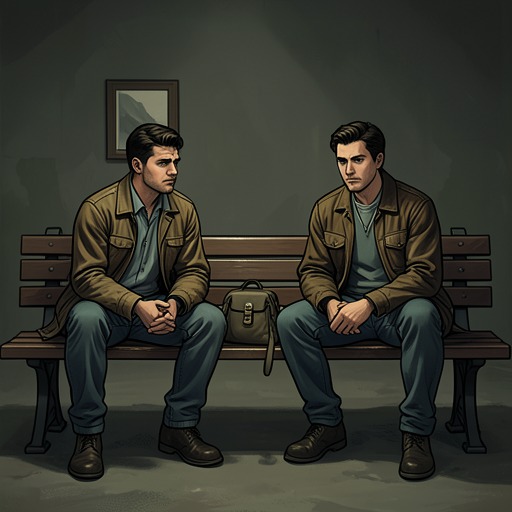
Colton’s understanding of Outer Darkness grows out of a religious environment in which he is already struggling to reconcile public respectability with private distress. His family performs a composed image at church: they eat waffles in tense silence before services, smile among other congregants, and pray with folded arms, while Colton knows that anger and shouting await once the family is home. Against that backdrop, religious language does not arrive as comfort alone. It exists alongside a household in which appearances are carefully maintained and a child learns to anticipate blame.
When Colton recognizes his desire for men, his fear turns inward. At sixteen, after seeing Ronnie in the gym showers in his imagination, he prays for the desire to disappear. He believes he cannot be gay and fears that failing to marry and raise a family according to the life he has been taught to regard as proper is already a grave failure. Same-sex desire makes that fear feel, to him, unforgivable and bound for hell. Outer Darkness names the extreme end of a moral world in which he has been taught to see his own identity not as a fact about himself, but as a threat to his soul.
That conviction is compounded by secrecy and shame. Colton takes a copy of Men’s Health from a convenience-store trash bin on his sixteenth birthday and hides it inside a torn Sports Illustrated cover, reasoning that punishment for lustful thoughts would be preferable to discovery of what those thoughts mean. The episode does not present his fear as abstract theology: it shapes what he conceals, what he prays to change, and what he can imagine happening to him if he fails.
Outer Darkness as a Tool of Coercion
The doctrine’s most brutal consequence is visible in the conversion camp. Colton’s parents send him to Father Benson, a Catholic priest, after his sexuality is discovered. The camp’s children are described as frightened and alone, sharing the fear that Outer Darkness awaits if they cannot correct themselves. The threat thus operates collectively: it gives religious language to the idea that queer children are defective, tempted, and in need of salvation, while making escape from the camp seem spiritually dangerous as well as physically risky.
Before Colton is taken to camp, he is left in a stripped room with a mattress and a Bible after the electricity is cut off. He is then put in a van and subjected to three days of bland food, water, limited bathroom breaks, and silence. Later, restrained in a chair, he hears Father Benson call him a problem child while his wrists are raw from ropes and his thighs bear injuries from cold water and electrical current. The scene exposes the distance between the camp’s language of salvation and its actual methods: the authority that claims to rescue Colton uses fear and bodily violence against him.
Father Benson’s teaching makes that violence legible as supposed purification. He tells Colton that spiritual cleansing is not supposed to feel good and describes the camp’s logic as burning away infected parts to reveal healthy skin. Colton temporarily absorbs this account, imagining that an alien presence has given him desires and weakness and that the camp’s cruelty might be necessary to restore him. Outer Darkness is part of the pressure sustaining that belief: if queer desire means damnation, then suffering can be presented as the price of avoiding it. The novel makes clear, however, that this framework does not heal Colton; it deepens his terror and helps drive him to run.
Doubt, Faith, and an Alternative Moral Voice
After fleeing, Colton travels by bus as far as Arizona and then hitchhikes into Colorado, where police take him to juvenile detention. Even there, he tries to understand his escape through the camp’s terms. He thinks the camp was hell but tells himself that the infected parts had to burn before healthy skin could appear, repeating Father Benson’s explanation of spiritual cleansing. The fact that he has escaped physically does not immediately free him from the doctrine’s power over his interpretation of himself.
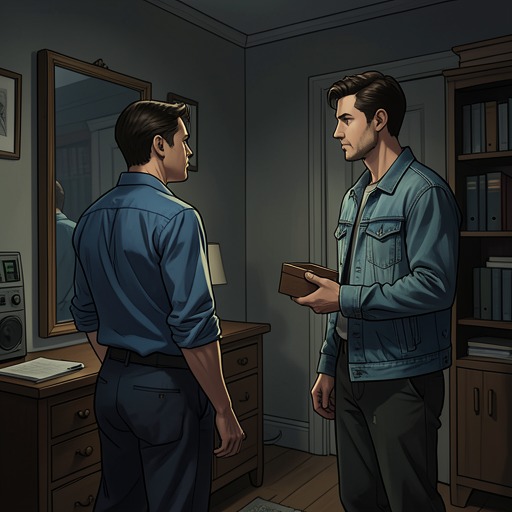
At Ted House, the certainty begins to loosen. Facing the possibility of leaving the home, Colton admits that he is unsure God wants to hear from him. The God he was taught to know, he thinks, would condemn the people who saved him to Outer Darkness. His uncertainty is not simply a loss of belief: it is a refusal to treat the inherited picture of God as the only possible one. James, who tells Colton that his own preacher father interpreted the loss of his legs as evidence that he had lost his way, offers a different moral response. James cannot claim certainty about God, but he insists that God would not turn away a child for being born as he is. His words give Colton permission to pray if prayer helps, without making acceptance conditional on a cure.
Colton’s later reflections keep this distinction open rather than resolving it into a simple rejection of religion. In a conversation with Marcel, he says that he never felt the religion itself was for him, yet values kindness, doing things for people, and having faith in something. He also says he still has faith that Jason will not always be a jerk. The emphasis shifts from obedience to the punishment he once feared toward an ethical practice—kindness—and a more tentative capacity to trust.
Narrative Significance
Outer Darkness connects several stages of Colton’s history: family and religious expectations, fear after he recognizes his sexuality, abuse at Father Benson’s camp, and the slow reconsideration of what faith might mean. The concept is especially consequential because it turns a future punishment into a present instrument of control. Colton fears damnation before the camp, interprets the camp’s violence as possible spiritual treatment while fleeing, and later questions the God imagined by the people who condemned him.
The idea also clarifies why compassionate support matters in the novel. Colton’s experience is not merely a conflict between religion and unbelief; it is a struggle over who gets to define goodness, harm, and belonging. The contrast between Father Benson’s claims of cleansing and James’s assurance that a child should not be rejected for how he was born makes the central moral question concrete. Outer Darkness remains a powerful fear in Colton’s history, but it loses some authority when he encounters people who offer care without demanding that he become someone else first.