At twilight during Christmas week
The Investigators Arrive
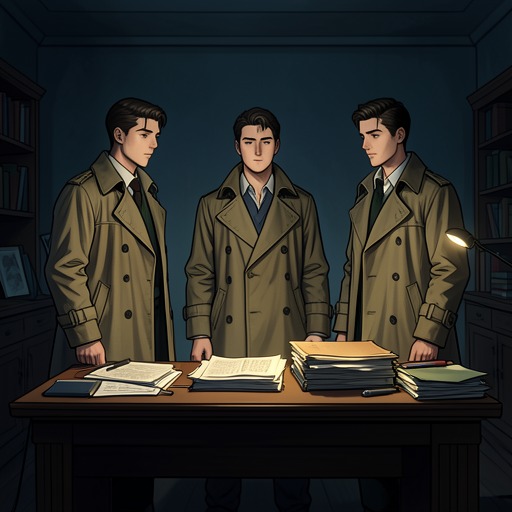
[Jupiter Jones](entity:character-recall-character-jupiter-jones-24f7c8652b39), [Pete Crenshaw](entity:character-recall-character-pete-crenshaw-8f89680b7b81), and [Bob Andrews](entity:character-recall-character-bob-andrews-8d44ed30d34a) arrive at [402 Paseo Place apartment building](entity:location-recall-location-402-paseo-place-a7d95f4c86c9), where [Fenton Prentice](entity:character-recall-character-fenton-prentice-65e593a0c6b3) is waiting for them. [Mrs Bortz](entity:character-recall-character-mrs-bortz-7ced90c8c089) tries to turn them away, but Prentice recognizes his expected visitors and brings them into his art-filled apartment.
The formal meeting quickly gives way to a disturbing confession: Prentice believes his home is being invaded by an unseen presence. The Three Investigators agree to hear the problem before deciding whether they can help.
During the first meeting
Prentice Describes the Shadow
Prentice says he has returned to find drawers disturbed and letters examined, though he has no servants and believes no one can enter through the windows. More frighteningly, he has sometimes sensed or glimpsed a tall, thin figure that seems to pass through rooms without opening a door.
Jupiter questions him about the apartment and examines the den, but finds no obvious means of entry. Prentice’s fear seems genuine, and Jupiter agrees to discuss the case with his friends before giving a final answer.
As the first visit ends
A Figure in the Den
After Prentice leaves them briefly alone, Jupiter notices something shift in the den’s shadowy corner and calls for Pete. Pete answers from the living room, so Jupiter switches on the light and finds nobody in the corner.
The moment makes Prentice’s account harder to dismiss, even though Jupiter tells himself he probably saw an ordinary shadow. As the boys leave, a sharp report sounds nearby and a masked man runs through the courtyard toward the street.
Moments after the first meeting
The Masked Fugitive
Pete sees the fleeing figure in a dark windbreaker and black ski hood. Two policemen rush into the courtyard and briefly mistake Pete for the suspect before Prentice confirms that the boy has been with him.
The officers pursue the fugitive, while the residents gather to watch. The flight connects Prentice’s unsettling case to a real crime in the neighborhood and introduces a mystery beyond the apparent haunting.
That same evening
The Church Search
The boys follow the search toward [St Jude’s Church](entity:organization-recall-organization-st-jude-s-church-65849023827d), where police question [Earl](entity:character-recall-character-earl-1fcd8e3ac40b), the caretaker, and search beneath the pews. [Father McGovern](entity:character-recall-character-father-mcgovern-213391ba9aa0), [Mrs O’Reilly](entity:character-recall-character-mrs-o-reilly-09393d399848), and nearby residents emerge as the church’s familiar circle, with Mrs O’Reilly insisting on ghostly explanations for local events.
The police find no fugitive and eventually end the search. The odd mix of a burglary, a church, and neighborhood ghost stories gives the Three Investigators several threads to keep in mind.
Later that evening
Edward Niedland’s Death
Prentice learns that the burglary took place at the home of his friend and protégé [Edward Niedland](entity:character-recall-character-edward-niedland-3c021d4226ad), who died of pneumonia two weeks earlier. [Charles Niedland](entity:character-recall-character-charles-niedland-bc5d0d8aca15) explains that his brother’s house may have been entered while he was away.
The loss is deeply personal to Prentice, who admired Edward’s art and is already distressed by the supposed intrusions in his own apartment. The investigators now know that the nearby crime may involve a significant artwork.
The night of the burglary
The Crystal Hound Is Stolen
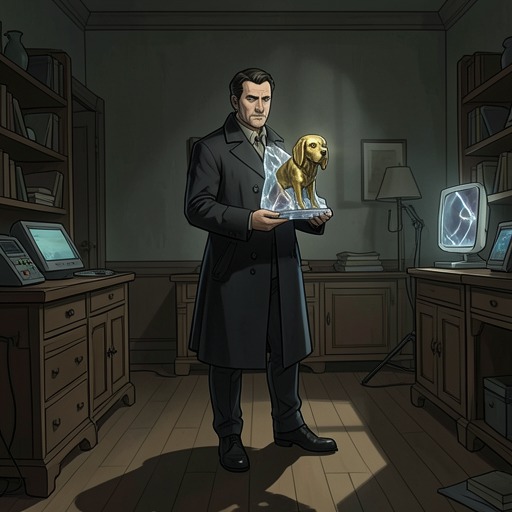
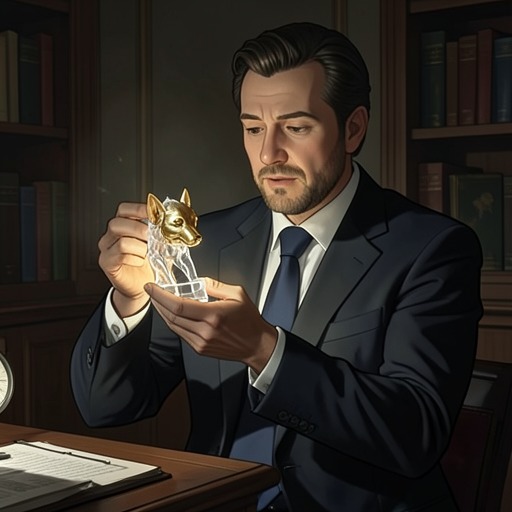
Charles reveals that the burglar took only the [Carpathian Hound](entity:object-recall-object-carpathian-hound-0db4bc69d37f), a glass-and-crystal sculpture made by Edward for Prentice. The statue’s golden details and exceptional craftsmanship make it valuable, but its disappearance is especially painful because it cannot truly be replaced.
The police found no conclusive fingerprints. Charles believes the thief entered through a kitchen window, while Prentice cannot understand why anyone would risk a break-in for just one object.
During the visit to Edward’s home
The Hound’s Legend
Charles recounts the [Legend of the Carpathian Hound](entity:concept-recall-concept-b3b3abc4ab0a): a cruel nobleman’s starving hunting dog killed a child, and the nobleman was later killed by the child’s father. Before dying, the nobleman cursed the village, and stories told of a gaunt, hungry dog haunting it afterward.
The tale explains the sculpture’s frightening design, but it also gives the stolen artwork an aura that could make it desirable to a collector. Prentice confirms that the work had been intended for him after Edward’s gallery exhibition.
Early the next morning
A Case Is Accepted
At [The Jones Salvage Yard](entity:organization-recall-organization-the-jones-salvag-cb5bb755a42c), Jupiter shows Pete and Bob a chemical mixture he has prepared as a detection tool. The [Investigative ointment](entity:object-recall-object-ec6e9e9be398) will leave indelible black marks on the hands of anyone who touches a treated surface.
Jupiter explains that Prentice called late the previous night, frightened by further appearances of the shadow. Though the boys cannot know whether the old man is imagining the presence, they decide that a real intruder deserves to be found.
The following morning
The Rectory Encounter
On their return to the apartment building, the investigators greet [Father McGovern](entity:character-recall-character-father-mcgovern-213391ba9aa0) outside the rectory and discover that Prentice has gone to Edward’s home. A note directs them there, but [Mrs Bortz](entity:character-recall-character-mrs-bortz-7ced90c8c089) questions them from the courtyard before they leave by the rear passage.
At Edward’s home, Charles describes the theft and says the [Carpathian Hound](entity:object-recall-object-carpathian-hound-0db4bc69d37f) was delivered there by chance. His account makes the timing of the burglary especially suspicious: the sculpture had only recently been left in the otherwise modest house.
Late that morning
The First Ointment Test
Back in Prentice’s apartment, Jupiter coats the ceramic knobs on the desk drawers with [Investigative ointment](entity:object-recall-object-ec6e9e9be398). The boys and Prentice then leave together, talking loudly enough to suggest that the apartment will be empty.
The plan is simple: if someone returns to snoop, the treated knobs should expose him. Their departure coincides with news that [Earl](entity:character-recall-character-earl-1fcd8e3ac40b) has been found injured in the church, adding another troubling incident to the unfolding case.
Late morning on the investigators’ first day
Earl Found Injured
An ambulance carries [Earl](entity:character-recall-character-earl-1fcd8e3ac40b) away from [St Jude’s Church](entity:organization-recall-organization-st-jude-s-church-65849023827d) after [Father McGovern](entity:character-recall-character-father-mcgovern-213391ba9aa0) finds him hurt in the choir loft. [Mrs O’Reilly](entity:character-recall-character-mrs-o-reilly-09393d399848) fears he has been murdered by a wandering spirit, while the priest believes Earl may have fallen in the dark.
Prentice tells the boys that Mrs O’Reilly claims to see the ghost of a former pastor. The possibility of a second apparent haunting makes Jupiter wonder whether the church stories and Prentice’s shadow might be related.
After lunch that day
The Marks Reveal a Snooper
When the boys return to Prentice’s apartment, Jupiter finds the ointment smeared across the desk knobs. Someone has opened a drawer and moved a telephone bill, and further traces appear on a bathroom mirror and the front-door lock.
The evidence proves that a physical person entered the apartment and left through the door using a key. Prentice had believed his special lock made a second key impossible, but Jupiter is now certain someone in the building has been snooping.
That afternoon
Mrs Bortz Exposed
Jupiter spots black marks on [Mrs Bortz](entity:character-recall-character-mrs-bortz-7ced90c8c089)’s hands in the courtyard and accuses her of entering Prentice’s apartment, opening his desk, and examining his mail. The manager protests, but Prentice takes her aside and confronts her privately.
Mrs Bortz admits she had obtained a replacement key while Prentice was abroad by persuading a locksmith to change the lock. The first mystery of the snooping is solved, yet Jupiter’s earlier sighting of a thin shadow still has no explanation.
That afternoon, after Mrs Bortz is confronted
Elmquist’s Beliefs
[Sonny Elmquist](entity:character-recall-character-sonny-elmquist-9ee63a93d4e5) comes out of his apartment and speaks to the boys about meditation, desire, and his hope of traveling to India. He argues that worldly possessions are illusory and criticizes Prentice’s attachment to his collection.
Elmquist also reveals that Prentice owns a Tibetan [Mandala](entity:concept-recall-concept-6b0e784f8ec9), although Prentice says he has never let the young man into his apartment. The unexpected knowledge makes Elmquist more than a merely eccentric neighbor.
Later that afternoon
The Mandala Clue
Prentice confirms that the [Mandala](entity:concept-recall-concept-6b0e784f8ec9) has hung in his den for years and that Elmquist has never been invited inside. Jupiter asks how Elmquist could know about it, but Prentice can offer only the possibility that the information appeared in art-world news.
Jupiter accepts the apparent end of the snooping case, yet Elmquist’s detailed knowledge does not sit comfortably with the evidence. He leaves with a sense that the matter is not finished.
That evening
The Shadow Returns
After returning to [Rocky Beach](entity:location-recall-location-rocky-beach-d8fb09bcfda1), Jupiter tells Pete and Bob that he expects Prentice to call again. He recalls that the shadow in the den resembled Pete in the dim light, but [Sonny Elmquist](entity:character-recall-character-sonny-elmquist-9ee63a93d4e5) also has a similar build and dark hair.
Jupiter suspects that he may have seen Elmquist, yet the young man was apparently asleep in his own apartment at the time. The contradiction becomes the central puzzle: how could a person appear in two places at once?
That evening, at Prentice’s apartment
A Second Apparition
Prentice calls to report that the shadow has appeared again, and the boys hurry back to his apartment. Jupiter watches the den and once more feels a presence; a dark shape seems to pulse in the far corner before disappearing.
From the balcony, Jupiter sees Elmquist sitting motionless in his own apartment with the television on. Prentice is relieved that Jupiter also saw something, but the apparent impossibility of Elmquist’s presence in both places deepens the mystery.
Later that evening
The Search Finds No Passage
The boys search Prentice’s rooms and walls for a hidden entrance or secret passage, but the apartment is solidly constructed and offers no route into the den. Prentice says the experience began only after Elmquist moved into the building.
With no ordinary explanation in sight, the investigators settle in for an overnight watch. Jupiter takes the first shift, hoping that an actual visitor will reveal how the shadow enters and leaves.
After eleven that night
A Light in the Church
While Jupiter keeps watch, Pete notices a brief glow in a stained-glass window of [St Jude’s Church](entity:organization-recall-organization-st-jude-s-church-65849023827d). Jupiter considers whether the pastor might be checking the building, but decides to investigate while Pete watches the apartment door.
The church door is unlocked. Inside, Jupiter sees a pale, white-haired figure dressed like a priest and holding a candle. The figure snuffs the flame, and a sudden shove sends Jupiter stumbling between the pews.
Moments later that night
Jupiter Locked Inside
As Jupiter struggles in the darkness, he hears the church door open and close and the lock turn. He finds himself trapped inside and discovers no way out through the sacristy or its other locked door.
Jupiter switches on the lights and searches the church, but the candle-bearing figure has vanished. He pounds on the doors and calls for help, turning a frightening encounter into a clear crime scene.
Shortly after the lock-in
The Missing Saint
[Father McGovern](entity:character-recall-character-father-mcgovern-213391ba9aa0) and [Mrs O’Reilly](entity:character-recall-character-mrs-o-reilly-09393d399848) arrive with police, and Jupiter describes the white-haired priest who knocked him down. He also points out that a statue dressed as St Patrick appears to be missing from the church.
The priest explains that the mitre, staff, and green cloak had been used in a Christmas pageant and returned to a costume house. The missing costume gives Jupiter a rational explanation for how the burglar may have posed as a statue during the earlier police search.
During the police examination that night
Two Intruders at the Church
Jupiter reasons that the burglar could have hidden in the church disguised as a statue, then attacked [Earl](entity:character-recall-character-earl-1fcd8e3ac40b) when the caretaker returned and might have hidden the stolen sculpture before escaping. The police learn that a spare church-key set has disappeared from the rectory.
But Jupiter distinguishes the candle-bearing figure from the person who shoved him: the apparent priest was near the altar, while the attacker came from the rear. He concludes that two people were inside the church that night, not one.
The following morning
The Ransom Call
After a quiet night in Prentice’s apartment, Jupiter asks about the timing of the shadow’s appearances. The boys leave to prepare for further investigation, but [Sonny Elmquist](entity:character-recall-character-sonny-elmquist-9ee63a93d4e5) tells them he has heard that Jupiter saw the phantom priest, though he had supposedly been at work.
Back at their headquarters, the investigators review the shadow, the church burglar, and the phantom priest as three connected but unresolved mysteries. A call from Prentice then changes the stakes: the thief has offered to return the [Carpathian Hound](entity:object-recall-object-carpathian-hound-0db4bc69d37f) for ten thousand dollars.
That morning
Prentice Refuses the Police
Prentice tells Jupiter that he intends to pay the ransom and has two days to gather the money. He refuses to notify the police, fearing that the thief might destroy the sculpture if he feels pursued.
Jupiter warns him that the burglar has already shown a willingness to use violence, but agrees that the boys will return. The ransom demand binds the haunting investigation to the theft and makes Prentice’s safety an immediate concern.
That afternoon
The Surveillance Plan
Jupiter retrieves a repaired closed-circuit television surveillance equipment set from his salvage-yard workshop. He intends to hide its small camera in a potted plant near Prentice’s door and watch the courtyard from inside.
The device will let the boys observe residents without announcing that they are watching. Jupiter suspects Elmquist may be connected to the shadow, but he still needs evidence about how the young man could enter Prentice’s apartment.
Late afternoon
The Courtyard Camera
The investigators install the camera before the courtyard lights come on. Its monitor reveals Elmquist carrying laundry, Miss Chalmers returning with a package, and [Mrs Bortz](entity:character-recall-character-mrs-bortz-7ced90c8c089) delaying her while she watches her unwrap it.
Miss Chalmers eats a chocolate from the box, then suddenly clutches her throat and collapses. The hidden camera turns from a tool for catching a snooper into an eyewitness to an apparent poisoning.
That evening
Chalmers Is Poisoned
The boys rush to the courtyard as Miss Chalmers writhes in pain. Jupiter smells something suspicious on a fallen chocolate and warns that she may have been poisoned.
[John Murphy](entity:character-recall-character-john-murphy-5e9a1a8ffaa7) drives her to [Central Hospital](entity:organization-recall-organization-central-hospital-a2d8adc003fa), with [Mrs Bortz](entity:character-recall-character-mrs-bortz-7ced90c8c089) accompanying them and the candy taken for analysis. The incident raises an urgent question: who knew Miss Chalmers’s habits well enough to expect her to eat the chocolates immediately?
Two hours after the poisoning
The Poison Is Confirmed
Murphy and [Mrs Bortz](entity:character-recall-character-mrs-bortz-7ced90c8c089) return from [Central Hospital](entity:organization-recall-organization-central-hospital-a2d8adc003fa) with grim news: the chocolates contained poison, though Miss Chalmers has had her stomach pumped and is under observation. Mrs Bortz is offended that police questioned her about the package.
When she proposes draining the pool while Miss Chalmers is unable to swim, Jupiter notices how many recent events have clustered around the building. The proposal later becomes a clue to the thief’s urgent need to keep the pool undisturbed.
Later that night
The Night Watch Begins
The investigators consider whether the poisoning, the church assault, the theft, and Prentice’s shadow are connected. Jupiter notes that the events share their location, while Pete observes that Elmquist has been around whenever trouble occurs.
They watch the courtyard through the monitor. Murphy leaves briefly, Elmquist disappears into his apartment, and the automatic lights go out at eleven, ending the camera’s usefulness for the night.
Shortly after midnight
Pete Sees Elmquist Vanish
Pete takes a position behind the rubber tree on the balcony. He sees Elmquist leave his apartment in a bathrobe and move toward Murphy’s door, but briefly looks away when Murphy returns for his ashtray.
When Pete looks back, Elmquist has disappeared in the middle of the courtyard. Pete hurries down to intercept him, but steps on one of [Alex Hassell](entity:character-recall-character-alex-hassell-2c915d81dc63)’s cats and falls into the swimming pool amid a furious screech.
Moments after Pete falls into the pool
The Cat Ends the Watch
The courtyard lights snap on as Hassell rescues his black cat from the water. The residents gather, and Pete has no convincing explanation for his midnight dash.
Elmquist appears at his own doorway, claiming he had been asleep and dreaming. Pete insists he saw the young man vanish near Murphy’s apartment, reinforcing the strange possibility that Elmquist can be present somewhere while his body remains at home.
Around four in the morning
The Car Bomb Explodes
Jupiter sees [Mrs Bortz](entity:character-recall-character-mrs-bortz-7ced90c8c089) leave for her usual early shopping trip. Soon after, an explosion erupts and her car swerves into a fire hydrant, bursting its tyres and flooding the street.
The boys, Murphy, and Elmquist help pull the hysterical manager from the wreck. Police find burned paper and cotton wadding beneath the bonnet and identify the blast as a small explosive device rather than gunfire.
Immediately after the crash
A Device Under the Bonnet
[Mrs Bortz](entity:character-recall-character-mrs-bortz-7ced90c8c089) tells police that someone shot at her, but the engine reveals a crude bomb that produced smoke and noise without killing her. The attack leaves the residents wondering who would want to frighten or harm the building’s intrusive manager.
Prentice explains that Mrs Bortz always shops at this hour, and the attack has occurred just as she was leaving. The investigators begin to suspect that someone is manipulating the residents’ movements rather than acting at random.
Late the following morning
Fire in Murphy’s Apartment
After a short sleep, the investigators hear cries of fire. Flames climb the curtains of Murphy’s apartment, and Elmquist smashes the windows while Pete and Jupiter bring a fire extinguisher.
The boys and Elmquist find Murphy unconscious and drag him into the courtyard. He survives after receiving oxygen, and firemen initially conclude that a cigarette left on the sofa started the blaze.
Just after the fire is put out
The Smoke Leaves Questions
Jupiter questions the accident explanation because Murphy had bragged about a special ashtray that could keep a burning cigarette from falling out. The stockbroker had also said he intended to sleep, yet he was found near the bedroom rather than at the front door.
The fire has apparently provided Murphy with a reason to be taken to hospital, just as other attacks have removed residents from the building. Jupiter suspects the disasters may be clearing the way for someone to reach the hidden Hound.
After the fire
The Suspects Scatter
Hassell, frightened by the growing danger, leaves for a motel with his pet cat. Elmquist offers the investigators permission to search his apartment, but Jupiter says he is sure the Hound is not stored in any tenant’s room.
Jupiter reasons that [Mrs Bortz](entity:character-recall-character-mrs-bortz-7ced90c8c089)’s routine snooping would make an apartment an unsafe hiding place. He believes the artwork must be nearby, and the attacks on Miss Chalmers and Mrs Bortz may have been designed to remove people who could notice activity around the pool.
That afternoon
Bob Consults the Occult
Bob visits [Dr Barrister](entity:character-recall-character-dr-barrister-ac3672c241ad) at [Ruxton University](entity:organization-recall-organization-ruxton-universit-c0554cb75610) to ask how Elmquist might seem to walk through walls. Barrister introduces him to [Professor Eugenia Lantine](entity:character-recall-character-professor-eugenia-l-44abd4aa1716), a specialist in parapsychology who has investigated alleged hauntings.
Lantine distinguishes the church’s supposed ghost from the shadow in Prentice’s apartment. Her account gives Bob a possible explanation for Elmquist’s impossible appearances without yet proving that the young man has any unusual ability.
During Bob’s consultation
The Wanderers’ Accounts
[Professor Eugenia Lantine](entity:character-recall-character-professor-eugenia-l-44abd4aa1716) recounts cases in which sleeping people seemed to perceive distant rooms or appeared to witnesses as ghostly doubles. In her theory, an astral body can leave its sleeping physical body and observe places beyond ordinary reach.
She warns that such wanderers are generally unable to move objects. The explanation could account for Elmquist’s knowledge of [Prentice’s Mandala](entity:object-recall-object-d0f96f31b765), but it also suggests that Elmquist could not have committed physical thefts while wandering.
That afternoon
Jupiter Questions the Victims
Jupiter visits [Gwen Chalmers](entity:character-recall-character-gwen-chalmers-b3804f38c063) at [Central Hospital](entity:organization-recall-organization-central-hospital-a2d8adc003fa) and learns that she is recovering. She says the poisoned candy was an ordinary brand and that she has no enemies, but reveals that [Mrs Bortz](entity:character-recall-character-mrs-bortz-7ced90c8c089) had told her Prentice was getting a dog.
The information confirms that residents had heard about a dog without necessarily knowing it was a crystal sculpture. Jupiter realizes that rumors may have spread the clue, but he still needs to find out which neighbor knew the Hound’s true identity and whereabouts.
Later that afternoon
Murphy Recovers at the Clinic
Jupiter finds [John Murphy](entity:character-recall-character-john-murphy-5e9a1a8ffaa7) at [Belvedere Medical Clinic](entity:organization-recall-organization-belvedere-medica-5ff1866823ae), where [Harley Johnson](entity:character-recall-character-harley-johnson-9e046dff2cbf) is scolding his guardian for smoking. Murphy says he fell asleep with a cigarette after the night’s commotion and woke in a smoke-filled room.
Murphy claims ignorance of Prentice’s supposed dog and says he may move from the unsafe building. Harley explains that Murphy has been anxious and sleeping poorly, a detail that makes his supposed exhaustion plausible but does not settle Jupiter’s doubts.
After Jupiter returns to Paseo Place
The Suspect List Narrows
Jupiter learns that Harley was away during the burglary and that he had not heard of Prentice’s dog. With Gwen in hospital, [Mrs Bortz](entity:character-recall-character-mrs-bortz-7ced90c8c089) away from the building, and Murphy also hospitalized, [Sonny Elmquist](entity:character-recall-character-sonny-elmquist-9ee63a93d4e5) appears to be the only neighbor left who might know about the sculpture.
The violence against residents raises the possibility that the boys themselves may be in danger. Jupiter joins the others as Bob returns with the theory of astral wandering, while Pete reports that Elmquist is at work and Hassell has checked into a motel.
That evening
The Shadow’s Limits
Bob explains [Professor Eugenia Lantine](entity:character-recall-character-professor-eugenia-l-44abd4aa1716)’s theory that Elmquist may wander in his sleep, and that such a visitor cannot move or handle objects. This could explain why Prentice saw someone who looked like Elmquist, even as Elmquist seemed to be asleep at home.
Jupiter accepts that Elmquist might be the shadow, but rules him out as the burglar if the theory is correct. The explanation also makes the [Mandala](entity:concept-recall-concept-6b0e784f8ec9) clue and the Hound’s location potentially accessible to Elmquist without making him responsible for the physical crimes.
That evening, during the case review
The Invisible Weapon Story
Jupiter recalls a mystery in which a glass knife became invisible when submerged in water. He recognizes that transparent crystal and a nearly invisible cord could be hidden against the colors of the courtyard pool.
The attacks now make sense as attempts to keep residents away from the water. Miss Chalmers swims there regularly, and [Mrs Bortz](entity:character-recall-character-mrs-bortz-7ced90c8c089) threatens to drain it; both had to be removed before the pool could be safely searched or the concealed object recovered.
The following day
The Hound Is Found
With most residents away, Jupiter slips into the pool and searches its patterned bottom. He finds the [Carpathian Hound](entity:object-recall-object-carpathian-hound-0db4bc69d37f), lowered into the water on a length of gilt cord that disappears against the blue-and-gold tiles.
Prentice is overjoyed to hold the sculpture again, but Jupiter persuades him to return it to the same hiding place. The burglar still expects ransom, and the investigators hope that watching the pool will reveal who comes back for the Hound.
That night around midnight
Elmquist Takes the Hound
From the balcony, the investigators watch a figure enter the pool, dive with a waterproof flashlight, and retrieve the Hound. They identify the swimmer as Elmquist and confront him at his apartment, where wet hair and footprints expose his recent trip into the water.
Elmquist says the Hound is in his oven and claims he intended to return it. Yet when Prentice mentions the ten-thousand-dollar ransom, Elmquist is genuinely confused, suggesting that he found the sculpture through a dream rather than through the original theft.
Moments after the recovery
Elmquist Describes His Dream
Elmquist admits that he dreamed of a glass dog being lowered into the pool by someone he could not identify. His account supports the possibility that his wandering self witnessed the burglar hide the sculpture.
Jupiter believes him and concludes that Elmquist is a wanderer, not the thief. The boys return the Hound to the pool so the actual burglar will still believe it is hidden there, and they resume their watch.
The next morning
The Decoy Ransom
The investigators keep Elmquist under Prentice’s eye, preventing him from returning to sleep and wander. Jupiter prepares a decoy ransom from clipped newspaper, coating it and its wrapping with [Investigative ointment](entity:object-recall-object-ec6e9e9be398) so that whoever handles it will be marked.
A letter arrives ordering Prentice to leave the package in a waste-paper basket at [Paseo Place Park](entity:location-recall-location-9b72d3173b76) at five. Jupiter expects the thief to collect it and urges Prentice to involve the police, turning the ransom exchange into a trap.
That afternoon, shortly before five
The Park Stakeout
The boys hide near the park but [Father McGovern](entity:character-recall-character-father-mcgovern-213391ba9aa0) spots them and invites them into the rectory. He has recognized Sergeant Henderson among the men apparently posing as a maintenance worker and newspaper seller.
Prentice leaves the decoy parcel in the waste-paper basket at the appointed time. A ragged man approaches, retrieves it, and bolts as the undercover officers close in.
At five o’clock
The Burglar Escapes
The disguised thief darts into the street and escapes the officers’ immediate grasp. Jupiter stops the pursuing police from wasting time, insisting that he knows where the burglar will be and that the man has a perfect alibi.
He directs them to [Belvedere Medical Clinic](entity:organization-recall-organization-belvedere-medica-5ff1866823ae). The package remains treated with ointment, and Jupiter expects that the person who handled it will soon carry unmistakable black stains.
Minutes after the park escape
Murphy’s Alibi Collapses
At [Belvedere Medical Clinic](entity:organization-recall-organization-belvedere-medica-5ff1866823ae), Jupiter finds Murphy in bed with the decoy package hidden in his room. Murphy’s ragged disguise and the parcel expose him as the man who collected the ransom, while the ointment promises further proof.
Jupiter explains that Murphy staged the apartment fire to create a hospital alibi, counting on the clinic’s quiet holiday staffing and the assumption that he needed rest. The police arrest him, ending the ransom scheme and identifying the burglar.
After Murphy’s arrest
The Crimes Are Explained
Jupiter lays out the full sequence: Murphy stole the Hound, disguised himself as a statue during the church search, struck [Earl](entity:character-recall-character-earl-1fcd8e3ac40b), and hid the sculpture before later lowering it into the pool. He then used poison and the car bomb to keep Miss Chalmers and [Mrs Bortz](entity:character-recall-character-mrs-bortz-7ced90c8c089) away from the pool.
The staged fire placed Murphy in hospital when the ransom was due, giving him a seemingly perfect alibi. His motive was desperation: as Harley’s guardian, he had lost money borrowed from Harley’s account through stock-market speculation and needed ten thousand dollars to replace it.
During the explanation after the arrest
The Hound’s First Clue
Bob suggests that Elmquist’s wandering self overheard Prentice arranging the Hound’s delivery with [Charles Niedland](entity:character-recall-character-charles-niedland-bc5d0d8aca15). Elmquist may have mentioned the sculpture to Murphy after waking, though he denies this and says he learned about it elsewhere.
Murphy could recognize the Niedland name and infer that a valuable piece was at Edward’s home. That information may have set the burglary in motion, connecting Elmquist’s strange ability to the criminal events without making him the physical thief.
During the final account
The Phantom Priest Remains
The investigators reconstruct Murphy’s escape from the church but cannot fully explain the candle-bearing white-haired figure Jupiter saw. Murphy also claimed to have seen the phantom priest, yet Elmquist’s dark hair and inability to handle objects do not neatly account for the candle or the figure’s appearance.
Jupiter considers that the figure could have been Elmquist in astral form, Elmquist physically disguised, or a genuine ghost. No theory resolves every detail, leaving the church’s alleged haunting as the case’s final uncertainty.
Mid-January
Hitchcock Hears the Case
The Three Investigators visit [Alfred Hitchcock](entity:character-recall-character-alfred-hitchcock-7aaebe8bfc17) and give him Bob’s written account. Hitchcock is astonished by Elmquist’s possible ability to leave his sleeping body, then asks Jupiter to explain how the team identified Murphy.
Jupiter recounts the elimination of the other suspects and the importance of the five o’clock ransom time, when Hassell would have been feeding cats. The detail rules Hassell out and points to Murphy, whose hospital stay supplied the perfect alibi.
Several weeks after the arrest
The Building’s New Peace
Elmquist denies that he can control his wandering, but Prentice persuades the building’s owners to make him move. Prentice’s shadowy visitor disappears, and the old man is finally free of the fear that someone is entering his apartment.
[Mrs Bortz](entity:character-recall-character-mrs-bortz-7ced90c8c089) also leaves, complaining that the neighborhood has become too dangerous. Prentice welcomes a less intrusive manager and can keep his collection without the constant snooping that had helped set the case in motion.
At the novel’s ending
An Unsolved Possibility
The investigators consider the remaining explanations for the phantom priest but find no decisive evidence. Elmquist’s wandering might explain a shadow, yet it cannot comfortably account for every detail of the figure in the church.
The case closes with the theft solved, Murphy exposed, and Prentice’s apartment peaceful, while the question of whether a real ghost appeared remains unanswered. The Three Investigators leave one mystery deliberately unresolved.