Evening of the farewell gala
The Ballet Girls' Panic
On the evening of the farewell gala performance for the retiring managers, the ballet girls rush into Sorelli's dressing-room in a state of terror, claiming they have seen the Opera Ghost. Little Jammes is particularly frightened, and the girls describe the ghost as a gentleman in dress-clothes who appeared suddenly in the passage, seemingly coming through the wall. They also recall the description given by Joseph Buquet, the chief scene-shifter, who had seen the ghost and described him as extraordinarily thin with a death's head. The girls are superstitious and believe the ghost is responsible for various mishaps. Sorelli, though skeptical, is also superstitious and tries to calm them, but the atmosphere is charged with fear.
Same evening, during the gala
Joseph Buquet Found Hanged
The ballet girls are thrown into further panic when Mme. Giry bursts into the dressing-room with the news that Joseph Buquet has been found hanged in the third cellar. The girls immediately attribute his death to the ghost, and little Giry blurts out that it must be the ghost, though she quickly tries to retract. The death is later ruled a suicide, but the circumstances are mysterious: when the managers went to cut him down, the rope had disappeared. This event deepens the superstition surrounding the ghost and sets the stage for the mystery.
During the farewell gala
Christine Daae's Triumph
At the gala performance, Christine Daae, a young singer who had previously been a mere understudy, astonishes the audience with her performance in Faust, replacing the ill Carlotta. Her voice is described as seraphic and superhuman, and she receives a standing ovation. The audience is amazed, and the Comte de Chagny, who is present with his brother Raoul, is deeply impressed. Christine faints after her performance and is carried to her dressing-room. This event marks the beginning of her mysterious rise to fame and the attention of both Raoul and the ghost.
Immediately after the gala performance
Raoul Recognizes Christine
Raoul de Chagny, the young viscount, rushes to Christine's dressing-room after her fainting spell. He kneels and kisses her hand, reminding her that he is the little boy who once rescued her scarf from the sea. Christine, however, does not seem to recognize him and laughs, which confuses and hurts Raoul. The doctor and the maid are present, and Christine asks to be left alone. Raoul, feeling rejected, leaves but later overhears a man's voice in her dressing-room saying, 'Christine, you must love me!' and Christine replying, 'When I sing only for you!' This revelation fills Raoul with jealousy and confusion.
After the gala, at the managers' supper
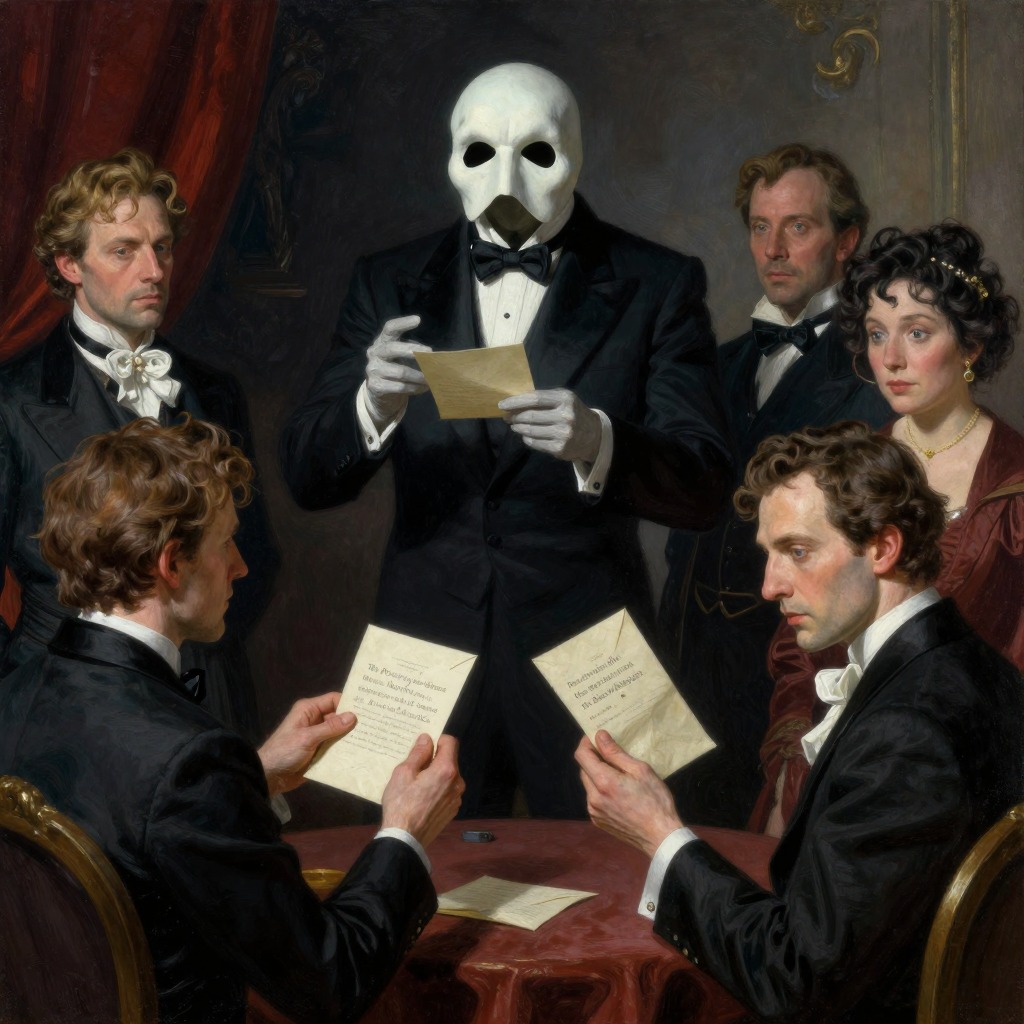
The Ghost at the Supper
During the farewell supper for the retiring managers, a strange, cadaverous man appears at the table, causing unease. He announces the death of Joseph Buquet, which shocks the managers. The man is later identified as the Opera Ghost, though no one knows how he got there. The retiring managers, Debienne and Poligny, take the new managers aside and reveal the existence of the ghost, showing them the memorandum-book with the ghost's demands, including a monthly allowance and the use of Box Five. The new managers, Richard and Moncharmin, treat it as a joke, but the ghost's presence at the supper is a harbinger of things to come.
Shortly after the new managers take over
The Ghost's Letters
The new managers, Firmin Richard and Armand Moncharmin, receive letters from the Opera Ghost, written in red ink, demanding that Box Five be reserved for him and that Christine Daae be given the role of Margarita. The letters also threaten dire consequences if the managers do not comply. The managers dismiss the letters as a practical joke by their predecessors, but they are uneasy. They decide to sell Box Five, which leads to disturbances during the performance, as the occupants are driven out by a mysterious voice claiming the box is taken.
After the incident in Box Five
Mme. Giry's Testimony
The managers summon Mme. Giry, the box-keeper, to explain the disturbances in Box Five. She claims that the ghost uses the box and that she has heard his voice, though she has never seen him. She recounts how the ghost once asked her for a footstool and how he leaves tips and small gifts. She also tells the story of M. Maniera and Isidore Saack, whose leg was broken after a quarrel in the box, which she attributes to the ghost. The managers are skeptical and dismiss her as mad, but they are intrigued by her stories.
A few days after the gala
Christine's Letter to Raoul
Christine Daae writes to Raoul, reminding him of their childhood and asking him to come to Perros-Guirec on the anniversary of her father's death. She mentions that she is going there to fulfill a sacred duty. Raoul, overjoyed, takes the train to Perros and finds her at the inn called the Setting Sun. Their meeting is awkward, as Christine seems distant and troubled. She tells him that she has been visited by the Angel of Music, a mysterious voice that gives her lessons. Raoul is skeptical and jealous, suspecting that the voice is a man.
Night at Perros churchyard
The Voice at Perros
Raoul follows Christine to the churchyard at midnight, where she kneels by her father's grave. He hears the sound of a violin playing The Resurrection of Lazarus, and then sees a shadowy figure with a death's head. He chases the figure, but it disappears into the church. Raoul is found the next morning half-dead on the steps of the altar. This event convinces him that Christine is under the influence of a mysterious and dangerous being.
A few days before the performance of Faust
The Managers Visit Box Five
Richard and Moncharmin decide to investigate Box Five themselves. They visit the box during the day and find nothing unusual, but they both claim to have seen a shape in the box, though they disagree on what it looked like. They laugh it off as an illusion, but they are secretly uneasy. They decide to watch the next performance of Faust from Box Five to see if the ghost appears.
Saturday morning before the Faust performance
The Ghost's Ultimatum
The managers receive a letter from the ghost, giving an ultimatum: he demands his box, that Christine Daae sing Margarita, that Mme. Giry be reinstated, and that his monthly allowance be paid. If not, he threatens that the performance will be cursed. The managers are furious and refuse to comply, but they are also worried. They decide to go ahead with the performance, with Carlotta singing Margarita, and they plan to watch from Box Five.
Day of the Faust performance
Carlotta's Threats
Carlotta receives anonymous letters threatening her if she sings that night. She is superstitious and frightened, but she decides to go on. Her friends rally to support her, and she is determined to perform. The managers, meanwhile, are in Box Five, waiting for the ghost to appear.
During the performance of Faust
Carlotta's Croak
During the performance, Carlotta suddenly croaks like a toad, 'Co-ack!' The audience is horrified, and the managers, in Box Five, are terrified, feeling the ghost's presence. They hear a voice saying, 'She is singing to-night to bring the chandelier down!' At that moment, the chandelier crashes down from the ceiling, killing the concierge who had replaced Mme. Giry. The performance is thrown into chaos, and Carlotta is humiliated.
After the chandelier incident
Christine's Disappearance
Christine Daae disappears after the performance and is not seen for a fortnight. Raoul is frantic and tries to find her, but the managers only say she is on holiday. He visits Mamma Valerius, who tells him that Christine is with her 'good genius,' the Angel of Music. Raoul is convinced that Christine is under the spell of a mysterious man and resolves to save her.
A few nights after Christine's disappearance
The Brougham in the Bois
Raoul, following a tip from his brother, goes to the Bois de Boulogne and sees Christine in a brougham with a mysterious companion. He calls out her name, but the carriage speeds away. This sighting deepens his despair and jealousy, as he believes Christine is with another man.
A few days later
The Masked Ball Appointment
Raoul receives a note from Christine, asking him to come to the masked ball at the Opera in a white domino and to meet her in a small room behind the chimney-place. He goes, and a black domino leads him to a private box. There, Christine, still masked, warns him to be careful. They see a figure dressed as Red Death, which Raoul recognizes as the death's head from Perros. Christine is terrified and makes Raoul promise not to follow the figure. They argue, and Christine reveals her distress, but she refuses to explain.
Later that night
Christine's Dressing-Room Scene
After the masked ball, Raoul follows Christine to her dressing-room and hides in the inner room. He hears her murmur 'Poor Erik!' and then sees her speak to an invisible voice, which sings to her. The voice is beautiful and captivating, and Christine seems entranced. Raoul, watching from behind the curtain, is overwhelmed by jealousy and confusion. He sees Christine walk toward a mirror and disappear, as if through the glass.
The next day
The Ring on Christine's Finger
Raoul visits Christine at Mamma Valerius's apartment and sees a plain gold ring on her finger. He questions her about it, but she refuses to explain, saying it is a present. Raoul is hurt and suspicious, and he confronts her about the voice and the ring. Christine becomes angry and tells him that he will never know the man's name. She also makes him promise not to try to find out about the voice.
A few days later
The Secret Engagement
Christine and Raoul meet daily in her dressing-room, where they play at being engaged. They are happy, but Christine is often nervous and fearful. She tells Raoul that they must flee soon, but she insists on singing one more time. She also tells him about Erik, the man behind the voice, and his terrible ugliness. Raoul is determined to save her, and they plan to escape after the next performance.
A few days before the planned escape
The Roof Conversation
Christine takes Raoul to the roof of the Opera, where she tells him more about Erik. She describes how she was taken to his underground home and how she saw his face, which was hideous. She also tells him about Erik's love for her and his threats. They plan to escape the next night, but Christine is afraid that Erik will kill them if they do.
Later that day
The Lost Ring
In Christine's dressing-room, she realizes that the gold ring Erik gave her is missing. She is terrified, as Erik had said that if she lost the ring, he would take revenge. Raoul tries to reassure her, but Christine is convinced that something terrible will happen. She refuses to flee immediately, insisting on waiting until the next night.
That night
Raoul Shoots at Erik
Raoul goes to bed, but he sees two glowing eyes at the foot of his bed. He fires his revolver at them, and the eyes disappear. He finds blood on the balcony, indicating that he has wounded someone. His brother, Count Philippe, is alarmed, but Raoul is convinced that it was Erik. This event shows Raoul's determination to fight the ghost.
The day of the planned escape
The Elopement Plans
Raoul spends the day preparing for the elopement, arranging a carriage and horses. He is determined to take Christine away that night. Meanwhile, the newspapers publish rumors of their engagement, and Count Philippe is opposed to the match. Raoul ignores his brother's objections and goes to the Opera that evening.
During the performance of Faust
Christine's Onstage Abduction
During the performance, Christine sings the invocation to the angels, and the stage suddenly goes dark. When the lights come back, she has vanished. The audience is in an uproar, and the managers are called. Raoul, who was in the audience, rushes to the stage, but Christine is nowhere to be found. The commissary of police, M. Mifroid, is summoned to investigate.
During the investigation
The Managers' Strange Behavior
The managers, Richard and Moncharmin, are locked in their office and behave strangely, asking for a safety-pin and walking backward. The staff is bewildered, and the commissary, M. Mifroid, tries to get them to open the door. Eventually, they reveal that they have been robbed of twenty thousand francs by the ghost, and they are trying to prevent further theft.
As Raoul enters the managers' office
The Persian's Warning
As Raoul is about to enter the managers' office, the Persian, a mysterious man, stops him and whispers, 'Erik's secrets concern no one but himself.' Raoul is startled, but the Persian disappears. This encounter introduces the Persian as a key figure who knows about Erik.
During the investigation
Mme. Giry's Revelations
Mme. Giry is brought before the managers and reveals that she has been in contact with the ghost, who promised that her daughter Meg would become an empress. She also explains how she helped the ghost steal the twenty thousand francs by substituting envelopes. The managers are astounded by her story, but they are still unable to catch the ghost.
During the investigation
The Safety-Pin Incident
Moncharmin, suspecting Richard of stealing the money, pins the envelope with a safety-pin to Richard's coat-tail. Despite this precaution, the money disappears again, and the pin remains. The managers are convinced that the ghost is responsible, and they are at their wits' end.
In the managers' office
The Commissary's Inquiry
M. Mifroid, the commissary, questions Raoul about Christine's disappearance. Raoul tells him about Erik and the Angel of Music, but Mifroid dismisses it as madness. He then reveals that Count Philippe's carriage has been seen leaving Paris, suggesting that the count may have taken Christine. Raoul rushes out to pursue his brother.
As Raoul leaves the office
The Persian's Intervention
Raoul is stopped by the Persian, who tells him that Christine is still in the Opera, with Erik. The Persian offers to help Raoul rescue her, and they prepare to enter the cellars. The Persian gives Raoul a pistol and instructs him to keep his hand at eye level to defend against Erik's lasso.
Later that night
The Descent into the Cellars
The Persian leads Raoul through secret passages and trapdoors into the cellars of the Opera. They encounter the rat-catcher and other strange sights, but they avoid detection. They eventually reach the third cellar, where they find the entrance to Erik's house.
In Erik's house
Entering the Torture Chamber
The Persian and Raoul enter a room that turns out to be the torture chamber, a hexagonal room lined with mirrors. They realize they are trapped, as the door has closed behind them. They hear Erik's voice in the next room, threatening Christine with a choice between wedding mass and requiem mass.
Inside the torture chamber
The Tortures Begin
The room begins to heat up, and the mirrors create illusions of a forest, then a desert, and finally a mirage of water. Raoul and the Persian suffer from heat and thirst, and Raoul becomes delirious. They discover a trapdoor leading to a cellar filled with barrels, which they hope contain water, but they find gunpowder instead.
In the torture chamber
The Scorpion or the Grasshopper
Christine communicates with Raoul and the Persian through the wall. Erik has given her a choice: turn the scorpion to accept marriage, or the grasshopper to blow up the Opera. The Persian and Raoul urge her to turn the scorpion, but they are unsure which is safe. Christine eventually turns the scorpion, and water floods the cellar, extinguishing the gunpowder.
After the flooding
The Rescue
The water rises in the torture chamber, and Raoul and the Persian nearly drown. But Christine, having turned the scorpion, persuades Erik to save them. Erik releases them and brings them to the Louis-Philippe room, where they recover. Christine has agreed to marry Erik to save Raoul and the Persian.
In the Louis-Philippe room
Erik's Renunciation
Erik, moved by Christine's tears and her act of kindness, decides to release her and Raoul. He gives Christine a gold ring and tells her to marry Raoul. He also asks her to return after his death to bury him. Christine kisses him on the forehead, and Erik weeps with joy. He then releases Raoul and lets them go.
Around the time of the rescue
The Death of Count Philippe
Count Philippe, believing that Raoul has run away with Christine, pursues them and ends up in the cellars of the Opera. He falls into the lake and drowns. His body is found on the bank of the lake. The Persian later learns of this and suspects Erik, but Erik claims it was an accident.
A few days after the rescue
Erik's Visit to the Persian
Erik visits the Persian in his apartment, looking weak and ill. He tells the Persian that he is dying of love for Christine and that he has let her go. He also tells him about the death of Count Philippe, which he says was an accident. Erik asks the Persian to inform him when he dies and to take care of Christine's papers.
Three weeks later
Erik's Death
The Persian receives a note from Erik, saying that he is dead. The Persian later learns that Erik's body was found in the cellars of the Opera, near the lake, with a gold ring on his finger. Christine had kept her promise and buried him. The skeleton is discovered years later during renovations.