Fall 1906
The Ox-Weighing Contest
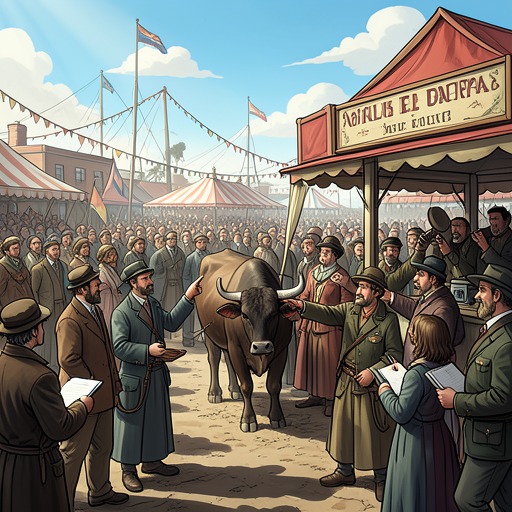
At a country fair in [Plymouth](entity:location-recall-location-plymouth-74fbc59efcb8), the elderly scientist [Francis Galton](entity:character-recall-character-francis-galton-a6b27730c6dc) encounters a competition to estimate the dressed weight of an ox. He gathers the entries from hundreds of participants, expecting that the average guess will expose the limits of ordinary judgment.
Instead, the crowd’s estimate is almost exact: 1,197 pounds against the ox’s actual 1,198. The result unsettles Galton’s belief in rule by a select few and introduces the book’s central question: how can a collection of imperfect judgments become remarkably wise?
May 1968, five months before discovery
A Lost Submarine
When the U.S. Navy’s [USS Scorpion](entity:object-recall-object-uss-scorpion-f3b3c5dca09a) disappears in the [North Atlantic](entity:location-recall-location-47148643b546), its last reported position leaves a vast search area and little certainty about what happened. Naval officer [John Craven](entity:character-recall-character-john-craven-7c9ccf2948a3) rejects the obvious plan of relying on a handful of leading submarine experts.
He assembles people with different specialties and asks each to wager on details of the submarine’s final moments. Combining their estimates with [Bayes’s theorem](entity:rule-recall-rule-bayes-s-theorem-442466271929), Craven produces a location no individual had chosen. Months later, the Navy finds the wreck just 220 yards from the group’s prediction, demonstrating how fragments of knowledge can form a coherent collective answer.
Late 1990s, during the run of Who Wants to Be a Millionaire?
The Studio Audience Wins
On the television quiz show Who Wants to Be a Millionaire?, contestants can ask either a chosen friend or the studio audience for help. The friend, selected as one of the contestant’s smartest acquaintances, answers correctly far less often than the audience.
The audience’s success is striking, even if the comparison is not a controlled scientific experiment. It gives a popular, modern echo of the ox contest: a dispersed group, not necessarily composed of experts, can outperform the individual people whom contestants trust most.
1920s through the mid-1950s
Classroom Estimates
A series of classroom and laboratory studies asks students to estimate temperatures, judge weights, rank objects, and solve puzzles. In experiment after experiment, aggregating individual guesses produces an answer that is more accurate than most individual responses, often approaching the best possible answer.
The crucial feature is that participants usually make their judgments separately before they are combined. The studies also reveal a limit: someone may beat the group in any single round, but no particular person reliably does so across repeated rounds. Averaging is a dependable method where searching for a single consistently superior judge is not.
Late twentieth century
The Maze Finds Its Shortest Path
Physicist Norman L. Johnson sends computer agents through a maze, where they first wander randomly and then make a second attempt using what they learned. On the second trip, the average agent finds the exit in far fewer steps.
Johnson then constructs a collective route by taking the majority choice at each junction. The resulting path is nine steps long—the shortest possible route and as good as the best individual’s. The experiment shows how locally gathered experience can be combined into a solution no single agent necessarily discovered.
January 28, 1986
The Challenger Explodes
The [Space Shuttle Challenger](entity:object-recall-object-space-shuttle-challeng-a336a6630d62) lifts off from [Cape Canaveral](entity:location-recall-location-cape-canaveral-d2b208f4ea63) and breaks apart seventy-four seconds later. Within minutes, investors begin selling shares in the four main contractors, but [Morton Thiokol](entity:organization-recall-organization-morton-thiokol-55d04d54dd97)’s stock suffers the sharpest decline and trading in it is briefly halted.
No public report yet identifies the cause, and there is no clear evidence that company insiders have tipped off the market. Even so, the pattern of buying and selling singles out the contractor responsible for the solid-fuel boosters, foreshadowing the eventual explanation of the disaster.
Six months after January 28, 1986
The O-Ring Cause Emerges
The [Presidential Commission investigation after the Challenger accident](entity:event-recall-event-4658edf23760) determines that the shuttle’s booster [O-ring seals](entity:object-recall-object-o-52b499eb3435) had lost resilience in the cold. Gaps allowed hot gases to escape and burn into the main fuel tank, bringing down the shuttle.
At a congressional hearing, [Richard Feynman](entity:character-recall-character-richard-feynman-0f78132f6d0d) demonstrates the cold’s effect by placing an O-ring in ice water and showing that it becomes brittle. [Morton Thiokol](entity:organization-recall-organization-morton-thiokol-55d04d54dd97) is held liable, confirming the responsibility the stock market appeared to recognize on the day of the explosion.
1899
Olds Opens a Motor Works
[Ransom E. Olds](entity:character-recall-character-ransom-e-olds-4f92d42c0183) opens the [Olds Motor Works](entity:organization-recall-organization-olds-motor-works-3b143dbf4fc3) in [Detroit](entity:location-recall-location-detroit-c63f400ec324) after years of struggle in the automobile business. His financier, [Samuel Smith](entity:character-recall-character-samuel-smith-6965f7e90b32), backs the company but favors expensive cars for wealthy buyers, while Olds sees a possible mass market for an inexpensive vehicle.
Olds cannot settle on a single design. In the company’s first year, he experiments with eleven prototypes, including electric, steam, and gasoline models. The disagreement and experimentation leave the company with no settled direction, but also with a range of possible futures.
March 1901
The Factory Fire
A fire destroys the [Olds Motor Works](entity:organization-recall-organization-olds-motor-works-3b143dbf4fc3) factory and nearly all of its prototypes. One vehicle survives because it is near the door and light enough to push outside: Olds’s inexpensive, low-cost model.
The accident forces the company to choose. Olds rushes the surviving design into production as the [Curved-Dash Olds](entity:object-recall-object-curved-dash-olds-41ebd845aae7), a plain, inexpensive car within reach of many Americans. What had been one possibility among eleven becomes the company’s defining product by chance as much as by deliberate planning.
1903–1905
The Curved-Dash Success
Olds promotes the [Curved-Dash Olds](entity:object-recall-object-curved-dash-olds-41ebd845aae7) with publicity stunts, including an eight-hundred-mile journey to the Manhattan Auto Show and a race at Daytona Beach. The demonstrations help persuade a skeptical public that automobiles are practical rather than mere novelties.
The company sells more cars than any other U.S. manufacturer in 1903, then increases sales again two years later. Olds has created an early mass-produced automobile, though he soon leaves the company after a dispute with [Samuel Smith](entity:character-recall-character-samuel-smith-6965f7e90b32)’s sons and later starts REO.
Early twentieth century through World War I
The Model T Standard
Hundreds of automakers compete with radically different designs and power sources. Electric cars have a substantial presence, steam-powered vehicles are admired for their speed and comfort, and gasoline cars have not yet secured an inevitable victory.
Manufacturers that invest in standardized parts and mass production gain the advantage. [Henry Ford](entity:character-recall-character-henry-ford-afd6a565ad79)’s moving assembly line and focus on one inexpensive model help make the Model T the familiar image of the automobile. By [World War I](entity:time-recall-time-world-war-i-bec7aac851ac), many companies have failed or been absorbed, and the market has narrowed around gasoline-powered cars.
Late twentieth century, in the account of bee-colony behavior
Bees Search for Nectar
A honey-bee colony needs to find nectar without first knowing where the best flower patches lie. It sends scout bees in many directions; scouts that find promising sources return and perform waggle dances that attract more foragers.
The colony’s distribution of workers emerges from many searches rather than a central plan. The process illuminates why a society may need to produce numerous varied alternatives before it can judge which ones are best—and why experimentation inevitably includes failures.
Late twentieth century
Diversity Improves the Group
Political scientist [Scott Page](entity:character-recall-character-scott-page-ba0beafecc46) uses computer agents with different skills to test how groups solve difficult problems. Groups that include both high performers and less capable agents with distinct abilities often outperform groups composed only of the strongest agents.
The finding is not that expertise or intelligence is irrelevant. Rather, similar strengths can leave a group with redundant knowledge, while different ways of approaching a problem expand its possible solutions. A diverse group can therefore be more capable than a gathering of people selected solely for individual brilliance.
Twentieth century studies of expertise
The Limits of Experts
Studies of professional forecasters and other specialists repeatedly find that expertise does not guarantee accurate predictions. Experts often disagree with one another, can give inconsistent judgments when shown the same evidence, and commonly overestimate their own certainty.
Expertise can be powerful within a narrow domain, as the contrast between chess positions and randomly arranged chess pieces demonstrates. But skill at one specialized task does not automatically make someone a reliable strategist or forecaster. The evidence challenges the impulse to entrust uncertain decisions to a single celebrated authority.
1961
The Bay of Pigs Failure
The Kennedy administration plans the Bay of Pigs invasion without seriously consulting key skeptics, including the CIA’s intelligence branch and the State Department’s Cuban desk. The same officials who devise the operation are then asked to judge its prospects, while warnings are quickly silenced.
The invasion proceeds on a distorted picture of [Cuba](entity:location-recall-location-b871768274f6): planners underestimate Fidel Castro’s popularity and the Cuban army, and imagine that an American role can be concealed. The failure becomes a defining example of groupthink, in which apparent agreement suppresses doubts and turns a narrow perspective into a disastrous decision.
1950s
The Lines of Conformity
In [Solomon Asch](entity:character-recall-character-solomon-asch-1f6ea5b832b6)’s conformity experiments, a participant judges which of three lines matches a comparison line while a group of confederates deliberately gives an obviously wrong answer. Many participants alter their public response at least once, despite being able to see the correct answer.
When a single person in the group gives the accurate answer, conformity drops sharply. The experiment suggests that even one ally can make dissent possible, a finding that matters wherever a group’s members must preserve independent judgment rather than simply echo the majority.
1968
The Skyward Crowd
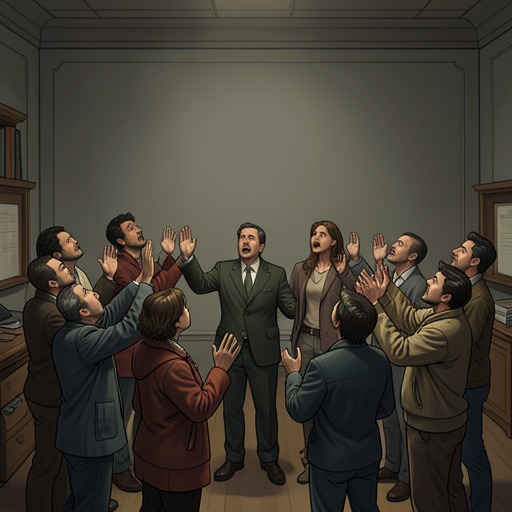
[Stanley Milgram](entity:character-recall-character-stanley-milgram-af8524be5e4b), [Leonard Bickman](entity:character-recall-character-leonard-bickman-01cec626447b), and [Lawrence Berkowitz](entity:character-recall-character-lawrence-berkowitz-605389eb7143) place people on a street corner staring at an empty sky. A lone observer attracts few passersby, but a larger cluster draws an increasing share of the crowd into looking upward.
The pedestrians are not simply yielding to direct pressure. They infer from the number of people watching that something must be happening. This social proof is often a reasonable shortcut, but it can also make a crowd treat others’ actions as evidence even when those actions contain no new information.
Super Bowl XXXVI, first quarter
The Rams Play It Safe
The heavily favored St. Louis Rams reach the New [England](entity:location-recall-location-edbf4fdebc64) Patriots’ territory twice in the first quarter. Head coach [Mike Martz](entity:character-recall-character-mike-martz-9bfff1a11c1e) chooses field-goal attempts instead of going for a first down; one kick succeeds and the other misses.
The decisions follow conventional football wisdom, but an analysis by [David Romer](entity:character-recall-character-david-romer-a8b9406bf325) suggests that teams should attempt to gain the first down far more often, especially in the areas where the Rams faced their choices. The episode shows how imitation, caution, and professional norms can keep experts from adopting a more effective strategy.
1846 through the 1850s
The Plank-Road Boom
[George Geddes](entity:character-recall-character-george-geddes-5737c851d611) persuades townspeople in Salina, New York, to build the first [plank road](entity:object-recall-object-6fa147d32b85) in the state. The road improves travel, and its apparent success helps ignite a nationwide rush to charter plank-road companies.
As towns watch others build similar roads, the technology seems increasingly proven and alternatives become harder to imagine. Yet the roads last only about four years, not the eight or more years their promoters predicted. By the end of the Civil War, nearly all have been abandoned: a seemingly rational cascade has spread a bad investment across the country.
1860s through the 1870s
The Screw Becomes a Standard
[William Sellers](entity:character-recall-character-william-sellers-5fae2bf65323) campaigns to replace handmade American screws with a standardized design of his own. Because machinists fear that interchangeable parts will undermine their livelihoods, Sellers targets influential users, including the Pennsylvania Railroad and the U.S. Navy.
Each new adopter makes the screw’s eventual victory appear more likely and encourages further adoption. Within a decade it is on its way to becoming a national standard, easing mass production. The beneficial result also exposes the hazard of cascades: the crowd could have followed the same influential lead had the design been poor.
From about 1996 through the late 1990s
The Telecom Investment Rush
Telecommunications companies become convinced that Internet traffic is growing at a rate of 1,000 percent a year. The growth rate slows, but the headline figure persists as conventional wisdom, encouraging firms to build capacity on an immense scale.
Companies that question the spending risk appearing reckless while competitors invest. After the bubble bursts, the industry’s excess capacity and financial distress reveal how shared assumptions can turn into an information cascade, with firms taking one another’s decisions as proof rather than reassessing the underlying evidence.
Early 1950s
Imo Washes Her Food
On the Japanese island of Koshima, a young macaque named [Imo](entity:character-recall-character-imo-857f80a3f47a) begins washing sweet potatoes in a creek before eating them. Other macaques gradually adopt the practice.
Imo later discovers that throwing wheat mixed with sand into the sea separates the floating wheat from the sinking sand. The group adopts this behavior as well. The story illustrates how one individual can invent a useful practice while the wider community makes the consequential collective choice to imitate it.
1940s, over the nine years after the first farmer adopts the seed
Farmers Test Hybrid Corn
Iowa farmers learn that hybrid corn can increase yields, but most do not immediately replace all their crops. They wait to see how their neighbors fare, then test the seed on part of their own fields before adopting it more widely.
The gradual spread of the new corn shows both social learning and independence. Farmers use their neighbors’ experience as a guide but retain personal testing when the decision matters. Adoption takes nine years to reach half the farmers in the region, rather than sweeping through as a sudden wave of imitation.
Late 1960s, during the Green Revolution
Rice and Wheat Farmers Choose
During the [Green Revolution](entity:time-recall-time-95e218ef4ab2) in [India](entity:location-recall-location-india-39df7eae59c1), farmers face different local conditions in wheat- and rice-growing regions. Wheat farms have relatively uniform land, so one farmer’s results are useful evidence for neighbors. Rice-growing conditions vary much more from farm to farm.
Wheat farmers rely more on neighbors’ experience, while rice farmers experiment more independently on their own land. The contrast shows that imitation is more useful when local circumstances are comparable; when they are not, another person’s success may reveal little about what will work nearby.
Around the turn of the twenty-first century
The Urn Decisions Cascade
In an experiment by [Angela Hung](entity:character-recall-character-angela-hung-4c724884e4a9) and [Charles Plott](entity:character-recall-character-charles-plott-88baf1a34bae), participants draw colored marbles from one of two urns and, in sequence, guess which urn is being used. Each person has a private clue from the marble drawn and a public clue in the guesses of those who came before.
When paid for individual accuracy, many participants follow the earlier guesses even when their own evidence points the other way, producing frequent information cascades. When payment depends on the group’s collective accuracy, participants give more weight to private information, and the group’s result improves. The experiment demonstrates how incentives and decision order can either smother or preserve useful diversity.
April 1946
Donovan Calls for an Agency
After leading the wartime Office of Strategic Services, [Wild Bill Donovan](entity:character-recall-character-wild-bill-donovan-f939936ef261) publicly argues that the United States needs a centralized, independent intelligence agency. The Pearl Harbor surprise and the prospect of conflict with the [Soviet Union](entity:location-recall-location-soviet-union-6cec7d1fe3b4) strengthen his case for gathering intelligence under one command.
Congress passes the National Security Act the following year and creates the Central Intelligence Agency. The new organization is intended to unify intelligence, though the wider community later develops into a collection of agencies with overlapping missions and substantial independence.
Postwar decades through September 11, 2001
The Intelligence Community Fragments
Rather than becoming a single intelligence organization, the U.S. system expands into agencies with separate responsibilities, budgets, and databases. The CIA director has limited authority over many of them, and the [FBI](entity:organization-recall-organization-c3b9c0848e8c) operates largely outside the intelligence community’s orbit.
The structure supports specialization but leaves no reliable way to combine the agencies’ information and judgments. Before September 11, the community fails to anticipate several major terrorist attacks; after the attacks, Congress faults the agencies for missing the collective significance of information they possessed.
1991
Torvalds Releases Linux
[Linus Torvalds](entity:character-recall-character-linus-torvalds-35a69b0af4b4) creates a version of the Unix operating system and releases its source code publicly, inviting others to improve it. Of the first ten people to download it, five send back bug fixes, code improvements, or new features.
The project grows into a decentralized collaboration among programmers around the world. Contributors work on what interests them, while Torvalds and a small group of coders vet changes before they enter the system. The arrangement combines broad participation with a mechanism for aggregating and reviewing contributions.
2000
The Fed’s Group Experiments
Economists [Alan S. Blinder](entity:character-recall-character-alan-s-blinder-c33d44e59d5d) and [John Morgan](entity:character-recall-character-john-morgan-23ae372022dd) design experiments to test whether groups can identify changes in an economy and make policy decisions quickly. Students first make individual decisions, then work in groups to interpret changing urn draws and to set interest rates in a simulated economy.
The groups make faster and more accurate decisions than individuals, outperforming even the best individual in some comparisons. The experiments challenge the assumption that committees must be slow or inferior, while underscoring that groups need a genuine method of combining their members’ judgments.
November 2002 through early March 2003
The SARS Outbreak Spreads
A severe respiratory disease appears in [Guangdong Province](entity:location-recall-location-03a4eb7ba21e), where hundreds of people become ill and several die. Cases then emerge in people returning from [China](entity:location-recall-location-134e6ca3a450) and [Hong Kong](entity:location-recall-location-48649d37d412), including a hospitalized patient in [Hanoi](entity:location-recall-location-1da5cfd84fe2); the illness is soon recognized as a new disease, SARS.
The World Health Organization issues a global warning and activates surveillance as the disease spreads from person to person. Finding the cause becomes urgent: identifying the pathogen could support diagnosis, containment, and eventually the search for a vaccine.
March 15–April 16, 2003
Labs Identify the SARS Virus
The World Health Organization brings eleven laboratories from around the world into a collaborative search for the cause of SARS. The labs share samples, images, test results, and daily discussions, while working in parallel rather than waiting for one central authority to assign every task.
Researchers at [Hong Kong University](entity:organization-recall-organization-2012418f474e) and the Centers for Disease Control separately isolate a promising coronavirus. Other labs detect and sequence it, and infected monkeys develop SARS-like illness. On April 16, the collaborating laboratories announce that the coronavirus causes SARS—a discovery no single lab could confidently have made so quickly on its own.
Eighteenth and early nineteenth centuries
The Quaker Trading Network
Quakers become influential in British banking, manufacturing, and trade, initially relying on the trust created by their shared religious community. Their reputation for honesty, careful records, and fixed prices attracts business partners from beyond the sect.
The experience suggests that trust can acquire economic value: reliable dealings with strangers make trade easier and less costly. Over time, commercial practices and institutions help widen trust beyond family, clan, or religious affiliation, allowing a larger and more impersonal market to function.
Eleventh century through the nineteenth century
A World Trade on Trust
Medieval Maghribi traders develop a far-reaching trading network supported by collective sanctions against members who break commercial rules. Merchant guilds, including the [Hanseatic League](entity:organization-recall-organization-2d2d426f2be1), likewise protect traders through shared enforcement and coordinated responses to unfair treatment.
Later, commercial law and business practice increasingly emphasize individual responsibility and the value of a trustworthy reputation. As long-term relationships and return business become more important, fair dealing becomes not only a moral ideal but a practical asset in trade between people without prior personal ties.
June 2002
The World Cup Conspiracy Claims
[Italy](entity:location-recall-location-125be658b0d0) loses to [South Korea](entity:location-recall-location-3cdcfaf4a171) in a World Cup match after controversial refereeing decisions, including a disallowed goal. Italian fans, newspapers, and public figures accuse the referee, [Byron Moreno](entity:character-recall-character-byron-moreno-9d1b5d151c5f), not merely of incompetence but of carrying out a conspiracy to eliminate Italy.
No evidence of a plot emerges, but the accusations reflect the deep distrust built into Italian soccer. Players and teams expect manipulation, contest decisions, and spend energy trying to influence officials instead of concentrating on the game. The shared failure of trust damages the quality of the contest itself.
September 2003
Grasso’s Pay Becomes Public
News breaks that the [New York Stock Exchange](entity:organization-recall-organization-f38ea608324f) plans to give its chairman, [Richard Grasso](entity:character-recall-character-richard-grasso-34c8bc458553), a package worth $139.5 million. Public anger grows despite the fact that ordinary critics will not personally recover the money or directly benefit from his departure.
The controversy becomes a public judgment about fairness: Grasso appears to be receiving a reward far beyond what his work warrants. The NYSE’s board eventually asks him to step down, showing how a willingness to punish perceived unfairness can influence institutions even when the people demanding accountability have no immediate material gain.
Late twentieth-century behavioral economics experiments
The Ultimatum Game Rejects Greed
In the ultimatum game, one player proposes how to divide money and another can accept the offer or leave both with nothing. If both players acted only to maximize immediate gain, responders would accept even the smallest offer; in practice, they often reject offers they consider unfair.
The proposers anticipate this and commonly offer an even split. Experiments also find that people respond differently when a proposer appears to have earned the right to keep more. The results reveal that judgments about fairness and deservingness shape cooperation, even when enforcing fairness costs the person doing the enforcing.
2003
Capuchins Reject Unequal Pay
Primatologists [Sarah F. Brosnan](entity:character-recall-character-sarah-f-brosnan-830ab1d38978) and [Frans B. M. de Waal](entity:character-recall-character-frans-b-m-de-waal-5f9611bc5d9f) train capuchin monkeys to trade a pebble for food. When both monkeys receive cucumber, they exchange reliably; when one receives a grape instead, the other often refuses the cucumber or stops trading.
The monkeys’ response suggests that sensitivity to unequal rewards is not unique to human social life. By abandoning food they could have eaten, the disadvantaged animals impose a cost rather than accept what they perceive as unfair treatment, echoing the logic of strong reciprocity in human cooperation.
1990s, in experiments conducted across fifteen societies
Markets Encourage Cooperation
Researchers take ultimatum, public-goods, and dictator games to fifteen small-scale societies with different ways of life. Participants in every society deviate substantially from the narrow, self-interested behavior predicted by the simplest economic models, though the forms and degree of cooperation vary.
The most market-integrated societies show the strongest prosocial behavior: participants make higher offers, contribute more, and punish unfairness more readily. The results suggest that repeated, reliable exchange can help make cooperation with people beyond one’s immediate community more workable.
Around 2000
Public Goods Need Punishment
In public-goods experiments by [Ernst Fehr](entity:character-recall-character-ernst-fehr-975faacfe82a) and [Simon Gächter](entity:character-recall-character-simon-g-chter-ee4afdddf9d6), participants can contribute tokens to a shared pot that benefits the group, though each person can gain more by free riding. Most begin by contributing, but contributions decline as they see others withhold their share.
When participants can identify and punish free riders, they spend some of their own resources to do so. Contributions then rise and remain higher, even after punishment is no longer possible. The experiment shows how enforcement and shared expectations can keep conditional cooperators from feeling like suckers.
1986 through 1995
Guardian Bank Serves Tax Evaders
John Mathewson opens Guardian Bank and [Trust](entity:state-recall-state-f2e789904592) in the [Cayman Islands](entity:location-recall-location-5e183c464bbe) and helps American clients conceal money from the [Internal Revenue Service](entity:organization-recall-organization-e86b060c8859). The bank serves businesspeople and professionals as well as criminals, allowing customers to access hidden accounts through debit cards.
After moving to San Antonio, Mathewson is arrested for money laundering and trades information about his depositors to avoid prison. His testimony reveals how widespread offshore tax evasion has become, feeding a public suspicion that honest taxpayers are being made fools of.
1990s through 2001
The Tax System Faces Doubt
Offshore schemes, corporate tax shelters, and the growing complexity of tax rules make Americans less certain that others are paying their fair share. Many people continue to say tax cheating is wrong, but the public begins to wonder whether those who evade taxes are getting away with it.
Taxpaying depends on more than the law: people must believe that others contribute, that public money is used reasonably, and that free riders are likely to be caught. When that confidence erodes, the willingness of ordinary taxpayers to cooperate is at risk.
Since television’s early years, with pressure mounting by 2003
The TV Ratings Stalemate
Television networks and local advertisers rely on Nielsen’s paper-diary sweeps to estimate local audiences, although few recipients return the diaries and many fill them out from memory. The resulting ratings are distorted by who cooperates and by special programming scheduled specifically for survey periods.
A more accurate alternative, the [Nielsen people meter](entity:object-recall-object-nielsen-people-meter-755e0cc3ed63), exists, but installing it across local markets would be expensive. The affiliates benefit from the existing system and pay most of its cost, while the networks and advertisers share the industry-wide damage without any one party having enough incentive to fund a replacement. The result is a persistent collective-action failure.
February 2003
London Charges for Driving
[London](entity:location-recall-location-london-420923d4a60a)’s mayor, [Ken Livingstone](entity:character-recall-character-ken-livingstone-2aec2eaa3d77), introduces a charge for driving into central London during the day. Cameras record license plates, and drivers who fail to pay face a fine. The policy aims to make each driver confront some of the congestion costs imposed on everyone else.
The scheme meets strong opposition, but its early results are substantial: traffic falls by almost a fifth and vehicles move more quickly. Rather than abolishing driving, the charge helps drivers coordinate by making the cost of using scarce road space visible.
Beginning in 1975 and expanding over subsequent decades
Singapore Prices Road Space
[Singapore](entity:location-recall-location-singapore-f0d99a335018) introduces a charge for entering its central business district during rush hour. The system develops into more detailed pricing by time of day, with electronic cards making the charge immediate and difficult to evade.
Unlike rules that simply ban certain drivers on particular days, pricing leaves the choice with each driver while changing the incentives. The experience illustrates how a decentralized set of personal decisions can reduce congestion when the costs of those decisions are made clear.
June 14, 2000
The Bridge Traffic Experiment
Traffic engineers [Carlos Daganzo](entity:character-recall-character-carlos-daganzo-86869f804413) and Juan Muñoz send a test vehicle onto the [Richmond–San Rafael Bridge](entity:location-recall-location-453c27b5748b) at a speed substantially below the surrounding traffic. The bridge has no entrance or exit ramps, yet lane changes increase and congestion forms behind the slow vehicle.
The experiment demonstrates how a small moving bottleneck can disrupt a highway. In dense traffic, drivers have limited ways to signal their intentions, and one person’s braking can trigger a chain of reactions that spreads backward through the flow.
August 1997
Automated Cars Form a Platoon
Researchers from California’s PATH program equip eight Buick LeSabres with sensors, automated controls, and radio links, then send them along a seven-and-a-half-mile section of [I-15 near San Diego](entity:location-recall-location-i-15-aa545ac471c1). The cars travel in a tightly spaced convoy and synchronize their speed without the delays of human reaction.
The four-day test demonstrates that automation could greatly increase highway capacity and reduce traffic jams. But the proposal raises questions about cost, control, and whether drivers will accept a system that requires them to hand much of the driving over to a computer.
Late 1990s through early 2000s
The Search for Coherent Flow
Physicist [Dirk Helbing](entity:character-recall-character-dirk-helbing-f38a0de65c1f) and his collaborators study how traffic can move as a coherent block, with cars traveling steadily even when each driver would prefer to go faster. Their work suggests that fluctuations in speed and irregular entry onto a highway can destabilize traffic.
Driver-assistance sensors and more responsive on-ramp signals could smooth the flow, even if only a fraction of cars use the sensors. The approach seeks to help drivers coordinate without replacing their choices with a fully automated highway.
January 1956
Smith Tests a Market
[Vernon L. Smith](entity:character-recall-character-vernon-l-smith-7e13b30a5611) turns a classroom into a simulated market, assigning students as buyers and sellers with private limits on what they are willing to pay or accept. They trade through a public double auction without knowing one another’s private valuations.
The bids and offers converge quickly on a market-clearing price, and trading maximizes the group’s total gains. The experiment shows that imperfect people with partial information can coordinate through a market even without a central planner who knows the correct outcome in advance.
1950s and the decades that follow
The Limits of the Ideal Market
Economic theory’s general equilibrium proof describes markets under demanding assumptions: complete information, fully rational participants, and contracts for every possible contingency. Real people and real markets meet none of these standards.
Smith’s classroom experiment helps make the theoretical claim more concrete by showing that imperfect participants can still reach near-ideal results under suitable conditions. Later experiments reproduce the basic finding, while also revealing differences between markets for ordinary goods and more volatile asset markets.
1936
The Pinsetter Is Invented
[Gottfried Schmidt](entity:character-recall-character-gottfried-schmidt-874ac4c01f0b), an engineer and avid bowler, becomes frustrated by the need for a person to reset pins after each frame. In a turkey coop in [Pearl River, New York](entity:location-recall-location-pearl-river-new-york-2e75e658edb0), he assembles a team and builds a working [automatic pinsetter](entity:object-recall-object-9c4e7d397781) from scrap metal, bicycle chains, and used automobile parts.
Schmidt secures a patent but has no way to manufacture the machine on a large scale. The invention is ready, but its future depends on finding an organization that can bring it to bowling alleys across the country.
Late 1930s, before World War II
AMF Takes Up the Invention
[Morehead Patterson](entity:character-recall-character-morehead-patterson-73ab960e39f3) of [American Machine and Foundry](entity:organization-recall-organization-0863c48497d7) recognizes the commercial promise of Schmidt’s pinsetter. He offers Schmidt a job and secures control of the patent, connecting an individual invention to the manufacturing and sales capacity of a large company.
The plan is delayed when [World War II](entity:time-recall-time-world-war-ii-d4353dde1684) redirects AMF’s factories toward war production. The pinsetter appears publicly in 1946, but technical problems remain; it will take years of further development before it can transform the bowling business.
1951 through the late 1950s
Bowling Becomes a National Craze
A bowling alley in [Mount Clemens, Michigan](entity:location-recall-location-mount-clemens-michig-158b206169ac), installs the first successful [automatic pinsetter](entity:object-recall-object-9c4e7d397781) in 1951. The machine makes games faster and more reliable, helping alleys shed their old image and become polished venues for family recreation.
Millions of Americans bowl regularly, and investors pour money into equipment makers and new alleys. The rapid growth makes bowling seem poised for still greater expansion, setting the stage for an investment boom that treats current popularity as a dependable forecast of the future.
1957–1963
Bowling Stocks Collapse
[Wall Street](entity:location-recall-location-wall-street-8bd87fa5cfd5) analysts extrapolate the sport’s explosive growth and predict that Americans will spend enormous amounts of time bowling. Bowling-related companies’ share prices surge, and investors pour roughly two billion dollars into the industry.
By 1963, bowling stocks have fallen about 80 percent from their highs. The popularity of the sport fades, while alleys built for an imagined future prove excessive. The episode becomes a small but vivid example of a market losing touch with the underlying value of what it is financing.
Seventeenth century through 1930s
Short Sellers Draw Public Anger
Short sellers, who borrow shares and sell them in hopes of buying them back at a lower price, are repeatedly accused of profiting from companies’ misfortune. Governments and investors have at times tried to restrict or ban the practice; after the 1929 crash, short sellers are blamed for the market’s decline.
Congressional hearings uncover little evidence that short sellers caused the crash, whose major excesses came from investors betting on rising prices. Yet the suspicion persists. The hostility matters because short selling can introduce skeptical judgments into a market where most investors naturally prefer to bet on gains.
Late twentieth century studies
Investors Reveal Their Biases
Behavioral-finance research finds that investors often herd, overreact to recent news, overestimate their skill, and hold losing stocks too long. A study of individual investors finds that frequent traders earn less than the market and often would have done better by trading less.
These errors do not automatically make the market collectively foolish. If individuals’ mistakes point in different directions, aggregation can cancel them out. The danger arises when biases become systematic, as when investors share the same assumptions or all follow the same signals.
Late twentieth century and early 2000s
Saving Becomes Automatic
Research finds that many Americans intend to save for retirement but repeatedly postpone doing so. People are more likely to save when they are enrolled in a retirement plan by default and must take action to opt out, rather than being required to sign up.
[Richard H. Thaler](entity:character-recall-character-richard-h-thaler-484901640ec4) and [Shlomo Benartzi](entity:character-recall-character-shlomo-benartzi-a1ed520067f1) also test a plan that lets workers commit a portion of future pay increases to savings. Workers agree to higher future contributions, and their average savings rate eventually doubles. The design works with people’s habits rather than demanding a dramatic change in their behavior.
1994 through mid-1998
Long-Term Capital Builds Its Bets
[John Meriwether](entity:character-recall-character-john-meriwether-c41a220bbc50) forms Long-Term Capital Management with experienced traders and prominent financial theorists, including [Myron Scholes](entity:character-recall-character-myron-scholes-1da7b3aacfdb) and [Robert Merton](entity:character-recall-character-robert-merton-cd119cdb9db0). The fund uses mathematical models to exploit small price gaps between related assets, often in illiquid markets.
Its strategy depends on prices eventually returning to their historical relationships. Borrowing heavily magnifies the possible returns, but also leaves the fund exposed if prices remain out of line longer than expected. The apparent precision of the models and the fund’s early success make its risks easy to underestimate.
August–September 1998
Russia Defaults and LTCM Falters
Russia’s default on its debt triggers a flight to safety after investors have already been shaken by the Asian financial crisis. Long-Term Capital Management is left with assets that few buyers want, and their prices fall sharply as the fund tries to sell.
The fund loses billions in a matter of months. A consortium of thirteen [Wall Street](entity:location-recall-location-wall-street-8bd87fa5cfd5) banks arranges a bailout to prevent its collapse from intensifying the wider crisis. The episode exposes the danger of leverage, illiquid markets, and strategies crowded with investors who all expect the same price relationships to return.
Summer 1998
A Consensus of Fear
As the crisis deepens, assets held by Long-Term Capital Management fall together, despite lacking obvious reasons to move in tandem. Other traders know the fund’s positions and become reluctant to buy what it needs to sell.
The fund’s experts are not undone simply by a lack of intelligence. Their trading world is small, specialized, and increasingly imitative; once fear dominates, there are too few investors with different views to provide a counterweight. The crisis shows why markets need disagreement as well as expertise.
Late 1950s
A Bubble of Bowling Stocks
The [automatic pinsetter](entity:object-recall-object-9c4e7d397781) helps bowling become a national pastime, drawing investors toward [American Machine and Foundry](entity:organization-recall-organization-0863c48497d7), [Brunswick](entity:organization-recall-organization-brunswick-abb133ca557b), and smaller bowling companies. Rising stock prices seem to confirm that the sport’s popularity will continue growing indefinitely.
As more investors buy because others are buying, price itself becomes evidence for further optimism. The resulting bubble directs too much capital toward an industry that cannot sustain the expectations placed upon it, illustrating how dependent decisions can turn a genuine trend into collective overreach.
Late twentieth century
The Caltech Bubble Experiment
At Caltech, students trade shares in an imaginary company. Each share pays a known dividend over a fixed number of rounds, so its value is objectively calculable and declines as the experiment approaches its end.
Despite having all the information needed to avoid overpaying, students trade at prices far above the shares’ value. They hope to collect a dividend or two and sell to a later buyer. The experiment shows how speculation can persist even when participants know the underlying price is wrong.
Late 1990s
Financial News Moves Prices
As [CNBC](entity:organization-recall-organization-cnbc-1ed74211e096) becomes a ubiquitous source of financial news, investors receive a continuous stream of reports about markets and other traders’ opinions. Studies find that stock prices and trading volumes can react almost instantly when CNBC highlights a company.
The reaction is too quick to reflect careful analysis of the report’s substance. Investors respond partly because they expect others to trade on what the network says. In this way, news about the market can become a force that amplifies the market’s own momentum.
Late 1980s
More News Proves Less Useful
Psychologist [Paul Andreassen](entity:character-recall-character-paul-andreassen-42a8c6732c79) gives business students portfolios and compares those who see only price changes with those who also receive a stream of financial news. The students with less information perform better.
News reports often make recent developments seem more meaningful than they are, encouraging overreaction and excessive trading. A related jelly-bean experiment finds that even true information can make a crowd less accurate when it directs everyone’s attention toward the same mistaken adjustment.
August 2001
Markets Turn into a Crowd
A woman climbs over the railing of [Seattle](entity:location-recall-location-seattle-ec620f372076)’s Memorial Bridge while traffic stalls. Some onlookers, drivers, and bus passengers shout at her to jump as police try to keep her calm. She leaps and survives the fall.
The incident is an extreme instance of a crowd’s conduct being shaped by the actions of others. A growing chorus can make participation feel more acceptable and anonymous, much as shared excitement or panic can spread through a market until individual judgment gives way to a collective extreme.
Late 1990s into the early 2000s
The Stock-Market Bubble Bursts
Investors pour money into technology and Internet companies, convinced that rapidly rising prices signal an enduring transformation. Some companies do represent real innovations, but the market’s excitement increasingly depends on the expectation that others will keep buying.
When confidence turns, prices fall and investors rush for the exit. The bubble and its crash reveal how a market can lose the diversity and independence that usually help it aggregate judgments, becoming instead a system in which everyone watches everyone else.
January 2003
The National Issues Convention
Three hundred forty-three carefully selected participants gather in [Philadelphia](entity:location-recall-location-philadelphia-375889b6054c) for a weekend of deliberation on American foreign policy. They receive balanced briefing materials, question competing experts and political figures, and discuss issues in moderated small groups before being polled again.
Political scientist [James Fishkin](entity:character-recall-character-james-fishkin-23ebcd0498eb)’s project rests on the idea that ordinary citizens can make informed judgments when they have knowledge and a chance to deliberate. The event offers a practical test of whether public debate can be more than a quick poll of people who have not been given the time or information to consider the choices.
Around 2000–2004
Deliberation Day Proposed
[James Fishkin](entity:character-recall-character-james-fishkin-23ebcd0498eb) and [Bruce Ackerman](entity:character-recall-character-bruce-ackerman-1d155d26336f) propose a national Deliberation Day, on which citizens would meet in small and large groups before major elections to discuss the issues. Participants who attend and then vote would receive payment.
The proposal seeks to reengage voters with civic life and give them a structured opportunity to learn and debate. Critics question whether citizens have the time, appetite, or ability to reason about the common good, while its proponents argue that political judgment should not be reserved for experts and elites.
Early 1960s through the twentieth century
The Voter’s Choice
Public-choice theorists apply economic assumptions to politics, arguing that voters, politicians, and regulators pursue their own interests. The theory helps explain lobbying and short-term political calculation, but its strictest version struggles to account for why people vote or why they sometimes support policies beyond their immediate material advantage.
Evidence suggests that voters often care about the health of the wider economy and about ideological commitments, not only their personal circumstances. Citizens may know little about policy details, but representative government lets them divide cognitive labor: politicians specialize in decisions while voters judge their broader performance.
The book’s concluding argument
Democracy and the Common Good
The book returns to a problem that cannot be settled by a single measurable answer: what policies serve the common good? Unlike a market forecast, political choices involve values and trade-offs on which different people can reasonably disagree.
Democracy may not reliably reveal an objective public interest, but it gives people a way to live together through decisions they can contest and revisit. Citizens accept that opponents may win because they expect their own chance to return. The decision to govern democratically, rather than the claim that every democratic decision is wise, is presented as a collective achievement in coordination and cooperation.