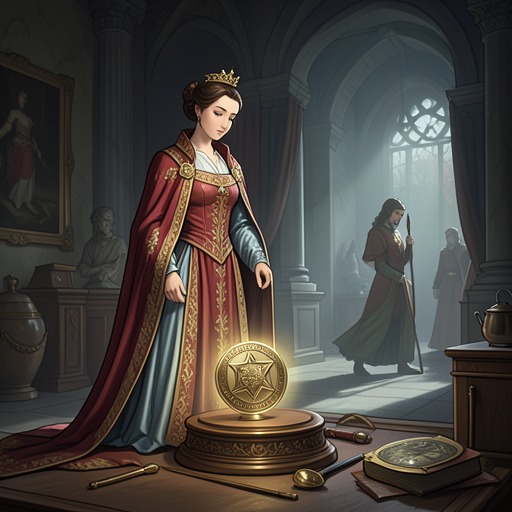
Fortress of Maith
TideThe Fortress of Maith is presented as a base of knowledge and responsibility for the guardianship of Edel’s Seven Seals. Its masters watch over the wards created by the first Curse-Breakers to protect Edel from Curse-Makers arriving from other shores. The fortress is not described architecturally, but its importance emerges through the work, correspondence, and affiliations of the people connected to it: protecting a seal is not an isolated task, but part of a wider effort whose consequences reach across kingdoms.
The fortress and the Seven Seals
Galahad Stormcrane introduces the fortress to Prince James as the place from which he has come, and explains that its masters watch over Edel’s Seven Seals. He identifies the seals as safeguards laid down by the first Curse-Breakers against threats from beyond Edel’s shores. This account gives Maith an institutional role: it is associated with the custodians who monitor a system of protection, rather than being described simply as a residence or a military stronghold.
The conversation makes the abstract network of seals tangible through the one Prince James says lies just beyond his window, in the sea. Galahad confirms its presence and describes a vast circle of dark stone, perhaps a mile across, visible underwater on a clear day. The underwater seal is not said to lie at the fortress; instead, the exchange links Galahad’s knowledge from Maith to the specific protection surrounding James’s kingdom. Maith’s significance therefore reaches beyond its own walls: its masters understand a geographically dispersed defense, and Galahad can explain how that larger system appears in the waters near the palace.
Galahad’s work beyond Maith
A letter Galahad writes to Master Reola after reaching Metern shows him acting within a continuing relationship with Maith. He reports that his journey was uneventful, but that he paused near Spegel’s southern border when he saw frost inside the woods. He is uneasy about sending Rose Melhorn to confront the curse there, particularly because she may face an ice fairy at the height of its power. Galahad notes that he is near Spegel’s eastern border and offers to help if Rose or Reola sends word. The letter presents his work as attentive to dangers beyond his immediate destination: even while pursuing the matter in Metern, he remains alert to another Curse-Breaker’s peril.
Galahad’s report also describes his first dealings with Prince James. He finds the prince open and amenable, if naïve, and says James accepted what he told him without pretense. James has installed him in a comfortable, well-stocked house near the palace, where Galahad finds many of Clanahan’s books. He learns that the former king and Clanahan were close friends. Galahad plans to return to the palace the next morning to ask for a guide around the island, so he can navigate independently. These details place his work in practical terms: gathering local knowledge, establishing access to the prince, and preparing to investigate the seal’s situation.
The investigation is urgent because Galahad expects the seal’s guardian to be dead. He tells Reola that he intends to lose no time in discovering how the guardian died and why. The expectation is not presented as a confirmed fact, but as the working assumption directing his inquiries. His report thus connects the fortress’s watch over the seals to the uncertainty and danger encountered at a particular post: knowledge of the system does not prevent a guardian’s death, and monitoring a seal may require investigating what has happened to the person responsible for it.
Correspondence and a wider network of aid
Reola’s reply places Galahad’s mission within a network of people who share information and can be sent to assist one another. Reola confirms Rose’s arrival at the Palace of Glas, which is buried in ice and snow, and reports that Queen Iskyla of Iss is sitting beside Prince Nikolas. Rose’s reception is hostile: the prince has threatened to kill her if she does not cure his headaches. Reola notes that harming a Curse-Breaker is illegal, while allowing that the prince may not know the law. Rose has Dust Boots, and Reola believes her temperament suits the problem, though the letter also conveys concern for her safety.
The offer of assistance makes this correspondence more than a pair of travel updates. Reola asks Galahad to report as soon as he learns what has happened to the seal’s guardian and offers to send help if needed, emphasizing that the seal’s protection is vital. Reola also promises that, should Rose require help, Galahad is the first person to be sent. The exchange shows people associated with Maith responding to separate dangers while keeping one another informed: Rose’s crisis in the frozen Palace of Glas and Galahad’s investigation in Metern remain distinct, but both are addressed through communication and the possibility of support.
Public affiliation and the cost of a neglected post
At a royal gathering in Metern, the king presents Galahad and Lady Meira as people of the Fortress of Maith. The introduction makes their connection to the fortress legible at court, giving Maith a public identity as well as the practical association with seal-keeping established in Galahad’s explanation to Prince James. The scene does not specify their exact offices there, but it confirms that both are recognized under that affiliation when brought before the queen mother.
Later, Galahad’s confrontation with Meira spells out the stakes of leaving a seal unguarded. He insists that she had promised, on the day he found her, to do what he ordered, and argues that the matter is larger than her own life. He accuses her of thoughtlessly abandoning her post at the Mhuirlan Seal, exposing the entire northeast coast to deadly powers that could destroy both Mhuirlan and Anhaga. With Myrkur having flooded the woods at the Ruined Mount, Galahad says he must now protect everyone, even if it costs him his life. The danger is not attributed to the fortress itself, nor does the text say that Maith can simply prevent every breach. Rather, the episode clarifies the responsibility attached to the seal-guarding system with which the fortress is associated: a vacant post can endanger distant shores and neighboring kingdoms.
The Fortress of Maith matters, then, less as a depicted building than as the point of reference for a dispersed protective order. Its masters watch over ancient seals; its associated figures travel, investigate, write, and offer aid across borders; and their public affiliation connects local royal affairs to a defense against wider magical threats. The book leaves the fortress’s physical appearance unstated while showing the weight of the work carried out in its name.