Diplock courts
TrespassesDiplock courts are a recurring focus of political and personal argument in the novel: courts without juries, described as relying on three judges, become a test of whether legal process can claim legitimacy amid the conflict in Northern Ireland. Through barrister Michael Agnew’s public criticism, Cushla Lavery’s growing engagement with the issue, and Tommy McGeown’s eventual trial, the courts are presented not as an abstract legal arrangement but as part of a struggle over evidence, political identity, and the right to be heard.
Structure and Political Meaning
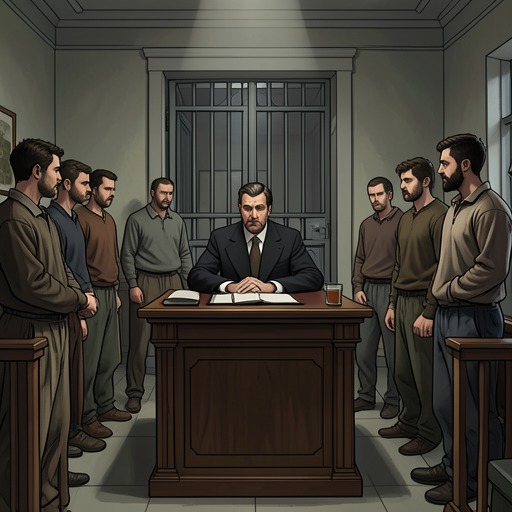
The arrangement that the characters call the Diplock court system is described as having no jury and three judges. Cushla argues that such a panel may reproduce a narrow institutional outlook: she suspects that the judges are Protestants who attended the same school. Her statement is an accusation about the system’s composition and fairness, not proof of each judge’s background. Its force lies in the perceived distance between the people who decide cases and the communities whose members appear before them.
Michael makes the broader case directly. He says that the system would not be tolerated elsewhere in the United Kingdom or in another country he regards as civilized. His objection is not simply that particular defendants may receive harsh outcomes; he challenges the procedure itself as an exceptional arrangement. In another conversation, he notes that Republican prisoners refuse to recognize the court. The refusal is therefore both a response to the institution and a political act performed within it: defendants may appear before the court while rejecting its authority to speak for them.
The issue is tied to a wider conflict over how political actions are named. Victor dismisses prisoners as gunmen and bombers who falsely claim unfair treatment. Michael insists that they are treated unfairly, and argues that without the political situation many of the young people in trouble would not have become defendants. The exchange leaves the disagreement unresolved, but makes clear that the label attached to a defendant—criminal or political prisoner—shapes how the court’s authority is understood.
Michael Agnew’s Opposition and Cushla’s Response
Michael’s criticism forms part of a longer public position. He is a barrister who made a documentary about the 1798 rebellion that caused controversy, spoke out against internment, and defended civil-rights campaigners when other lawyers would not. Gerry Devlin describes him as all right, meaning that he is not a bigot. The narrative thus places his objections to the courts within a record of public advocacy rather than presenting them as a private grievance about one case.
At a dinner, Michael’s remarks about Diplock courts surface while he and others are discussing the legal system. Cushla, helping to serve, hears him say that the absence of juries is not what he signed up for. The domestic setting places a professional and political dispute beside small acts of hospitality; Cushla burns her wrist while reaching into the warming oven and Michael takes her hand to the cold tap. His physical attentiveness does not settle their differences, but the moment connects the abstract question of justice to the developing intimacy between them.
Afterward, Cushla replays the evening and worries that she had tried too hard to impress Michael, including by opening her Irish-language books. In class, she imagines him in barrister’s robes, facing defendants who refuse to recognize a British court and answer in Irish they learned at Long Kesh. Her image links the courtroom to imprisonment, language, and political identity. The thought that Michael may be required to preside over a process he distrusts intensifies her earlier sense that she has not understood either him or the legal world in which he works.
Cushla’s view also becomes more explicit in conversation with Gina Lavery. When Gina points out that a person’s guilt is not the same question as the lawyer’s duty to defend him, Cushla argues that everyone is entitled to a defence. She then admits inwardly that her confidence is newly acquired: she has become involved with a barrister and is speaking as if she were an expert. When Gina mentions Michael’s criticism of the courts in the newspaper, Cushla calls the system unfair. The scene shows her moving from personal fascination with Michael toward an argument she can state in her own terms, even as she recognizes how recently she entered it.
Evidence, Authority, and the Record
The novel places courtroom claims beside the materials Michael collects as a lawyer. Cushla discovers files containing statements that defendants refused to sign, accounts of arrest and custody, and photographs documenting abuse in police detention. The material makes the question of fairness concrete without making the courtroom and the police station interchangeable: the courts decide cases, while the records concern how statements and evidence may be produced before a case reaches judgment. Their proximity in the narrative raises the question of what a legal process can establish when the circumstances behind its evidence are themselves disputed.
Cushla’s encounter with these documents changes what Michael’s professional objections mean to her. His complaint about a system without juries is no longer just a position aired at dinner or in a newspaper; she sees that his casework includes records of young defendants’ experiences in custody. The files also make her a witness to a private archive that is difficult to reconcile with the public language of procedure. The novel does not present the archive as a court ruling, but as evidence that the official process may not contain the whole account of what happened to those it prosecutes.
A later interview with Cushla by the Royal Ulster Constabulary further distinguishes formal legal procedure from the powers that surround it. An officer uses a file and Tommy’s small black notebook to question her about her relationship with Michael and whether she gave Tommy her telephone number. He tells her she can remain for up to seven days, then later says she was free to leave at any time. Cushla walks out without her basket, keys, or car, feeling stripped of her ordinary identity. This is not a hearing in a Diplock court, but its contrast between official assurances and the experience of being questioned extends the novel’s concern with how state authority is exercised and remembered.
Tommy McGeown’s Trial and the Courts’ Narrative Role
The conflict over recognition becomes decisive in Tommy McGeown’s trial. A newspaper report says that he refused to recognize the court, offered no defence, and answered no questions. He is convicted on evidence described in the report as forensic, circumstantial, and damning. The account gives the reader the formal outline of the case while leaving Tommy’s refusal to participate as the most visible fact about his relation to the court. The outcome confirms that rejecting the institution does not prevent it from reaching judgment.
The report also connects Tommy’s case to Michael. Tommy had been working on a house opposite Michael’s when Michael invited him in for tea. Cushla imagines the ordinary kindness of the encounter and wonders whether Tommy mistook Michael, in his wig and gown photograph, for a judge. The text presents this as Cushla’s speculation, not an established explanation for Tommy’s later actions. Its uncertainty matters: the newspaper can report a conviction and summarize evidence, but it cannot answer what Tommy understood, when he formed his decision, or how an encounter with Michael entered his thinking.
That gap between recorded outcome and inaccessible motive gives the courts their larger narrative significance. The institution can classify evidence, hear—or record the refusal to provide—a defence, and deliver a verdict; it cannot, by those acts alone, resolve the political and personal histories that surround a defendant. Across Michael’s objections, Cushla’s changing understanding, and Tommy’s trial, Diplock courts embody the novel’s question of whether procedure can command trust when participants dispute its fairness and when the record leaves crucial parts of their experience outside its reach.