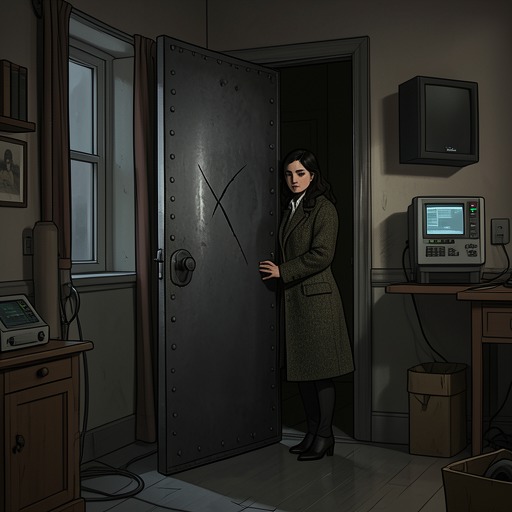
Dúil (desire and longing)
TrespassesDúil (desire and longing) is at once a word under study and a pressure lived out in the relationship between Cushla Lavery and Michael Agnew. The novel places the term in a book on Michael’s crowded table, then lets him test its possible meanings in a handwritten note: desire, liking, fondness, craving, yearning, want. That unsettled list gives shape to a relationship marked by physical attraction, unequal availability, and a longing that the word can approach without neatly containing.
The word and its setting
The novel presents Dúil as a chapter heading, followed by a news report that two men have been arrested in south Down in connection with an arms cache near the border. The pairing does not establish a direct connection between the word and the report, but it places private feeling within a narrative world where political danger is also part of ordinary public attention.
Later, Dúil appears as the title of Liam O’Flaherty’s book among the legal texts and box files on Michael’s dining table. A second book, de Bhaldraithe’s Irish dictionary, makes language itself part of the room’s material surroundings. Cushla notices that the copy of Dúil bears a name written in the old Celtic script, with an English name printed beneath it. The book is therefore not simply an abstract prompt: it is a previously owned object whose inscription leads Cushla to wonder about the girl who once held it.
Michael’s tentative gloss
The morning after their meeting, Michael gives Cushla a foolscap notebook on which he has written Dúil and a range of English possibilities: desire, liking, fondness, craving, yearning, and want. His question marks matter. Rather than offer a firm definition, he treats the word as something to be investigated, and his final suggestion is itself tentative: perhaps it is like the Portuguese word Saudade.
Cushla asks what Saudade means, and Michael supplies its pronunciation while describing it as a Portuguese word that he thinks resembles Dúil. The exchange makes comparison a method of approach, not a resolution. Several English words accumulate around the Irish one, while the Portuguese comparison adds another language without settling the distinction. The notebook records an effort to understand a feeling whose meanings overlap but do not collapse into a single, certain equivalent.
Michael’s research also gives their conversation an unusual intimacy. He has been studying the language and admits that he must stop frequently to look things up; Cushla tells him he would make a good teacher because he does not make her feel corrected. The word is thus discussed in a scene of attention and instruction, but the exchange remains personal: Dúil is something they try to understand together while their relationship is already being shaped by desire.
Desire under unequal terms
The novel gives the word a bodily context before the morning conversation. Michael kisses Cushla for a long time, and the encounter develops into sex. Her request that he go slowly is a clear expression of her wishes within the scene; his response and her participation make physical desire present as an experience, not just a topic in his notebook.
That intimacy takes place within terms Cushla already recognizes as unequal. Michael phones shortly before seven on Good Friday, while she is finishing Gina Lavery’s customary fish-finger sandwich with melted butter and malt vinegar. He says he is at dinner and will be at the flat by ten, then invites her to come. She agrees, but feels resentment as she does so: she understands that he is offering only what suits him, with meetings arranged at short notice and encounters fitted around pretexts and available places. Her longing does not erase her knowledge of this limit; the two coexist.
As Cushla passes a long public hoarding covered with warnings about suspicious activity, bombers, cars, and children’s toy guns, she also reads an admonition against seeing a married man twice her age whenever it suits him. Its placement brings a public instruction into sharp proximity with her private circumstances. The sign names the imbalance she has already felt, but it cannot make her desire disappear. The contrast clarifies the force of Dúil in the novel: wanting is neither proof that the arrangement is fair nor a feeling Cushla can simply dismiss once she recognizes its costs.
The past and the object left behind
Cushla’s experience of intimacy is not represented as beginning with Michael. The narrative recalls Columba, an engineering student from Fermanagh who was emigrating to Canada after graduation. Cushla used her dying father as an excuse not to go with him, while the knowledge that Columba was leaving allowed them to spend his final month in the city learning to please each other. Remembering that experience as she moves with Michael, she is grateful to have had someone with whom to practise. The recollection distinguishes sexual knowledge acquired in a relationship understood to be temporary from the present affair, whose emotional terms are less easily contained.
In the morning, Cushla returns to the inscribed copy of Dúil while Michael leaves the room. She looks again at the name in English and notices the careful, distinctive lettering, wondering about the girl who owned the book. The scene leaves two kinds of uncertainty together: the question of what Dúil can mean, and the unanswered question of the former owner’s life. The book’s inscription, Michael’s provisional gloss, and Cushla’s constrained affair do not yield a definition that closes either question. Instead, the word gathers a set of related but unsettled meanings around the gap between what is desired and what is offered.