Sectarianism and communal identity
TrespassesSectarianism and communal identity in the novel are not confined to political slogans or moments of public violence. They surface in the pronunciation of a letter, the language used to describe Irish, the clothing that identifies schoolchildren, and the assumptions attached to a bottle of whiskey or a funeral. Across these encounters, Catholic and Protestant identity is both imposed from outside and negotiated in the details of daily life; individuals may reinforce those divisions, resist them, or find themselves caught between them.
Language as a Boundary
For Cushla Lavery, the politics of Irish language begins with the way another person names it. When Michael Agnew asks whether she speaks Irish, she appreciates that he does not call the language Gaelic. She explains that she studied it for her A levels and at teacher-training college, although she sees little practical use for it in her surroundings. His interest gives the language a place in their conversation beyond the limited use she expects for it, and he later asks her to join an Irish-language conversation group. The invitation connects cultural identity to a social encounter rather than treating language as an abstract emblem.
That connection is less comfortable when Victor turns a language lesson into a test of Cushla’s candour. He asks her to explain the Irish word for no. Cushla offers an expression that can mean no, while Victor insists that it means something closer to it isn’t and calls the answer slippery and non-committal. Asked how someone might refuse a drink, she supplies another Irish expression meaning that she does not want one. The exchange places her in front of an audience that is waiting for her response: Irish becomes not simply a language she knows, but material that others use to question her directness and credibility.
A childhood memory shows how even a single sound can disclose communal difference. At a birthday party, Cushla is asked to spell her name; the other children exchange looks at its fourth letter. She does not understand the significance at the time: Catholics pronounce the letter H one way, Protestants another. Her name is not remembered by the children, and the small social injury remains with her. The episode makes identity audible before the child has the knowledge to interpret what she hears, and links linguistic difference to the experience of being singled out.
Religious Authority and Inherited Fear
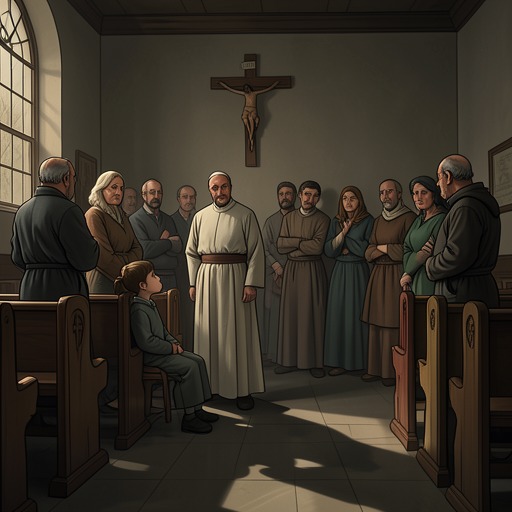
At school, communal identity is reinforced through both institutional space and religious instruction. The school stands on parish land shared with the church and parochial house, and Father Slattery enters classrooms unannounced to deliver catechism. Cushla has complained to Bradley that these visits unsettle the children. Her distrust also has a personal basis: when her father was delirious in hospital, Father Slattery prayed with him and persuaded him to write a cheque for a colour television. The priest’s authority thus reaches from the classroom into the family’s private vulnerability.
When Father Slattery finds Davy McGeown and another boy in trouble, he turns a disciplinary moment into a lesson in communal fear. After questioning Davy about his age, he tells the class a story of a young girl attacked by men and marked with the initials of a loyalist organization. Davy asks whether the girl was seven; Father Slattery dismisses the question and directs the children toward a broader conclusion about Protestant hostility, then identifies Davy as one of the McGeowns. The telling does not allow the children to consider the girl’s age or circumstances on their own terms. It converts a frightening story into an assertion about an entire community and places Davy’s family identity at the centre of the warning.
The same religious authority governs the children’s preparation for First Confession. Cushla tells them they are too young to have sins and suggests ordinary childhood misdemeanours they might confess. Father Slattery instead emphasizes original sin, remorse, and guilt, warning that he will show no leniency and that the length of each child’s penance will make their sinfulness visible. He gives them pictures of Padre Pio and speaks of the saint’s wounds; as he hands one to Davy, he bends to say something privately to him. The episode places Cushla’s attempt to shield her pupils from adult burdens beside a religious practice that measures and publicly signifies fault.
Everyday Codes and Public Exposure
Sectarian assumptions also operate as everyday standards of taste and respectability. At a gathering in Mrs Coyle’s home, Jim presents Michael with Bushmills as a good Protestant whiskey. Cushla recognizes the wider convention behind the remark: neatness and order can be called Protestant-looking, and Catholics use the description too. She silently hopes Mrs Coyle will acknowledge that the remark carries a judgment about Catholics, but receives no sign from her. Cushla is left to register the insult without knowing whether the person she wants to recognize it shares her reading of the moment.
The gathering also reveals the limits of private familiarity. Cushla has arrived with Michael, but when the other guests begin to come in, she realizes that he and their hosts may have avoided arriving together in view of them. The guests arrive punctually, which she reads as another sign of their Protestant orderliness; more painfully, she feels that no one cares what Mrs Coyle thinks of her. Communal identity here is not announced as an explicit dispute. It works through timing, appearances, and the management of who is seen with whom.
In public, clothing can make identity unmistakable. When Gerry Devlin leads children across the road on their way to a picnic, they wear their own clothes rather than uniforms. The choice is intended to protect them, but because other schools in town require regulation clothing, the children are readily identifiable as Catholics. Fidel watches them pass from his shop and addresses Cushla; he then crouches in front of Davy, who looks down and rearranges things in her basket. The scene leaves unresolved whether Fidel expects the boy to thank him for Creme Eggs whose source Cushla has not disclosed. A gesture that might be kindness therefore sits within an unequal social encounter, where the child’s response is observed and potentially expected.
The political division becomes literal at a checkpoint during the strike. Cushla and Gina Lavery are on their way to visit Cushla’s father’s grave when masked men stop their car; one holds a shotgun. Gina recognizes the third man as Fidel, despite his mask, and points out that his beard is visible below it. He lets them pass. Only after the strike ends, when the bare larder and empty fuel tank no longer occupy all her attention, does Cushla take in the full meaning of the encounter: someone she has known most of her life has stopped her at a paramilitarized checkpoint established to prevent people like her from participating in government, and has pretended not to know her. Familiarity has not dissolved the boundary; at the checkpoint, it is part of what makes the pretense legible.
Belonging, Solidarity, and Loss
The novel does not reduce communal identity to a simple division between hostility and alliance. During a school closure, a crowd of students gathers at the locked gates while a sectarian chant is directed at the children leaving the school. A missile lands near a very young pupil. Cushla goes to the edge of the footpath and opens her arms toward Minty, who looks away. The episode gives public expression to hostility toward the Catholic school community while also showing the failure of a familiar adult to meet Cushla’s appeal. Her position as a teacher cannot by itself overcome the pressure surrounding the school.
After Michael Agnew’s murder, communal belonging shapes how his death is heard. On the way to his funeral, Gina calls it mortifying that one of their own has committed the killing; Cushla understands the phrase to mean a Catholic. The newspaper reports that the murder bears the hallmarks of an IRA assassination. Cushla thinks of documents on Michael’s desk: she has seen only the folder concerning police brutality, while he had told her he handled many kinds of work. The public identification of a Catholic perpetrator does not settle what happened or what Michael’s other work involved. Instead, communal shorthand presses grief into collective shame while leaving important questions open.
Across these scenes, identity is neither merely chosen nor wholly fixed. A language lesson can offer recognition and become an interrogation; religious teaching can provide familiar forms while being used to instill fear and guilt; a neighbor can be both known personally and encountered as an armed gatekeeper. The novel locates sectarian division in these specific, material situations, where names, sounds, clothes, household objects, and acts of recognition decide who is treated as belonging—and where small gestures of care remain possible without erasing the boundaries that surround them.