State surveillance and coercive policing
TrespassesState surveillance and coercive policing in the novel make visibility a source of danger: photographs and police records turn private lives into material for investigation, while the threat of detention makes official power felt even when no charge is stated. The monitoring of Michael Agnew and Cushla Lavery converges with the RUC’s questioning of Cushla, exposing how an intimate relationship, her contact with the McGeown family, and a murder investigation become entangled in a system whose records do not tell the whole story.
Photographs and the watched relationship
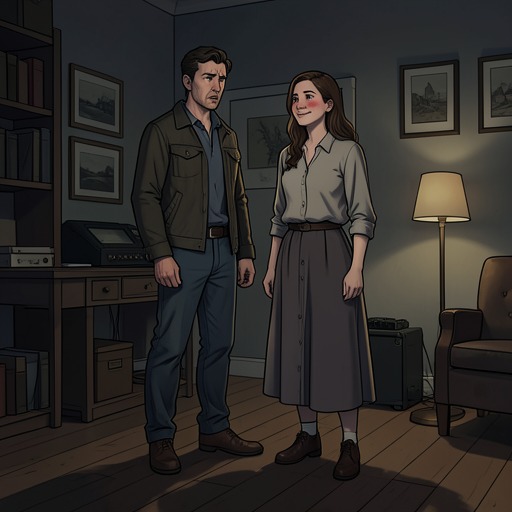
The surveillance becomes concrete through photographs presented to Cushla during questioning. One shows her and Michael on a footpath beside the perimeter of the barracks, lit by a streetlamp; he is carrying a bottle of brandy and laughing. The image fixes a passing moment as evidence of association. Another photograph captures Cushla speaking while Michael turns towards her. She reads his expression as evidence that he had loved her. The same record that can be used to investigate their movements therefore preserves an intimacy that the police did not create and cannot fully explain.
The photographs are not isolated snapshots. Cushla later considers that officers had been standing outside Michael’s flat, photographing him and noting the cars that passed his home. She cannot tell whether the surveillance began because of her or preceded their relationship. That uncertainty matters: she had assumed that her affair with Michael and her friendship with Davy McGeown were separate strands of her life, but the investigation makes them appear connected. Surveillance imposes a pattern on events by collecting their visible traces, even when Cushla herself does not know what brought the watching into focus.
Records, law, and competing accounts
The novel places police surveillance beside Michael’s work as a lawyer. At a dinner, Michael objects to Diplock courts and the absence of juries, arguing that the legal system’s treatment of Republican prisoners would not be accepted elsewhere in the United Kingdom or in a civilised country. The exchange is not a description of surveillance itself, but it establishes the contested legal environment in which the state’s records and procedures acquire force. Michael argues that political circumstances help produce the criminal cases brought against young people; his interlocutors dismiss the prisoners as violent offenders. The disagreement concerns not only punishment, but who is permitted to define what has happened.
Cushla encounters another kind of record when she finds material Michael has assembled about three boys accused of offences. The file contains unsigned statements, police photographs, and the boys’ accounts of arrest and custody. Its existence shows Michael attempting to preserve evidence that official procedure might otherwise exclude or obscure. Later, an officer shows Cushla Tommy McGeown’s small black notebook and asks whether she gave Tommy her telephone number. She explains that it was so he could contact her if the family needed shopping. A practical gesture of help is thus recast as a possible connection relevant to the investigation. The notebook, like the photographs, makes a private relationship legible to police, but it cannot by itself establish the meaning of that relationship.
The interview and the pressure of detention
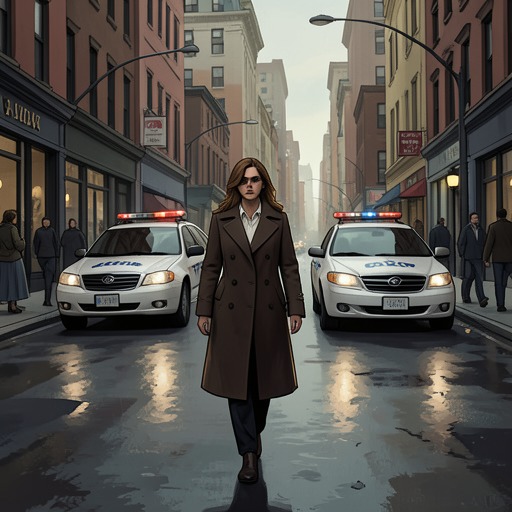
Cushla’s interview demonstrates how coercion can operate through the setting and the interviewer’s control, not only through formal accusation. Disco Peeler closes the door, does not take notes, and tells her that he can keep her for up to seven days. Cushla says she has done nothing. The encounter leaves her unsure of the limits of his power and unable to rely on the ordinary signs of a documented interview: there is no written record of the exchange, and she hears no one else in the corridor. His eventual thanks for her cooperation follows this threat, giving the word cooperation an uneasy weight.
Afterwards, the officer walks behind Cushla through the station and opens the fire door in front of her, so that she has to duck beneath his arm to avoid touching him. She is technically free to leave, but outside she feels as though she has been stripped of who she was: she has no basket, keys, or car. The contrast between formal freedom and felt dispossession is central to the episode. The threat of seven days’ detention has already shaped the encounter, even though she is not ultimately held. The procedure’s apparent ending does not undo the pressure that preceded it.
Surveillance and retrospective responsibility
The interview changes how Cushla reads the preceding weeks. She recalls Michael seeming harried, a state she had attributed to moving between two homes and two women; now the possibility that he was being watched offers another context, without resolving whether she was the reason. She reviews the links among her choices, Michael’s life, and her involvement with the McGeowns, considering how small contingencies might have altered what followed. Her question about whether Michael would still be alive if he had never met her expresses the burden of that retrospective reconstruction, not proof that the surveillance caused his murder.
The novel reinforces that uncertainty when Cushla later reads the newspaper account of Tommy’s trial. The report describes Tommy’s refusal to recognise the court, his lack of defence, and the forensic and circumstantial evidence used to convict him. Cushla imagines the earlier encounter in which Michael invited Tommy into his house for tea while he was working nearby, but the newspaper cannot supply what passed between them or when Tommy decided to act. Across photographs, notebooks, legal records, and news coverage, institutional accounts make people and events visible while leaving essential motives unresolved. Surveillance and coercive policing therefore function not simply as observation, but as a contest over who can assemble the evidence, interpret it, and determine what it means.