Irish language and political identity
TrespassesIrish language and political identity in the novel are joined not by a single shared meaning but by competing acts of recognition: learning Irish can be a cultural practice, a social test, or a political stance. Through Cushla Lavery’s teaching and encounters with Michael Agnew’s circle, the language becomes audible evidence of who belongs, who is being judged, and who has the power to define a refusal.
Learning Irish and the question of belonging
Cushla has studied Irish for her A levels and again at teacher-training college, but sees little practical use for it where she lives. Her education therefore gives her knowledge without granting her easy authority. When Michael Agnew asks whether she speaks Irish, she appreciates that he calls it Irish rather than Gaelic: the distinction matters to her as a sign that he recognizes the language on terms she values. Yet the encounter also exposes her uncertainty about whether study alone makes her a convincing participant. At a dinner, she remembers having told Gerry Devlin that she learned Irish for her examinations and training; self-consciousness about her pronunciation surfaces as she tries to perform that answer naturally.
Her name adds another layer to this insecurity. Michael notices that Cushla has an Irish name, but she describes it as an invented one, comparing it to Colleen. The exchange makes identity appear less like a settled inheritance than something tested in conversation: a name may suggest cultural affiliation, while its bearer may still doubt whether she can claim the language behind it. The Irish she has learned is both a real skill and a measure against which she fears being found wanting.
Language as social boundary
The novel locates this pressure in small, memorable differences as well as in political argument. In a childhood recollection, Cushla remembers meeting Protestant girls who asked her to spell her name and reacted to its fourth letter. She did not then understand that Catholics said haitch and Protestants said aitch. A difference in pronunciation, apparently slight, marks a communal boundary before she can explain its significance. The girls’ failure to remember her name, after asking her to spell it, deepens the memory of being examined but not accepted. Gina Lavery’s response afterward, criticizing Cushla for how she might have appeared in front of the others, carries the scrutiny back into the family.
That childhood episode informs Cushla’s discomfort among Michael’s acquaintances. At the dinner where she brings out her Irish books, she is conscious that the others can speak imperfectly without shame, while she is preoccupied with the possibility of getting something wrong. Their confidence and her self-monitoring reveal that fluency is not the only issue: the same language can function as shared play for some and as a test of cultural legitimacy for her. Her sense that she may be too young or too Catholic to fit the company makes Irish learning inseparable from classed and sectarian judgments, even when no one states those judgments outright.
The grammar of refusal and political argument
At a gathering, Victor turns Cushla’s teaching into a challenge by asking about the Irish word for no. Cushla explains that Irish has no direct equivalent in the simple form Victor expects, and offers expressions that can mean no or convey that she does not want something. Victor characterizes this as slippery and evasive; Cushla asks what he means by that description. The exchange stages a dispute over more than vocabulary. Victor treats the language’s structure as evidence of an unwillingness to commit, while Cushla insists on the distinction between grammatical form and the meaning a speaker can communicate. The lesson becomes a contest over who gets to interpret Irish speech.
The political vocabulary makes that contest explicit. At another gathering, Victor asks Cushla to translate terms including propaganda, internment, and terrorist, keeping his attention on Michael. Cushla supplies Irish equivalents, turning a language exercise into an encounter with the words through which the conflict is named and categorized. The terms do not settle the disagreement; they expose the political weight that the participants bring to the exercise. Irish is neither outside the conflict nor reducible to a single political position. It can carry the labels through which opposing sides describe events, while the act of asking for those labels can itself become antagonistic.
Courts, testimony, and the limits of official language
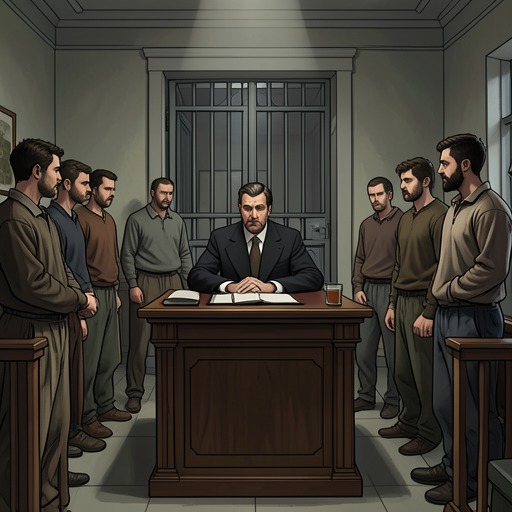
Legal proceedings connect Irish to institutional refusal. Cushla imagines Michael in his judicial robes as prisoners parade before him, refuse to recognize a British court, and answer in Irish they have learned at Long Kesh. The language in this scene is not simply a school subject: using it is part of rejecting the court’s authority. Michael’s own concerns about Diplock courts and the absence of juries place that refusal beside an argument about legal procedure. In conversation with Victor, he says that the system treats defendants unfairly and would not be tolerated elsewhere in the United Kingdom. Victor dismisses the claim that Republican prisoners are political prisoners, while Michael argues that the political situation has helped bring many young people into trouble. Their disagreement shows how the same defendants can be described through sharply opposed political vocabularies.
When Cushla later examines Michael’s files, the contrast between official proceedings and recorded experience becomes material. The papers include copies of statements the boys refused to sign and accounts of their arrests and custody, alongside photographs documenting evidence of mistreatment. The files do not make Irish the sole means of truth, but they place written testimony beside a legal process whose legitimacy is under dispute. The refusal to recognize the court and the preservation of accounts of custody both raise the question of whose words enter the record and what a legal institution will accept as evidence.
Teaching, intimacy, and the persistence of the language
Irish also creates a point of contact between Cushla and Michael beyond their political disagreements. Cushla recalls their Irish-language conversations and, during a later investigation, confirms that Michael invited her to join an Irish-language conversation group. The invitation links the language to their personal relationship, but does not erase the political circumstances surrounding it. In their shared world, lessons, dinner-table debate, legal work, and private connection overlap; Irish can be a way of speaking together without making the tensions around them disappear.
The novel’s treatment of Irish thus resists a simple opposition between cultural preservation and political instrument. Cushla’s schooling gives her competence but not immunity from exclusion; pronunciation and names expose communal distinctions; the debate over how to say no makes interpretation itself contentious; and prisoners’ use of Irish turns speech into a refusal of legal authority. Across these settings, language does not merely reflect an identity already formed. It is repeatedly used to test, contest, and make that identity legible, while the speakers remain divided over what the words mean and who has the right to decide.