Michael Agnew and Victor
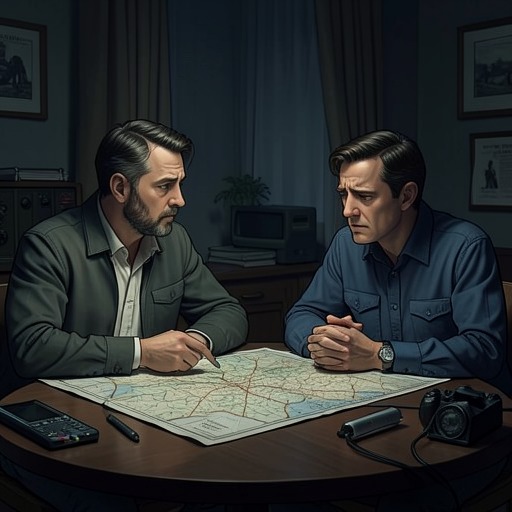
TrespassesMichael Agnew and Victor are linked by a political and judicial dispute that exposes opposing judgments about Michael’s legal work, but their connection also carries signs of warning, concern, and later understanding. Victor challenges Michael’s defence of Republican prisoners as indefensible; Michael insists that the system treats them unfairly. In a later conversation with Cushla Lavery, Victor recalls trying to warn Michael about pressure surrounding a police brutality case and acknowledges the happiness Cushla brought him. The relationship therefore moves between public argument and private recognition without evidence of a final reconciliation.
Public Disagreement
At a gathering where Victor had been commissioned to write a book about the UWC strike, the conversation turned to Republican prisoners refusing to recognize the court. Michael defended their treatment as unfair, arguing that the system would not be tolerated elsewhere in the United Kingdom or in any civilised country. Victor answered with a pointed rebuke: he cast Michael as the prisoners’ champion and accused him of defending the indefensible. Their disagreement concerns more than a single legal position. It places Michael’s insistence on fairness against Victor’s rejection of the cause he believes Michael is serving, making the dispute a direct conflict over what counts as defensible advocacy.
The exchange unfolds in company rather than in private. Michael’s arm rests across the back of Cushla’s chair, and Penny notices it, then looks toward Jim. That small change in attention locates the argument within a socially charged room: Michael’s public stance and his closeness to Cushla are both visible to others, though the evidence does not establish what Victor makes of the gesture. The scene gives the disagreement an audience and leaves its interpersonal consequences partly unspoken. Victor’s criticism is explicit; any further response among the people present remains unstated.
Tension Beneath the Argument
Michael’s manner toward Victor is controlled but tense. He asks whether Victor is all right in a soft voice, while his body appears hard, as if he might lunge. The contrast makes the exchange more than an abstract debate: Michael addresses Victor directly, yet the narration marks an antagonism that his courteous tone does not dispel. The evidence does not explain what immediately prompted this posture, so it cannot be assigned to a particular remark or motive. It does, however, show that their disagreement carries a physical and emotional charge alongside its stated political content.
The material associated with Victor helps situate the dispute without settling its terms. His commission to write about the UWC strike places him in a setting where political and institutional questions are under discussion. Michael’s defence of prisoners and his criticism of how the system treats them are plainly stated; Victor’s opposing judgment is equally plain. Beyond those positions, the evidence does not specify Victor’s broader politics, the argument of his book, or whether either man changes his view. Their conflict is therefore best understood through the particular exchange the narrative records, rather than expanded into a complete account of either man’s beliefs.
Warning and Concern
Later, Victor tells Cushla that he thought Michael was drawing too much attention to himself. He connects this concern to pressure on Michael to drop a police brutality case and says that he tried to warn him. This recollection complicates the earlier image of Victor as simply Michael’s public opponent. Victor had criticized Michael’s advocacy, yet he was also attentive to the pressure surrounding the case and attempted to caution him. The evidence does not identify who was applying that pressure or describe the warning itself; what it establishes is Victor’s awareness of the danger of heightened attention and his attempt to alert Michael.
Victor’s concern does not amount to agreement with Michael’s position. Rather, the two strands coexist: Victor could regard Michael’s defence of prisoners as indefensible and still recognize that Michael was under pressure in connection with his legal work. The distinction matters because it prevents their relationship from being reduced to a contest between a principled advocate and an unfeeling critic. The narrative records Victor’s criticism, his warning, and his later recollection, but does not show whether Michael accepted the warning or how he responded to it.
Michael Remembered
In speaking with Cushla, Victor turns from the case to Michael’s last months. He remembers Michael as happy during that period and tells Cushla that she had made him happy. Cushla says that she loved Michael but could not tell him, and wonders aloud why she is telling Victor. Victor replies, smiling, that Michael probably had a fair idea. This exchange gives Victor a role distinct from that of the man who publicly challenged Michael: he becomes the person Cushla can tell, and the person who offers a gentle interpretation of what Michael may have understood.
The scene does not prove that Victor knew the full nature of Cushla and Michael’s relationship, nor does it explain how he came by his view of Michael’s feelings. Its significance lies in the modesty of what it reveals. Victor does not claim certainty; he offers a qualified belief, and his smile softens the earlier record of antagonism without erasing it. Through Cushla’s admission and Victor’s response, Michael’s legal controversy is placed beside a private happiness that Victor recognizes after Michael’s death. The relationship between the two men remains unresolved, but its shape is broader than opposition: public condemnation, a private warning, and a final act of sympathetic recognition all belong to it.