Michael's Aran sweater
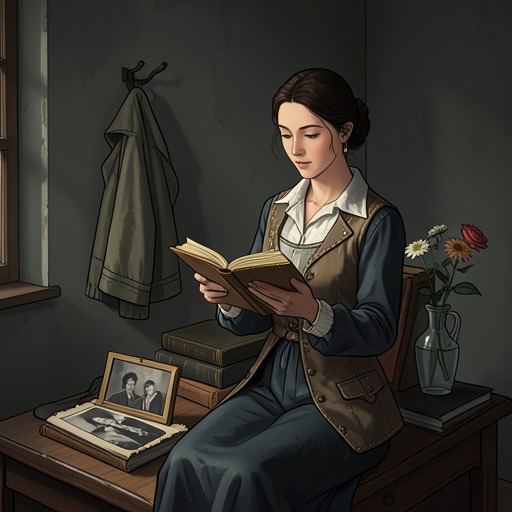
TrespassesMichael's Aran sweater is an intimate material trace of Michael Agnew in Cushla Lavery’s life. Taken from his apartment and worn during a period of political danger, it later becomes a means of approaching his absence: its presence offers Cushla a momentary sense of closeness, while its failure to restore him makes the limits of memory palpable.
The Sweater in Michael’s Apartment
Cushla encounters the sweater in Michael’s bedroom, where it is draped over the arm of a velvet chair. She has entered his home after being out with Gerry Devlin, and goes first to the bedroom, uncertain what she might find. Seeing that Michael is not there, she takes his Aran cardigan and puts it over her dress. The action is ordinary and unannounced, but the garment changes the scene: in a room marked by Michael’s private routines, Cushla takes something that belongs to him and wears it herself.
The surrounding room holds more than personal traces. On the dining table are whiskey glasses and papers arranged in stacks, while a nearby explosion makes Cushla fear that something has happened to Michael. The documents include records of police custody and evidence of abuse. In this setting, the sweater is not an emblem detached from events; it is part of the intimate space through which Cushla encounters both Michael’s work and the danger surrounding him. Her wearing it offers no explanation or protection. Instead, it makes their private attachment physically present at a moment when the wider violence makes his safety uncertain.
An Intimate Object Amid Concealment
The sweater belongs to the private relationship Cushla and Michael have kept concealed. Its significance comes not from a declared exchange but from the access it gives her to his bedroom and belongings. When she takes it from the chair, her gesture folds their intimacy into the material details of his home. The cardigan remains Michael’s, but on Cushla it also registers how their lives have crossed.
That relationship is entangled with obligations and other attachments. Michael is married to Siobhán de Buitléar and has a child; Cushla’s access to his private things cannot undo those facts or the secrecy of the affair. The sweater is therefore a close, personal object without being evidence of an uncomplicated bond. It can bring Michael near while also belonging to a life that Cushla does not possess in full.
Wearing It Through Grief
After Michael’s death, Cushla is shown at home wearing the cardigan. The morning brings her mother, Gina Lavery, into the room with breakfast, while Cushla is unwell after drinking the previous evening. Gina tells her to go to school; Cushla asks her to telephone Bradley and say she is ill. Their exchange carries both rebuke and familiarity, but the sweater remains with Cushla as she stays in bed. The episode connects it not only with Michael’s absence but also with the household in which Cushla must continue living and working through that absence.
The previous evening, Gina had brought home a bottle taken from the bar, and the two women drank together as Gina told stories about Michael. Those recollections had made Cushla feel closer to him. In the morning, that closeness seems to her mawkish and indecent. The contrast matters: stories can briefly produce intimacy, then become difficult to bear, while the cardigan remains physically on her. It does not resolve the feelings the stories have stirred. Cushla’s bodily distress and inability to return to work show grief disrupting the ordinary schedule of school and home, with the garment accompanying rather than curing that disruption.
A Brief Presence, Then an Absence
Later, Cushla lies down with Michael’s cardigan on her pillow and presses her face into it. For a few minutes, the familiar trace associated with him makes his presence seem close. Then her senses adjust, and that impression is gone. The passage gives the garment a precise emotional function: it can summon an experience of nearness, but only briefly. What remains is not Michael himself but Cushla’s awareness of how quickly the object’s comfort recedes.
This encounter takes place alongside her reflections on the secrecy of the relationship and her place at Michael’s funeral, where she stayed at the back of the church. She wonders whether she wanted sympathy, recognition of her loss, or acknowledgment that Michael had loved her. The cardigan cannot answer those questions. It gives grief a material focus, but does not grant Cushla public recognition or remove her sense of complicity in the relationship’s concealment. Her tears continue as she lies still and watches the light fade. Across these scenes, Michael’s Aran sweater shifts from something worn in his private room to a keepsake of limited, temporary contact: close enough to hold, yet unable to make the dead present for more than a moment.