Battle to defend the Pusan Perimeter
TrumanThe Battle to defend the Pusan Perimeter was the crisis in which American and South Korean forces, pushed back by North Korean advances, traded ground for time and made a stand in the peninsula’s southeast. The retreat was costly and disorienting, but it served a strategic purpose: to keep the forces intact long enough for men and supplies to arrive at Pusan and for a defensible line to be established.
Retreat and the defensive line
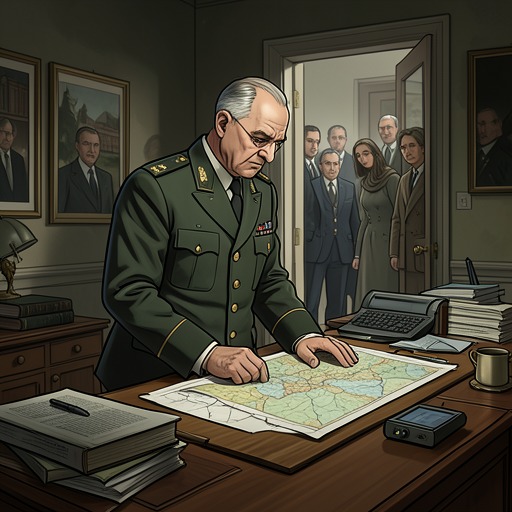
In a briefing at Blair House in mid-July, Omar N. Bradley used a map propped on an easel before Harry S. Truman’s desk to show the length of the American and South Korean line and explain the need for a gradual withdrawal. The intended sequence was to continue delaying actions, then contract the front to a shorter line in the southeastern corner of the peninsula. The map made the retreat legible as a military plan, even as events on the ground made it precarious.
American and South Korean forces fell back from Osan to the Geum River, then to Daejeon, where house-to-house fighting took place on July 19. They continued through the steep passes of the Sobaek Mountains to high ground behind the Nakdong River. In seventeen days of fighting, they had withdrawn seventy miles. The movement was not simply a collapse: it gave the forces time to regroup around a shorter defensive position while reinforcements and supplies were brought through Pusan.
Conditions and costs
The retreat took place during the Korean monsoon, amid drenching rain and temperatures regularly above 100 degrees. Weapons and clothing deteriorated, roads became clogged with refugees, and broken communications made coordination more difficult. American troops were unfamiliar with the terrain and had little knowledge of the local people or language. With little sleep and food, the forces repeatedly fought and fell back; casualties in some units reached 30 percent.
The retreat’s strain extended beyond the immediate battlefield. Reports of exhausted groups reaching safety after walking through hostile country, and news of American prisoners killed after capture, showed the human cost behind the changing lines. The pressure was compounded by the prospect that the North Korean advance might overrun South Korea before assistance could reach the defenders.
Holding the perimeter
The account describes the campaign as one of the darkest chapters in American military history, while emphasizing that the defenders accomplished the task before them. The U.N. commander was trading space for time, bringing men and supplies through Pusan; despite the odds and the humiliations of retreat, American and South Korean units prevented the advance from overrunning the south. Truman later characterized their stand as one of the most heroic rearguard actions on record.
On July 29, Walton Walker, the tactical U.N. commander in the field, ended the withdrawals with a stand-or-die order. Pusan was not to fall, and the troops were instructed to fight until help arrived. The order marked a sharp change from the repeated retreat: the shortened line had become the position to defend, and its survival now depended on holding it.
Presidential authority and significance
The military emergency also tested Truman’s judgment about the limits and responsibilities of presidential power. A special assistant urged him to seek a war resolution from Congress while public support remained strong. Dean Acheson argued that congressional approval was unnecessary and that the process of seeking it could cause harm. Truman sided with Acheson, reasoning that an appeal to Congress during the crisis could make it harder for future presidents to respond to emergencies. The choice reflected his concern not only with the immediate conduct of the war but also with the precedent his action would set.
That concern accorded with Truman’s broader conviction that control of the war effort belonged in civilian hands. The perimeter campaign thus joined a military test of endurance to a political one: the administration had to support battlefield operations while deciding how presidential authority should be exercised. The defense’s significance lay in the time the retreat bought, the line the forces ultimately held, and the continuing question of how a democracy directs a war under pressure.