Trinity test
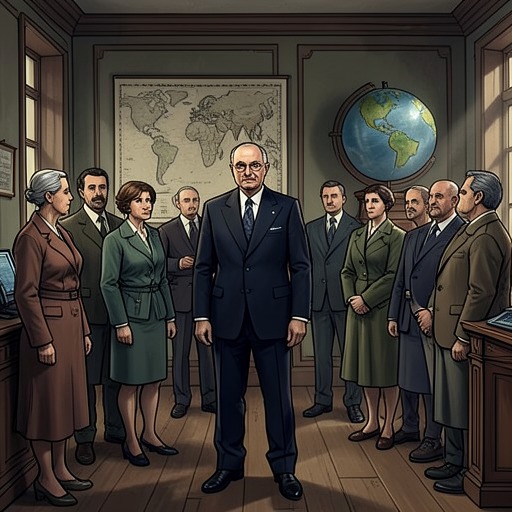
TrumanThe Trinity test was the first nuclear explosion in history, detonated in the New Mexico desert on July 16, 1945. Its successful result transformed an unfinished military project into a demonstrated force of extraordinary scale. Harry S. Truman did not witness the test: while he was at Potsdam, a secret telegram announced that the operation had exceeded expectations, and a fuller report later brought the explosion’s physical details into the conference room. The event’s significance lay both in what the test proved and in the new confidence it gave the President as he faced the final stages of the war.
The Test and Its First Report
The explosion occurred at 5:29 in the morning at a remote part of Alamogordo Air Base, in the New Mexico desert—1:29 in the afternoon in Berlin. At that moment, Truman and other Allied leaders were meeting at Potsdam, unaware that the first nuclear explosion had taken place. The book sets the event against the ruined streets of Berlin: the devastation visible to the conference participants was, it observes, small beside what had become possible that same afternoon.
That evening, Henry L. Stimson received a top-secret telegram from George Harrison in Washington and took it directly to Truman at his Babelsberg quarters. Its deliberately guarded message reported that the operation had taken place that morning and that the results seemed satisfactory and already exceeded expectations; further details would follow. The telegram disclosed success without yet conveying the scale of the event. Its terse language made the test sound like a technical report, even as the result announced a fundamental change in what a weapon could do.
The Explosion in Detail
The fuller account reached Potsdam on Saturday, July 21, when General Groves’s report arrived by special courier. Stimson and George C. Marshall reviewed it together before Stimson brought it to Truman at 3:30 that afternoon. James F. Byrnes was summoned, the doors were closed, and Stimson read aloud. The report described a test bomb exploded atop a 100-foot steel tower, rather than dropped from an aircraft, and estimated the energy released as equivalent to 15,000 to 20,000 tons of TNT. Its assessment was unequivocal: the test had been successful beyond the most optimistic expectations.
The report conveyed the explosion through a sequence of physical effects. For a brief period, the light within a radius of 20 miles was compared to several suns at midday. A huge fireball lasted several seconds, then mushroomed to more than 10,000 feet before dimming. The flash was visible as far away as Albuquerque, Santa Fe, Silver City, and El Paso—generally about 180 miles from the site. The sound traveled about as far in a few instances, though generally it was heard for roughly 100 miles; only a few windows broke, including one about 125 miles away.
The cloud extended the account beyond the initial flash. In about five minutes, it surged to an elevation of 41,000 feet, some 36,000 feet above the ground, passing through a temperature inversion at 17,000 feet that many scientists had thought would stop it. Two further explosions occurred in the cloud. The report suggested that iron in gaseous form, mixed with oxygen, had ignited and caused them. It also recorded several thousand tons of dust drawn from the ground and large concentrations of radioactive material produced by fission. At the center of the blast, the tower’s steel had evaporated; the pulverized earth left a crater more than 1,000 feet across, with a greenish cast. Together, these details rendered the test not as a single flash alone but as a chain of effects reaching from the ground into the upper atmosphere.
Scientists’ Reactions and Truman’s Response
General Thomas F. Farrell’s account, included in Groves’s report, described the people at the control shelter with J. Robert Oppenheimer. Farrell recalled the explosion’s searing light and a roar that seemed to warn of doomsday. When it was over, Dr. Kistiakowsky threw his arms around Oppenheimer and embraced him, shouting with delight; others shared the release of emotion. The report described the scientists as recognizing that the explosion had exceeded their highest expectations and that they had been present at the birth of a new age. Groves’s conclusion nevertheless turned from achievement to the task still ahead: the battle test, he wrote, was what counted.
Stimson spent nearly an hour reading the report. Whether Truman or Byrnes interrupted him with questions is not recorded. When he finished, both men looked immensely pleased, and Stimson described Truman as tremendously energized. Truman said the report gave him entirely new confidence and thanked Stimson for coming to the conference and being there to help him. The test thus entered the narrative in two forms: as a measurable physical event, described through distances, heights, and explosive force, and as a change in the President’s confidence at a moment of international decision.
Significance and Limits
The test established that the weapon worked, but it was not itself a battlefield use. Groves’s report distinguished the successful experiment from the “battle test” that remained ahead. That distinction matters: the evidence presents the explosion as both a scientific achievement and a prelude to a consequential military decision, without collapsing the two into one event. In Potsdam, the report’s arrival connected a remote desert explosion to the deliberations of leaders confronting a devastated Europe and the continuing war.
The narrative also emphasizes the gap between the spectacle witnessed by the scientists and the delayed knowledge available to Truman. He first received a guarded success signal, then, five days later, a detailed account of the flash, fireball, cloud, crater, and radioactive material. By the time the report was read behind closed doors, the test’s physical scale had become legible to him; its political and military significance remained bound to the battle test still to come.