Ziekenhuiskapel
UpZiekenhuiskapel is the hospital chapel Emma enters while searching for meaning in a world that seems to have become incomprehensible. Its modest interior becomes the setting for a powerful shift in her perception: stained glass, a statue of Mary and child, and changing sunlight combine into a delusion of safety and cosmic significance. The chapel offers no stable refuge; as the light fades and rain sets in, the same room turns oppressive, and Emma tries to escape it.
Setting and approach
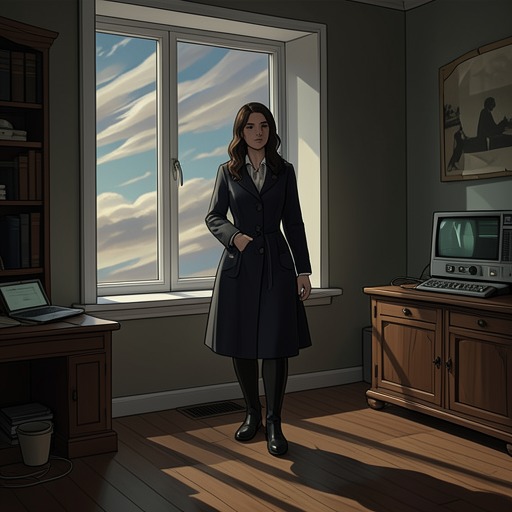
Emma reaches the chapel after deciding that the strange language she believes she hears in the hospital shop cannot be explained simply by the shop’s surroundings. She turns toward a dark door and, as she studies the sign above it, feels that the task is not to find answers but to ask the right questions. Crossing the corridor, she opens the door and smiles, convinced that the real message lies inside. The transition is immediate: an ordinary hospital passage gives way to a room she experiences as charged with meaning.
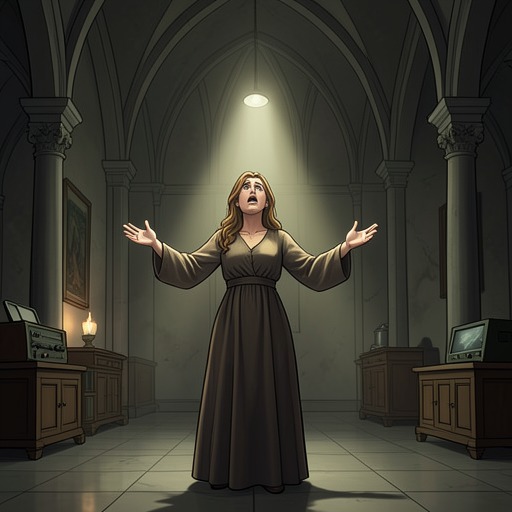
The chapel itself is plain and dim. A few chairs line the walls, and a small altar stands at the far end. Above it, three narrow stained-glass windows cast color across the bare walls. Emma looks upward in astonishment and reads the sudden color as light she has been seeking. The spare arrangement matters: the room contains little beyond seats, altar, windows, candles, and a small statue, yet her attention turns each detail into part of an encompassing revelation.
A refuge made by perception
When Emma lowers her gaze, the shadows seem warm, dark, and constricting, as though a large panting animal were waiting in a corner. She hurries to the far end and sits in the last chair along the wall. The sunlight has already been muted by clouds; with its brightness receding, she feels clarity giving way to a threatening mental fog. In the corner, she senses a large black, shaggy dog, more wolf than pet, with shining eyes and long white teeth. She knows it is there although she cannot see it, and believes it is waiting for her, a price she must pay. The apparition makes the chapel’s darkness more than a visual effect: it becomes an immediate threat inside the place she had entered in hope.
Searching for something that might keep the earlier feeling from disappearing, Emma notices a low table with candles and a small statue of Mary. The statue’s gentle expression and the child reaching outward become an address to her. She takes the gesture as assurance that she is safe there, provided the nursing staff do not find her. In that belief, concealment becomes more than hiding in a room: she thinks she can become invisible, even to herself. The chapel is therefore refuge only within the logic of the episode. The safety she experiences depends on remaining undiscovered, while the staff’s possible arrival is recast as a danger.
Light, revelation, and reversal
As the sun breaks through, light appears to burst across the chapel in countless fragments, spilling color over the floor, Emma, her chair, and the statue. She feels warmth on her face and interprets the sequence of looks—from mother to child, child to her, and her to the light—as confirmation. Her sense of separateness dissolves: she imagines the stones becoming her skin, the frames expanding with her breathing, and her heart beating in the image before her. She concludes that the circle is complete and that she is the key to the universe. The room’s fixed architecture has become, in her experience, a system that includes and explains her.
The conviction does not hold. Other people enter briefly: a woman lights a candle, a man puts money in a collection box, and visitors take seats before leaving. Their ordinary actions continue around Emma while she remains absorbed in the chapel’s supposed message. She keeps her face toward the sun until it disappears. Then rain clouds gather behind the glass, and the scene loses its radiance: the seemingly golden window becomes pieces of glass joined together, and the statue becomes an inanimate object. The change does not merely dim the room; it overturns the meaning Emma had built from its light.
Rain begins beating against the windows. The air feels heavy and close, Emma coughs and struggles to breathe, and the light, the atmosphere, and the feeling of revelation are gone. She decides she must leave. The route to the door seems twice as long, and the dog remains an unseen presence in the dark. Just as Emma reaches for the handle, a tall, lanky figure rises from a chair in the corner and walks toward her, holding a cigarette packet. The scene ends at the threshold of her escape, with another person interrupting the solitude she had understood as protection.
Place, hallucination, and the limits of safety
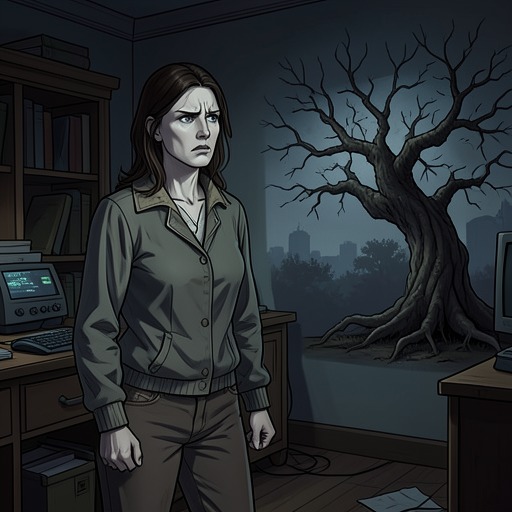
Later material gives the episode a frame beyond the chapel itself. Emma acknowledges that there are no therapy dogs at PAAZ, and she tells Rajid Panjani about seeing snakes on a narrow country bike path: objects she initially perceives as snakes prove to be branches when she concentrates, only to appear as snakes again when her concentration slips. She also explains that the most frightening part of such experiences is not simply the apparent object, but the sense that the world has changed while she was not looking, followed by shock, fear, and the worry that she may be losing her grip on reality. That account illuminates the chapel episode without reducing it to a collection of strange images: its shifting light and transformed objects enact the instability she later describes.
The chapel’s religious imagery also marks the difference between a felt revelation and a dependable sanctuary. Emma reads the statue, the stained glass, and the sunlight as a sign that she has found safety and cosmic purpose; the rain restores the objects’ ordinary material appearance but does not provide comfort. As a location, Ziekenhuiskapel holds both poles at once: a quiet interior where Emma can withdraw from the ward, and a space in which her isolation and fear intensify. Its decisive narrative force lies in that reversal, as the same room moves from apparent protection to a place she has to flee.