PAAZ
UpPAAZ is a hospital psychiatric ward, but in Emma’s story it is more than a clinical setting: it is a threshold she resists crossing, a familiar interior that holds both distress and care, and a building whose disappearance makes return impossible. Its worn surfaces and changing layout give physical form to the difference between being treated for an illness of the body and seeking help for one of the mind. By the time PAAZ is demolished, Emma has left it, yet the place remains part of how she understands her own history.
Setting and approach
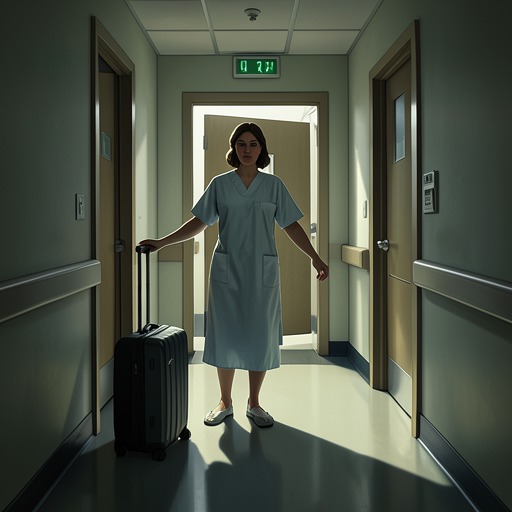
PAAZ is reached by a Bridge whose passage carries social meaning. The hospital’s other patients are understood to be ill in body, while those heading toward the psychiatric ward are treated as ill in mind; the contrast exposes a separation that overlooks the mind as part of the body. Emma experiences the route as laden before she arrives. Then the carpet of the connecting walkway gives way to the ward’s worn linoleum, and the familiar interior moves her unexpectedly. The secretary’s office and therapists’ rooms are on one side; a coffee machine and waiting-room chairs are on the other. At the end, stairs lead down to the admission unit on the ground floor. This first encounter makes the ward at once ordinary in its furnishings and emotionally charged by what the threshold signifies.
On a later approach, Emma tries to make admission seem like a test of her own doubts. Sergei disappears down the corridor, leaving her a brief chance to follow; she stays, picks up her bag, and walks ahead of Rajid toward the lower door. She tells herself that one day in PAAZ will expose her conviction that she feels unwell as a misunderstanding, replacing opinion with proof. The resolve is a way to endure the walk, not evidence that she has accepted the need for care. When Rajid explains that Emma is returning for a period of rest and that he will be her clinician, the ward’s role becomes explicit: it is where her admission and treatment will take place.
Architecture, familiarity, and boundaries
The ward’s sensory details make its arrival difficult to mistake. Emma recognizes the worn linoleum, hears patients murmuring in the hall, and registers the dry, dusty, disinfectant-laden smell that she associates with fear. The building is not simply new territory: its walls are familiar enough to trouble her. She reflects that a patient can be taken out of PAAZ without PAAZ being taken out of the patient, a formulation that links the physical building to the lasting imprint of having been admitted there.
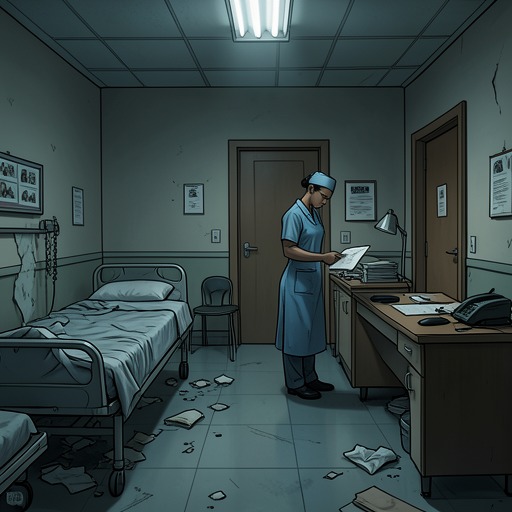
That familiarity does not mean the ward has stayed the same. Emma notices that a door now closes off part of the corridor. She describes the original plan as a simple U: sleeping wings formed the two arms, joined in the middle by the hall, office, lounges, and consultation rooms. The new door separates one arm from the rest. Gwen unlocks it, brings Emma through, and locks it behind them. Emma protests that this is the locked ward and that she was not meant to go there. In a few movements, keys and a threshold turn an architectural alteration into an immediate question of where she belongs and how much freedom she has.
PAAZ also becomes a refuge when the wider hospital feels intolerable. As the halls, people, colors, and sounds overwhelm Emma, she attributes what is happening to medication side effects and tries to move unnoticed back toward the ward. The Hospital shop and Hospital chapel have acquired a troubling significance for her, but she attempts to dismiss that significance and seeks the relative security of the familiar corridor. The setting therefore offers no simple division between safety and fear: its recognized route can provide shelter, while its doors and locked section make the conditions of that shelter concrete.
Treatment and the rhythms of ward life
Admission does not resolve Emma’s uncertainty about being ill. After a hospital emergency assessment, she is preoccupied with the prospect that stopping one medication will mean beginning another the following week. Her mood charts remain blank on the table as she thinks about staying through the weekend rather than being with Sergei, and she dreads another weekend as a PAAZ patient. The ward’s ordinary timetable and treatment routines are experienced against the life outside it, especially work and her relationship. Being in the hospital may make care possible, but it also makes separation unmistakable.
The clinical work described at PAAZ includes waiting for medication effects to pass, considering Depakine alongside lithium, and using mood charts to establish how often episodes occur and whether they have triggers. Rajid connects that proposed monitoring to his assessment that Emma may have bipolar disorder, and encourages her to discuss what she has disclosed with Lars. The ward is thus a place where Emma’s experiences can be put into a treatment framework, but the process unfolds over time rather than delivering immediate certainty. At one point she has spent three weeks there and no longer has side effects, yet remains unsure whether she is getting better or whether recovery can happen in that setting.
Ward life also has its own demands and interruptions. On a Monday morning Emma’s puzzle has been moved to make room for a recovery session, and she is uneasy about the change after the session was shifted from Friday because of a conference. Her reaction reflects how a small rearrangement can matter within a day organized around predictability. Elsewhere, construction sounds hollow through the office, making the ward’s eventual removal audible before it is complete. Routine, disruption, treatment, and building work all coexist in the same institutional space.
A place of distress and connection
PAAZ is associated with episodes of severe emotional pain, but the narrative does not reduce the ward to a setting for symptoms. Emma recalls the depression as an experience that strips away energy and leaves fragments of the self clinging to life while being pulled downward. Her account of distorted time sharpens the contrast: mania is figured as a present that races forward, while depression lets the past consume the future until time itself seems to disappear. These experiences give the ward a particular weight as a place where the struggle to describe illness meets the practical presence of other patients and clinicians.
The relationships around PAAZ can complicate isolation without erasing it. In conversation about the ward’s unobtrusive staff, Emma hears them described as its quiet strength: people who do their work without complaint and still make time for a walk with someone on the locked side. The point is not that illness or the need for support ceases to matter, but that a person’s value and place in relationships do not depend on being well. Sergei’s presence in the hospital’s orbit likewise makes the boundary between patient life and life outside the ward less absolute, even as Emma feels the loss of a weekend together.
Beatrice’s reflections also give the ward a vocabulary for the different tempos of suffering. Emma later recognizes the force of Beatrice’s observation that depression has no sense of time: unlike the manic present that seems to escape both past and future, depression makes the illness itself appear to be all that can be seen in either direction. PAAZ gathers such exchanges alongside formal treatment. It is not only a building where clinicians assess and prescribe, but also an environment in which patients’ accounts help make otherwise isolating experiences intelligible.
Departure, demolition, and narrative memory
The ward’s ending begins before Emma’s own departure. On her last day, the sounds of construction enter the office, and the realization arrives that both her stay and the old PAAZ are ending. She wants to go home, yet cannot contemplate the fact that this will be her last time in a place she never wanted to return to. The contradiction is central to the farewell: leaving is desired, while the loss of the possibility of return is painful. The demolition means that PAAZ will not remain available as a place she can revisit, even if she later wishes to.
When Emma sees the site again, there is nothing of the old ward left. A wide expanse of sand occupies its former location; the hospital, the new building, the car park, and a monastery bell among the trees remain as landmarks, but PAAZ is gone. She tries to recover the building’s exact shape in her mind and cannot. The sand seems to have erased its contours there as well as on the ground. The physical disappearance and the failure of recollection reinforce each other: she has lost not only a destination but also some of the certainty with which she once pictured it.
The final movement is not a return to the demolished ward but a departure from its site. With Sergei beside her and pony hooves sounding nearby, Emma looks back once more, then puts an arm around him and continues on. The closing gratitude to PAAZ holds together the care and distress associated with the institution without turning admission into a simple cure. The afterword further qualifies the setting’s documentary appearance: PAAZ was a fully anonymized, true-to-life account of the author’s first psychiatric admission, while the later narrative draws on experiences from different parts of psychiatric care, including a second PAAZ admission. Those later events did not all occur at this ward or involve the nurses and clinicians portrayed in the book. PAAZ is therefore both a specific remembered institution and a narrative place shaped from a broader set of experiences.