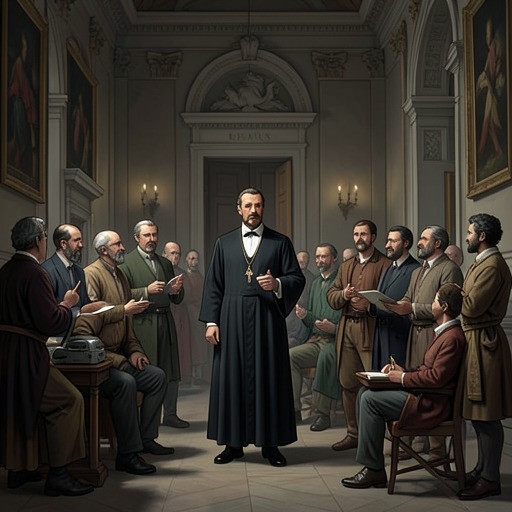
Philosophers become kings or kings become philosophers
UtopiaPhilosophers become kings or kings become philosophers names an ideal of government in which political power and philosophical wisdom meet. In Thomas More’s dialogue with Raphael Hythloday, the ideal is not a simple endorsement of serving rulers: it opens a dispute about whether sound counsel can change a court, and what a philosopher risks by trying. The exchange links public responsibility to the book’s sharper contrast between princely politics and the common life described by the Utopians, while leaving the value and feasibility of that alternative unresolved.
The Maxim in the Dialogue
The phrase enters when More presses Raphael to overcome his aversion to princely courts. Raphael has described how courtiers dismissed his proposals until Cardinal John Morton appeared to approve of one; then they praised it, even though the Cardinal had offered it in jest. To More, the episode demonstrates the influence of a ruler’s judgment, but also the susceptibility of courtiers to favor and flattery. He nevertheless argues that a generous and philosophical person should devote his abilities to public affairs, ideally by advising a prince, because a ruler’s conduct can shape the condition of an entire nation.
More invokes Plato’s proposition that nations would be happy if philosophers became kings or kings became philosophers. In this conversation, the maxim gives classical authority to the claim that learning should not remain separate from political action. More admires Raphael’s knowledge and believes that his counsel could serve humanity; he treats participation in government as a duty that may justify some personal discomfort. Raphael, however, disputes both More’s assessment of his aptitude and the likelihood that such service would benefit the public.
Counsel Against Princely Ambition
Raphael explains his skepticism by imagining a council occupied not with governing well but with acquiring territory. Its advisers debate how to retain Milan, recover Naples, subdue Venice and the rest of Italy, and enlarge the dominions of the French king. In that setting, counsel is directed toward advantage and expansion, not the welfare of subjects. Raphael imagines speaking against policies that impoverish the people, arguing instead that a king’s safety and honor depend on their prosperity and that the ruler should care for their happiness more than for his own.
His alternative is concrete rather than merely idealistic. He points to a law among a people living near Utopia that limits a new king’s treasury to a thousand pounds of gold, or an equivalent value in silver. The limit is meant to prevent the ruler from accumulating wealth at the country’s expense or using it to invade others’ rights, while preserving enough for emergencies. The example shows the kind of institutional restraint Raphael thinks wise government requires—and the distance between that restraint and the ambitions he expects to find in a prince’s council.
The Dispute over Political Compromise
More answers that counsel need not either remake a commonwealth at once or abandon it. If established evils cannot be removed, he argues, a public servant should maneuver so that matters become as little bad as possible, much as a person aboard a storm-tossed ship does not leave merely because he cannot command the winds. He distinguishes this flexible practical philosophy from abstract speculation: advice, in his view, must accommodate the circumstances in which it is offered if it is to have any effect.
Raphael rejects the implication that such accommodation will preserve a counselor’s ability to do good. In the courts he describes, a man may be expected to approve the worst plans; merely withholding full approval can make him seem a spy or traitor. If he joins in counsel, he may share blame for actions he opposed; if he remains honest among dishonest companions, they are more likely to corrupt him than to be improved by him. The philosopher-king ideal therefore meets a problem of political practice: wisdom may be needed in government, but the institutions in which it must operate can punish or absorb its independence.
Raphael reinforces his argument with Plato’s image of people choosing to stand in the rain. A philosopher who knows persuasion will be useless may do better to stay inside than to join the crowd and get wet. The image makes withdrawal seem like prudent self-preservation, whereas More’s ship analogy makes continued participation seem like responsibility. Their contrasting figures give the debate its force: one stresses the cost of ineffective intervention, the other the cost of abandoning a damaged commonwealth.
Utopia and the Unresolved Conclusion
Raphael’s most far-reaching answer is that no nation can be governed justly or happily while property exists and money measures value. He contrasts societies divided among a few with the Utopians’ common ownership, where, in his account, people live in plenty under a wise constitution and few laws. For him, the political failures that make philosophical counsel ineffective are not incidental errors that a clever adviser can correct; they are connected to the structure of property itself. More’s maxim thus points beyond the prince’s council toward a fundamental disagreement about the conditions of justice.
The dialogue does not settle that disagreement by making More accept Raphael’s account without qualification. After Raphael finishes, More recalls objections to Utopian practices, especially common life without money and the removal of what people conventionally regard as a nation’s magnificence. He refrains from challenging Raphael at that moment, commends the constitution in general, and takes him to supper, saying that they may examine the subject more fully later. More closes by wishing that many features of Utopia might be followed while admitting that he cannot agree with everything Raphael has related. The maxim remains a demanding ideal, but the ending leaves open whether wise counsel can reform existing rule—or whether justice requires a different foundation altogether.