Make thieves and then punish them
Utopia“Make thieves and then punish them” names the central reversal in Raphael Hythloday’s critique of English justice: the law punishes theft with death while the society around it helps produce the conditions that make theft a means of survival. In his argument, the gallows do not remedy poverty or prevent crime; they conceal the role of policy and privilege in creating both. The expression joins a social diagnosis to a demand that punishment be judged by its justice and consequences.
The debate behind the expression
At dinner with John Morton, Cardinal and Chancellor of England, Raphael hears an English lawyer praise the execution of thieves, noting that as many as twenty could hang on one gibbet, and wonder why theft nevertheless continued. Raphael answers that death is neither a just nor an effective response to simple theft: a penalty cannot restrain people who see no other way to live. He compares the policy to a teacher who chastises pupils instead of teaching them, arguing that public provision should give people a way to support themselves before they are condemned for failing to do so.
The lawyer’s claim that handicrafts and husbandry offer adequate work does not, in Raphael’s account, address those shut out of it. People disabled in war may be unable to resume their trades or learn new ones. Noble households also employ large numbers of idle retainers who can be dismissed when a lord dies or becomes ill; once they are sick, ragged, and without prospects, they may turn to theft. Raphael thus shifts the question from whether theft deserves punishment to how people are made vulnerable to it.
Enclosure and the making of poverty
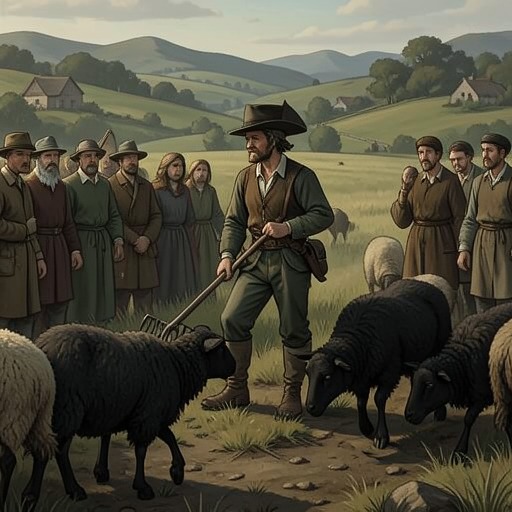
Raphael identifies the expansion of pasture as a particularly English cause. Landowners seeking greater returns from wool enclose fields, demolish houses and towns, and drive tenants and owners from their holdings, sometimes by force or pressure. Families must sell their household goods cheaply and move without knowing where to go. When their small reserves run out, they face begging, imprisonment as vagabonds, or theft; meanwhile, the conversion of arable land to pasture removes the agricultural work for which many displaced people were trained. A single shepherd can tend sheep on land that formerly required many workers to plough and harvest.
The consequences extend beyond immediate displacement. Reduced cultivation raises grain prices, while the higher price of wool leaves poor cloth-makers unable to buy their material and contributes to unemployment. The destruction of villages and neglect of rural labor also weaken cattle breeding: wealthy owners buy lean cattle, fatten them, and resell them, while the supply may diminish if animals are consumed faster than they can be raised. Raphael warns that scarcity could follow. These linked changes make theft, in his account, not an isolated failing but one result of decisions about land, production, and who may earn a living from them.
He also points to conspicuous spending on clothing and food, gambling and other pastimes, and houses of ill repute as sources of impoverishment. His proposed remedies address the processes he has described: rebuild villages or lease land to those who will, restrain the rich from engrossing land, restore agriculture, regulate wool manufacture, and provide work for people otherwise left idle. The expression’s accusation culminates in the claim that if a society neglects people’s education and livelihood and then punishes the crimes to which their circumstances dispose them, it first creates thieves and only afterward condemns them.
Proportional punishment and public safety
The phrase also frames Raphael’s challenge to the death penalty on grounds of proportionality. At the next meeting, John Morton asks whether opposition to execution amounts to tolerating theft or inviting more crime. Raphael replies that a person’s life cannot be worth less than a small sum of money, and that human laws cannot simply authorize what divine law forbids. He further distinguishes theft from murder: if both carry the same punishment, a robber may have an incentive to kill the person best able to identify him. Excessive severity, on this reasoning, can increase the violence it is supposed to deter.
As an alternative, Raphael describes the Polylerites, a people in Persia whose law requires thieves to make restitution to the person robbed; when the stolen goods are gone, the value is taken from the thief’s property, with what remains going to the thief’s wife and children. The offender serves in public works rather than being imprisoned or chained, and is supported from public resources. Work is enforced, but those who perform it well are treated without disgrace. Raphael presents this system as an example of punishment that combines restitution, labor, and public provision instead of equating theft with a capital crime.
The later account of Utopian law offers a related but distinct contrast: slavery is generally used as the punishment for even grave crimes because the offender’s labor benefits the community and the continuing spectacle of punishment may deter others. That policy is not the same as the Polylerites’ treatment of theft, but both accounts reject execution as the necessary answer to crime and weigh punishment by its public effects. Across these comparisons, “Make thieves and then punish them” exposes the contradiction between a society that narrows lawful means of subsistence and a justice system that treats the resulting theft as solely the offender’s responsibility.