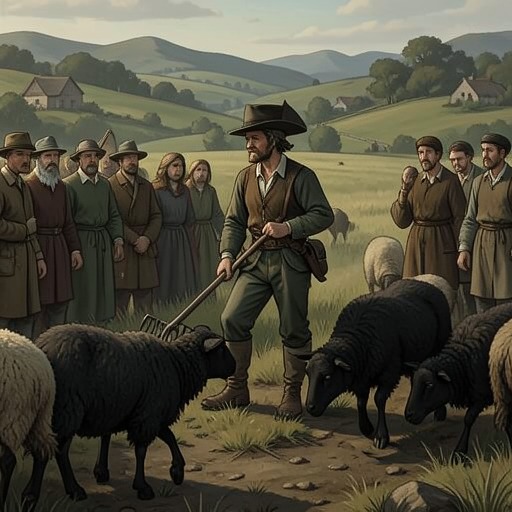
Sheep devouring men
Utopia“Sheep devouring men” is Raphael Hythloday’s deliberately startling image for the social damage caused when profitable pasture displaces people and farming. In his account, sheep do not literally attack anyone: their apparent voracity makes visible the human consequences of enclosure, concentrated wealth, and a legal system that punishes theft without addressing the conditions that produce it.
The Image and Its Setting
Raphael introduces the phrase during a debate about theft at the dinner table of John Morton. A lawyer has praised the severe execution of thieves, even noting that as many as twenty could hang on one gallows. Raphael argues that the punishment is both unjust and ineffective: people unable to find another livelihood may steal despite the threat of death. His comparison of punitive law to a schoolmaster who chastises rather than teaches leads into an account of the social arrangements that make people desperate.
The sheep image marks a shift from causes Raphael has discussed more generally, including idle retainers and men disabled by war, to what he presents as a particularly English source of poverty. He says that rich, soft wool makes pasture unusually profitable. Nobles, gentry, and religious landowners, dissatisfied with existing rents, turn land from cultivation to sheep raising. The animal’s familiar mildness sharpens the irony: the harm lies not in the sheep’s nature but in the system built around their value.
Enclosure and Displacement
Raphael describes landowners enclosing thousands of acres, demolishing houses and towns while leaving their churches standing. Owners and tenants lose their holdings through trickery, force, or such ill treatment that they are driven to sell. Rural families—men and women, married and unmarried, old and young, with children—are uprooted without knowing where to go. Their household goods bring little money, and what little they receive is quickly spent.
The loss is not only of homes but of a means of making a living. Where ploughing and harvesting once required many hands, one shepherd can tend a flock across the same extent of land. Displaced people who were trained for country work therefore find that the work itself has vanished. Those willing to labour may find no one to hire them; begging can lead to imprisonment as vagrants, while theft can bring execution. The phrase compresses this chain of changes into one image: the sheep’s expansion across the land corresponds to the shrinking room left for people.
Prices, Wealth, and Scarcity
Raphael links the spread of pasture to rising prices and growing insecurity. More pasture means less arable land and less demand for agricultural labour. Wool becomes so expensive that poor people who once made cloth can no longer afford it. Meanwhile, the concentration of sheep in a few wealthy hands allows owners to delay selling until prices are as high as possible. Even a disease that kills large numbers of sheep does not, in his account, undo that power over supply and price.
Other livestock become dear as villages are demolished and breeding is neglected. Wealthy owners buy cattle while they are lean and cheap, fatten them on their land, and sell them at higher prices. Raphael warns that if animals are consumed faster than the regions supplying them can replace them, the stock will diminish and scarcity will follow. Rising corn prices add pressure on households, which reduce their numbers; people dismissed from those households have still fewer options. The phrase thus describes more than immediate displacement: it points to a broad economic transformation whose effects accumulate through work, food, clothing, and population.
Poverty, Theft, and the Proposed Remedy
Raphael’s argument reverses the usual account of criminal responsibility. The poor are not simply choosing idleness: land-use change removes the work for which many were trained, while the law treats the resulting desperation as a reason to punish them. His formulation, “you first make thieves and then punish them,” gives the dinner debate its central accusation. A state that tolerates the conditions producing theft cannot make its harshness proof of justice.
He proposes rebuilding villages or leasing enclosed land to people who will restore them, restraining the rich from engrossing land, reviving agriculture, and regulating wool manufacture so that displaced people can find work. These remedies address the process that creates poverty rather than merely increasing the penalty at its end. The sheep image is therefore both a denunciation of enclosure and a challenge to a legal order that responds to its consequences while leaving its causes intact.
The Image Beside Utopia
The phrase belongs to the book’s layered form: a discussion framed by Thomas More and Peter Giles gives Raphael room to criticize contemporary institutions through a traveller’s report. Its force depends on the contrast between an apparently ordinary economic choice—raising sheep for valuable wool—and the destruction of villages and livelihoods that follows from it.
The contrast with Utopia complicates any simple opposition between English enclosure and an ideal alternative. Utopian communities manage farmland collectively and send residents in rotation to learn agricultural work, but the account also describes colonies founded on neighbouring land that the Utopians judge insufficiently cultivated. They incorporate local people if they accept Utopian customs and use force if they refuse to leave. The juxtaposition does not erase Raphael’s criticism of English landowners; it does show that the book’s scrutiny of land use and human displacement reaches beyond the memorable English metaphor. “Sheep devouring men” endures as a concentrated expression of the costs hidden inside apparently profitable economic change.