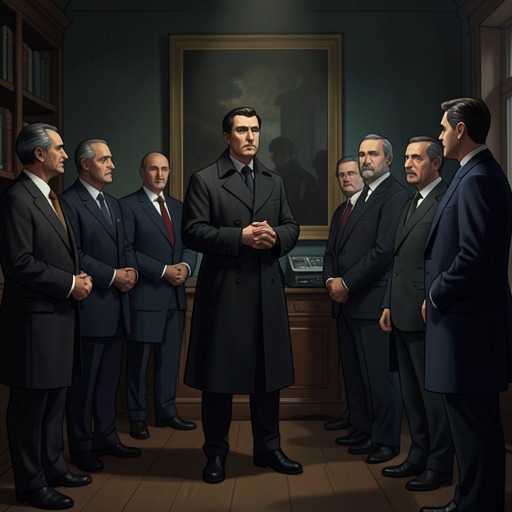
No room for philosophy in the courts of princes
UtopiaNo room for philosophy in the courts of princes is the governing expression of a debate over whether a conscientious adviser can serve a ruler without becoming an accomplice to injustice. In the dialogue between Thomas More and Raphael Hythloday, it marks not a settled verdict but a clash between two kinds of political counsel: More’s effort to make service useful within flawed institutions and Raphael’s insistence that a court may leave no honest room for it.
The Debate’s Setting
The question arises after Peter Giles observes that Raphael’s knowledge of peoples, customs, and government could make him valuable to a king. Raphael rejects the suggestion that entering royal service would simply allow him to help: calling it assistance rather than servitude, he argues, does not change its substance. He prizes the freedom to live as he chooses and doubts that a court would welcome counsel from someone of his disposition. Thomas More nevertheless urges him to put his learning and experience to public use, reasoning that a ruler’s decisions spread through the nation like water from a lasting fountain.
Raphael’s account of an earlier dinner in Cardinal John Morton’s household sharpens the dispute. He had offered practical counsel that was initially mocked; when the Cardinal appeared to approve it, the same company changed its manner and praised what it had dismissed. Raphael presents the episode as evidence that courtiers follow the signals of power rather than the merits of advice. Thomas More recalls his own early life in the Cardinal’s household and values Raphael’s respectful recollection, but the story does not persuade him to abandon the possibility of service.
Raphael’s Case Against Court Service
Raphael imagines a royal council absorbed in war: advisers discuss how to retain Milan, recover Naples, subdue Venice and the rest of Italy, and add further territories to the ruler’s dominions. In that setting, he argues, a counsellor who urges the king to care for his subjects’ welfare instead of pursuing conquest would be ignored or treated as an obstacle. The court’s habits and interests make sound advice ineffective before it is even heard.
His objection is also ethical. Raphael says that counsellors must do more than remain silent when others advance harmful plans: they may be expected to approve them openly, and even tepid dissent can invite suspicion. An adviser who joins such a company risks being corrupted by it; if he remains innocent, he may still share the blame because he took part in its deliberations. The danger, then, is not merely that the philosopher will fail to reform the court, but that the court will make him answerable for the wrongs he could not prevent.
To express the futility of intervention, Raphael invokes Plato’s image of a crowd choosing to run into the rain. A person who knows that persuasion will not bring them indoors would only get wet by going out to address them. The image turns the counsellor’s predicament into a choice between ineffective intervention and self-preservation: without influence, the would-be reformer may suffer alongside those whose conduct he cannot change.
More’s Case for Accommodation
Thomas More distinguishes between abstract speculation and a more flexible philosophy capable of working within its circumstances. His analogy is theatrical: a philosopher who interrupts a comedy performed by servants with a speech from a different kind of drama would spoil the play, even if the imported speech were better in itself. Political advice, More argues, must likewise fit the setting in which it is offered.
For More, the failure to remove every injustice does not justify abandoning public life. If accepted beliefs cannot be uprooted at once, a counsellor should try to manage affairs so that they become as little harmful as possible. His comparison is to a ship in a storm: inability to command the winds is not a reason to desert the vessel. This approach does not claim that a court can be made wholly just through tact; it treats partial mitigation as a duty where complete reform is beyond reach.
The Limits of Compromise
Raphael rejects More’s proposed flexibility as a description of court life. In his view, the adviser cannot simply select a discreet role or withhold approval: he must support bad counsels and dark designs, or risk being treated as a spy or traitor. More’s distinction between pliant counsel and abstract philosophy therefore meets Raphael’s objection that the institution itself sets the terms of participation. Accommodation may preserve a chance to do some good, but it may also entangle the counsellor in the very wrongdoing he hopes to restrain.
The exchange makes political silence and political service equally consequential. More fears that withdrawal leaves a commonwealth to its existing vices; Raphael fears that participation gives those vices a respectable partner and transfers their blame to him. Neither position is reduced to a simple choice between courage and cowardice: the disagreement concerns what an adviser can actually accomplish, and what moral responsibility follows from trying.
Utopia as the Measure of Reform
Raphael’s final standard is the commonwealth of Utopia, where he says shared goods and the absence of money allow public welfare to take precedence over private accumulation. He contrasts it with societies in which wealth and property are concentrated, laws proliferate without securing justice, and the poor remain vulnerable. His claim that a nation cannot be governed justly or happily while property and money rule every other value gives the court debate its larger political horizon: the problem may lie not only in individual rulers or advisers, but in the structures that organize power and wealth.
The ending preserves the tension rather than resolving it. Thomas More commends Raphael’s account of Utopia but admits that he cannot agree with everything related, especially its common life without money. He postpones a fuller examination, while saying that some Utopian practices are more to be wished for than expected in existing governments. The expression thus remains a live question within the dialogue: whether philosophy can guide power from inside its institutions, or whether those institutions make honest counsel ineffective or complicit.