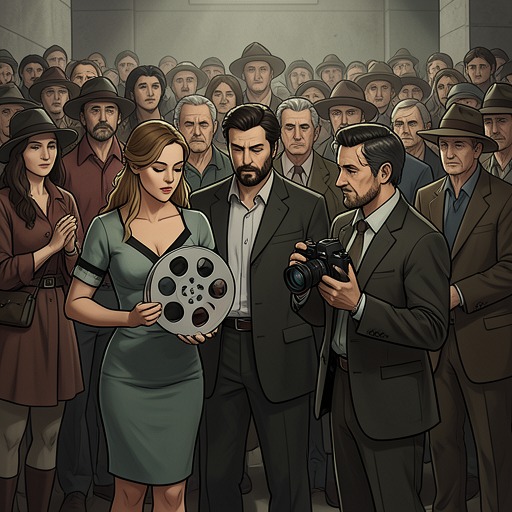
Film Footage Shot by 24fps
VinelandFilm Footage Shot by 24fps is the surviving visual record of a political community coming apart and of the fatal violence surrounding Weed Atman. Made amid a night of escalating disorder, the footage turns the camera into both a witness to public upheaval and a record of Frenesi's intimate involvement in a killing.
Production and Subject Matter
The footage spans two connected scenes of crisis. At dusk, as an unannounced gathering formed around the campus fountain beneath the silhouette of the Nixon Monument, 24fps members filmed a crowd that seemed to have lost its former solidarity: familiar faces had become strangers, and those present sensed an imminent break with the recent past. DL carried an Arri while Zipi assisted with a spring-wound Bolex. Elsewhere, at Rex's house by the beach, Sledge Poteet handled a giraffe and helped Krishna with sound, while Howie managed the lights and recharged Frenesi's camera. Frenesi tried to film Weed recounting what had happened, inviting him to describe events in his own terms; the lights went on and off as he seemed ready to speak, then changed his mind. The larger documentary followed the final hours of the People's Republic of Rock and Roll, not as one concentrated assault but as scattered clashes through a darkened night, with power and water cut, fires, tear gas, gunfire, and uncertainty about where danger might emerge. To film it, the crew used their most sensitive stock, 7242 taken from the Film Arts Department refrigerator, and opened their lenses fully, sacrificing the depth of field Ditzah wanted. The resulting images included descending helicopters, young people dancing to the same radio station, and soldiers in camouflage and blackened faces moving through the darkness; when sudden arc lights exposed them, they tried to destroy the lights, but the camera continued to face what came toward it.
The Murder Sequence and Its Limits
The footage of Weed Atman's death records a confrontation whose decisive instant escapes the image. When Rex returned to the house, Jinx hurried the children out while Weed stood between her and Rex. Rex was trembling, with a bag slung over his shoulder and a heavy object inside; both cameras were running, Ditzah operating an old, battered Auricon and Howie the Canon Scoopic 16mm Camera. Rex demanded that Frenesi tell Weed they knew everything. Ditzah’s camera caught close views of Rex as he began to understand what was happening, while Howie framed the three of them. The sequence preserved not just accusation but the moment Rex’s confidence collapsed into shock.
The record then divides between sound and image. Howie had to change reels, but Krishna captured the audio: Rex shouting after Weed, a door squeaking, footsteps and furniture striking, the engine of a vehicle starting. Frenesi tried to bring a spotlight outside; Howie, now filming, missed the fatal instant while searching for the lens ring. The gunshot was nevertheless recorded on Krishna’s tape. When Howie reached the scene and Frenesi directed the light toward it, Weed lay face down in a pool of blood, the cloth around the exit wound still smoldering. Rex posed for the camera and mimed blowing smoke from his P38. The film could not show the shooting clearly, but its soundtrack and aftermath made the violence legible.
The camera then held on Rex as he accused Frenesi and approached Weed’s body. He still had the gun, but, as the sequence presented him, he was no longer its master; he knelt and placed it beside the dead man. Frenesi turned off the spotlight, ending the recorded scene on Rex’s face, with the light reflected in his pupils and Frenesi herself distorted in the wide-angle image. That framing makes her presence impossible to dismiss: she is not merely behind a camera, but visibly directing the light onto the dead man, the killer, and the weapon she had supplied. The footage preserves her silence and her role in making the scene visible, without resolving what she might have said or done differently.
Years later, Prairie watched the images with Ditzah and DL. For Prairie, the most revealing shot was not an abstract record of the killing but the view of her mother holding a thousand-watt Mickey-Mole spotlight beside Weed’s corpse, illuminating the man who had killed him and the weapon Frenesi had procured. The film’s harsh light made concealment look like its opposite: Frenesi’s participation appeared in the open, while the camera’s fragmentary record still left the fatal moment in darkness. Ditzah’s 24fps archive, which held the footage and other materials, was later caught in the destruction of her home; officials burned film reels and papers outside the garage, turning the vulnerability of the record itself into part of the story.
Viewing, Memory, and the Archive
When Prairie watched the recovered images with Ditzah and DL, the footage became more than a record of events: its fragments altered what she understood about her mother. The filmed scenes and the images shown alongside them had carried her through an unsettling encounter with Frenesi’s past; afterward, Prairie felt vividly alive, but also as if she had been expertly thrown around for hours. The footage’s force lay partly in that mismatch between the apparent clarity of the image and the painful work required to interpret it. What it preserved could disclose Frenesi’s actions without making those actions easier for her daughter to accept.
The record’s physical survival was itself precarious. Ditzah had worried about the safety of the 24fps archive, and when DL and Takeshi returned to her neighborhood, they found her house destroyed and film reels, cans, and papers burning outside the garage. Officials were sweeping surviving fragments back into the flames. The footage thus belongs to an archive that could expose what happened but could not guarantee its own preservation: images and documents were made, stored, watched, and then subjected to destruction. Its material vulnerability sharpens the contrast with the computer records that elsewhere simply make people disappear from official systems; here, erasure takes the visible form of film and paper consumed by fire.
Film as Counter-Record
The footage’s fragile material survival stands against a newer kind of record-keeping, in which a life can be removed without any visible trace. Hector Zuñiga tells Zoyd that Frenesi Gates had been under witness protection, then speaks of the arrangement in the past tense. Later, a computer-terminal check reveals that many familiar people have simply vanished from the system. At a supermarket, after her checks are refused, Frenesi recognizes the consequence: she and Flash may no longer be protected, and unresolved matters may return as they are pushed back into ordinary cause and effect. The film archive makes a different claim on memory. Its images expose particular bodies and actions, but their survival depends on vulnerable reels, cans, and paper rather than on an invisible database’s continued recognition. Frenesi imagines electronic records as sequences of ones and zeroes capable of representing human lives and deaths, while a higher, almost divine computer sees only whether each person is present or absent. Against that abstraction, the footage preserves uneven particulars: a face caught in harsh light, a gunshot heard while its instant escapes the camera, and a daughter watching her mother illuminate the aftermath. Yet neither medium offers security. A computer can make people disappear from its files; the 24fps archive can be burned. The footage’s importance lies not in promising a complete or permanent account, but in holding a partial record that can still force viewers to confront what official systems and personal silence leave obscured.