24fps Image Archive
VinelandThe 24fps Image Archive is the surviving physical record of a guerrilla film collective’s work: reels and cans of footage made amid political conflict, preserved by Ditzah Pisk Feldman, and later watched by Prairie as she pieces together her mother’s past. Its importance lies not simply in what it documents, but in the act of looking it makes possible. Through the films, Frenesi Gates appears both before the camera and behind it, while the archive itself becomes vulnerable to the power it sought to record.
Definition and Physical Form
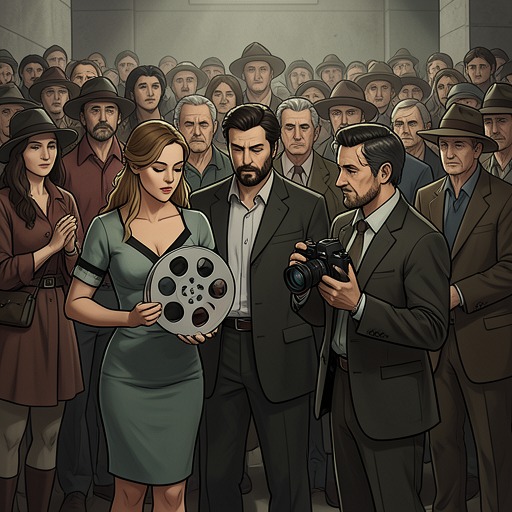
At Ditzah Pisk Feldman’s house, the archive occupied a workroom at the back of the property. A film-editing machine stood among scattered 16mm strips and wound reels; other footage was stored in metal cans. These materials were identified as the archives of 24fps, the old guerrilla film operation. They were not a polished or centralized collection: some had been transferred to videotape and copied elsewhere, while Ditzah retained the original films.
The archive also had a wider documentary afterlife. Prairie’s computer dossier on Frenesi Gates included material relating to 24fps among official records, FBI memoranda, defunct underground newspapers, and transcripts of Frenesi’s radio interviews on KPFK. That dossier was distinct from Ditzah’s reels, but it helped direct Prairie toward the collective’s images and gave her a second route into a past she had not witnessed.
The Collective’s Method
The films emerged from a mobile practice. 24fps members traveled around the country in an informal convoy of used sedans, vans, an equipment truck, and a damaged but fast Sting Ray used as a scout car. They kept in touch by CB radio, sought out disturbances, filmed them, and moved their documentary evidence to safety. The archive therefore records not only political scenes but a method of reaching, capturing, and circulating them.
Close-ups were central to that method. The filmmakers believed a face could disclose what power tried to conceal: its acts left traces in the expressions of people it had bought, threatened, or made to repeat evasive formulas. In footage from the San Joaquin Valley, an interviewer’s question cuts to a close-up of Frenesi. Her eyes fill the faded frame, and she answers that people have learned to pay attention. The image makes her claim concrete: the archive’s scrutiny turns the camera toward the people and performances through which authority presents itself.
Prairie’s Encounter with the Images
Prairie first approaches the materials through her mother’s dossier, which feels to her like an eccentric relative’s scrapbook assembled over years from uneven sources. Photographs retrieved from the computer show Frenesi at demonstrations, under arrest, and beside recognizable figures from the Movement, often with a camera. One image draws Prairie’s attention to her mother’s hand resting near the barrel of an assault rifle. The pictures make the political past startlingly intimate: this is the young woman who is also Prairie’s mother, rendered unfamiliar by old-fashioned hair, makeup, miniskirts, and bell-bottom trousers.
A separate photograph shows Frenesi walking with DL across what may be a university campus. Their long shadows fall over the grass; Frenesi turns toward her companion with a restrained smile while DL speaks. Prairie reads the scene’s calm as a moment outside political performance, a glimpse of the women together without the public masks the movement demanded. The image cannot tell her everything about their friendship, but it gives her a still point from which to imagine their shared life.
At Ditzah’s house, the reels extend that encounter from still image to moving record. Prairie watches footage of strikes, police confronting farmworkers and demonstrators, the clearing of a Texas commune, and raids on young people and animals. The images also catch fields, workers, campus grounds, and moments of beauty, but such intervals do not soften what the films show. Watching for hours, Prairie realizes that her mother was often the person behind the camera. She imagines absorbing Frenesi through the framing and the unsteady movement of the image, as if the projection allowed a limited visit with someone otherwise absent.
Political Pursuit and Archival Survival
The archive also preserves the collective’s pursuit of Brock Vond. 24fps followed his itinerant grand jury hearings in Oregon, where he was investigating alleged subversion at a small community college. Because Vond repeatedly changed the hearings’ location and time, the filmmakers tracked him from courthouse to motel, fairground exhibition hall, school auditorium, and drive-in arena, eventually encountering him again at the courthouse. Frenesi, filming allegorical murals of Justice and Progress, noticed his figure in the viewfinder and zoomed in to follow him. She had used a Canon Scoopic 16mm camera given to her by Sasha Gates; the footage was later projected on a sheet in a darkened motel room for the collective to watch.
The archive’s survival strategy was to make it less vulnerable to capture. The films were transferred to videotapes, and duplicate copies were distributed in several places to disperse the collection. Yet the originals left with Ditzah remained exposed. When DL and Takeshi returned to the neighborhood, they encountered a large security operation and a fire at Ditzah’s property. Film, plastic reels, and papers burned in piles outside the garage; workers swept fragments back into the flames, and nearby residents had shut themselves away. The destruction turns the archive’s earlier purpose inside out: evidence gathered to make hidden violence visible is itself made the target of a conspicuous show of force.
Significance
The 24fps Image Archive connects family memory to public evidence. Prairie’s understanding of Frenesi develops through photographs, documentary footage, and the fragments collected in the computer dossier; each medium offers access while also leaving gaps. The camera does not restore the past intact, but it lets Prairie see her mother acting within it, making choices about where to point the lens and what viewers should be made to confront.
The archive’s material history also contrasts two forms of power over information. Its members filmed faces and carried copies away in an effort to resist concealment; elsewhere, people disappear from computer records, and a telephone can be suspected of carrying a wiretap. Against such systems of monitoring and erasure, the reels offer a fragile counter-record: images copied and dispersed for safety, then threatened at the place where originals remained. Their value is inseparable from that fragility.