Frenesi Gates’s Computer Dossier
VinelandFrenesi Gates’s Computer Dossier is both an accumulated record of Frenesi’s past and the medium through which Prairie Wheeler begins to approach a mother she never knew in full. Kept in a computer archive at the Kunoichi Attentives Sisterhood Mountain Retreat, it offers Prairie evidence rather than a single family story: official documents, political ephemera, recordings, and photographs preserve fragments of Frenesi’s life, but also leave gaps that Prairie must confront rather than simply fill.
Identity and Compilation
The dossier belongs to the retreat’s computerized archive, which Sister Rochelle explains is maintained alongside subscriptions to outside information services. It contains a substantial file on Frenesi Gates, accumulated over many years from a variety of sources, often without a consistent order. Its contents make the file less like a finished biography than an irregular scrapbook assembled by an eccentric relative: administrative documents with stamps, seals, and reference numbers sit beside FBI memoranda marked in felt pen, clippings from underground newspapers that have since ceased publication, and transcripts of Frenesi’s radio interviews on KPFK.
Material relating to 24fps, the film collective Frenesi had worked with alongside DL, forms another important part of the record. The dossier therefore joins different kinds of evidence that were created for different purposes. Official papers classify and document; movement newspapers and radio interviews preserve public arguments and self-presentation; collective film material points toward a history recorded through images. The file’s unevenness is itself significant: Frenesi appears not through one authoritative account, but through layers of records made and retained by institutions, political communities, and media.
Prairie’s Encounter with the File
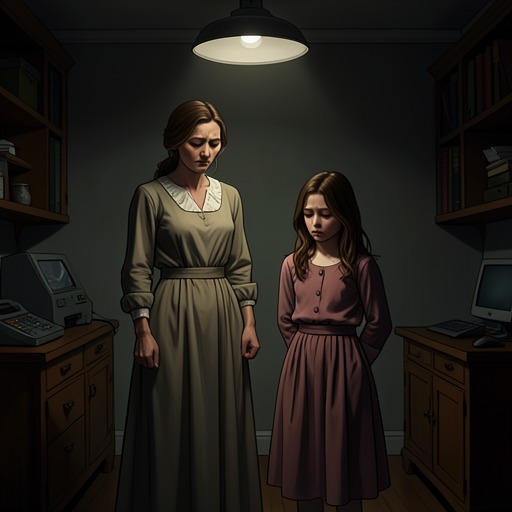
Prairie learns that the dossier exists while staying at the retreat. Her eagerness to know what it contains is personal, but gaining access is delayed until after dinner. Before she reaches the terminal room, she spends hours working in the kitchen and dining hall: serving food, clearing dishes, refilling coffee, and cleaning pots and floors. The contrast gives her later encounter with the file a concrete setting. It is not an abstract research project; it follows a stretch of communal labor and begins after the ordinary work of the day has been done.
Opening the dossier feels to Prairie like entering a haunted house, moving from one room to another under the guidance of her mother’s faint presence. She already knows that a computer’s apparent exactness can depend on minute details: even the spaces between characters matter. That precision makes the question of whether a ghost can be taken equally literally more difficult. The file may help the living summon a presence from records, but Prairie wonders whether the presence can think independently or only answer the needs that brought someone to the keyboard: grief, longing, and a sense of justice denied. The dossier does not settle the question. Its force lies in making archival access feel at once intimate and uncertain.
Photographs and a Recoverable Past
The archive allows Prairie to call up photographs of Frenesi, both personal images and pictures published in newspapers and magazines. In many, Frenesi carries a movie camera at demonstrations, is being arrested, or stands beside recognizable figures from the movement. One image shows her looking toward a riot-equipped police officer beside a wire fence, while her hand rests against the barrel of an assault rifle. Prairie recognizes the photographs as records of her mother, yet their dated clothes and political settings make Frenesi seem like a stranger: a young woman in miniskirts or bell-bottom trousers, belonging to a period Prairie has known mainly through television and old programs.
A separate snapshot shows Frenesi and DL walking together on what appears to be a university campus. Their long shadows fall across the grass; a footbridge, palm trees, stairs, a volleyball court, and windows establish the ordinary California setting around them. Frenesi turns toward DL with a restrained smile as DL speaks. Prairie reads the relaxed faces and unguarded movement as signs that, in this moment, the women are not performing political roles. The photograph preserves a quieter relation than the public images of protest and arrest, though Prairie can only infer what lies beyond the frame.
The two women remain available in the computer’s deep archive as scattered ones and zeroes, still recoverable in a definable space. The narration places the image within the history of their friendship: by the time of the photograph they have known one another for nearly a year, through mutual support, renegotiated promises, endured irritations, shortcuts, and experiences that exceed either woman’s certainty. Their meeting was not guaranteed to produce closeness; the turbulent period and Berkeley’s promise of action brought people together, but the photograph records a bond that had to develop. Prairie’s attention to the image turns archival viewing into an encounter with a relationship, not merely a way to identify faces.
Film as a Route into Frenesi’s Perspective
The dossier’s connection to 24fps leads Prairie beyond still photographs to reels of film. As the footage runs through the night, she sees strikes against strikebreakers, police lined along an artichoke-field fence, raids on a Texas commune, beatings, sexualized abuse of arrested women, children thrown aside, and animals killed. Other images show farmworkers at sunrise, the burning of marijuana crops, and school and university campuses converted into military parking areas. The recordings offer little comfort: occasional glimpses of a flowered lawn or a sunset do not cancel the violence the films insist must be seen.
Prairie gradually realizes that Frenesi was often the person behind the camera. By trying to keep her mind empty, Prairie feels able to absorb her mother’s presence and share her eyes: the choices of framing and approach, and the bodily fatigue, fear, or nausea that make the image tremble. She imagines the footage as a special kind of death in which visits remain possible, but limited and mediated by projector and screen. The camera grants access to Frenesi’s acts of looking without restoring an unmediated conversation with her. For Prairie, the archive is therefore both a passage toward her mother and a reminder that the available encounter is structured by machines and surviving records.
Electronic Survival and Exposure
The dossier’s promise of persistence sits within a wider world where computer records can also vanish. Frenesi hears that many familiar people have simply disappeared from a computer, and at a supermarket later recognizes the consequences of a political economy that may leave her and Flash unprotected. She imagines their fate being decided not by a visible blow but by keystrokes connected to chains of electronic presences and absences. In that vision, a person’s life and death can be rendered as data, while the human troubles that fill a life remain unseen by the system that records it. The dossier’s capacity to preserve Frenesi is thus inseparable from the possibility that records can determine who counts as present and who is erased.
The file’s fragility is echoed, but not identical, in the later raid on Ditzah Pisk’s home. DL and Takeshi return to find the 24fps archive being burned: film, reels, and papers are consumed in a deliberately imposing operation. That destruction concerns the collective’s physical archive, not the computer dossier Prairie consulted at the retreat. The distinction sharpens the stakes of both forms of preservation. A computer can keep images retrievable, but the larger history of surveillance and political power includes monitoring devices, databases, and the forcible destruction of records. Prairie’s dossier matters because it keeps fragments of Frenesi’s past available; it cannot guarantee that the evidence will remain whole, neutral, or beyond the reach of those who would control what can be remembered.