Hugh Quoil
WaldenHugh Quoil, known locally as Col. Quoil, was an Irish ditcher and the last inhabitant of Walden Woods before Henry David Thoreau. Thoreau never knew him as a neighbor: Quoil died shortly after Thoreau arrived. Instead, the narrator reconstructs him through rumor, recollection, and the remains of his house, making Quoil a sharply particular figure whose brief, painful life is preserved alongside a vanishing woodland past.
Identity and Background
Quoil occupied Wyman’s tenement in the woods. Local rumor held that he had been a soldier at Waterloo, though Thoreau presents this as hearsay rather than confirmed history. The name Col. Quoil gave the story an air of rank, while the practical work he did in the neighborhood was ditching. Thoreau imagines that, had Quoil lived, he might have heard him recount his battles; the imagined conversation marks both the attraction of Quoil’s rumored past and the distance that death placed between them.
The contrast between Napoleon’s exile to St. Helena and Quoil’s arrival in Walden Woods compresses a grand European history into the fate of a solitary local laborer. Quoil’s life in the woods is not narrated as a sequence of exploits. What remains is an abrupt, bodily record: a man reputed to have seen the world, now remembered through his manners, his illness, and the neglected place where he lived.
Illness and Death
Thoreau recalls Quoil as a man of manners, with the kind of polished, civil speech that seemed to exceed what listeners could comfortably attend to. That worldly bearing stands in stark contrast to his condition: he wore a greatcoat in midsummer, suffered from what the account calls trembling delirium, and had a carmine-colored face. The description is concrete but fragmentary; it conveys severe illness without offering a diagnosis or fuller account of its cause.
Quoil died on the road at the foot of Brister’s Hill shortly after Thoreau came to the woods. The timing explains why Thoreau says he did not remember him as a neighbor. Quoil belongs instead to the woods’ immediately preceding human history, known indirectly by a newcomer who arrived too late to meet him. His death on the road gives the remembered life a stark ending, but the account does not supply a witness, a final exchange, or further circumstances.
The House and Its Remains
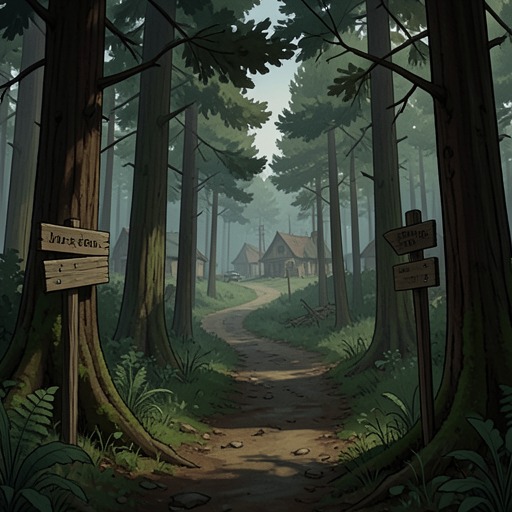
Before Quoil’s house was pulled down, Thoreau visited it. His comrades avoided the building as an unlucky castle, a local reputation that makes the dwelling seem charged with misfortune without establishing anything supernatural. Inside, Quoil’s old clothes lay curled by use, as if they were still his body. The simile turns ordinary garments into a residual presence: the absent man appears through the shapes left behind in his rooms.
The house also held evidence of work interrupted by illness. At the rear was the dim outline of a garden, planted but never given its first hoeing. Although it was harvest time, shaking fits had prevented Quoil from tending it; Roman wormwood and beggar-ticks had overrun the plot, and the latter clung to Thoreau’s clothes as its only fruit. A woodchuck skin, freshly stretched across the back of the house, remained as a trophy from Quoil’s last hunt. The unfinished garden and the hunting trophy preserve different kinds of labor, but together they make the dwelling legible as a life that could not continue its ordinary tasks.
No warm cap or mittens would be needed by Quoil again. The observation draws attention from household possessions to the finality of his absence, without claiming to know what he felt or what he expected. In time, only a dent in the earth marked the site of the dwellings, with cellar stones buried below and berries growing there. The house’s disappearance converted a lived-in place into a subtle mark in the ground, while vegetation occupied the site of domestic life.
Memory and the Changing Woods
Quoil’s story forms part of a larger recollection of people who had lived in the woods before Thoreau. Within the memory of many townsmen, the road near his house had once echoed with the laughter and gossip of inhabitants. Quoil is one named figure within that remembered community, but his particular traces are unusually intimate: clothing, an unworked garden, and the skin of an animal. The narrative sets collective recollection beside the physical remnants that make one person’s absence palpable.
The woods themselves did not remain as Thoreau had known them. After he left those shores, woodchoppers further laid them waste; trunks on the pond bottom, an old log canoe, and the dark surrounding woods were gone. The loss meant that there would no longer be rambling through wooded aisles with occasional views of the water. In that altered landscape, Quoil’s vanished dwelling is not an isolated ruin but one layer in an ongoing history of settlement, disappearance, and clearance. His story ends without a surviving house or a firsthand relationship to the narrator: what endures is the brief testimony of memory, the ground’s small depression, and the contrast between a once-inhabited wood and the landscape left after its trees were cut.