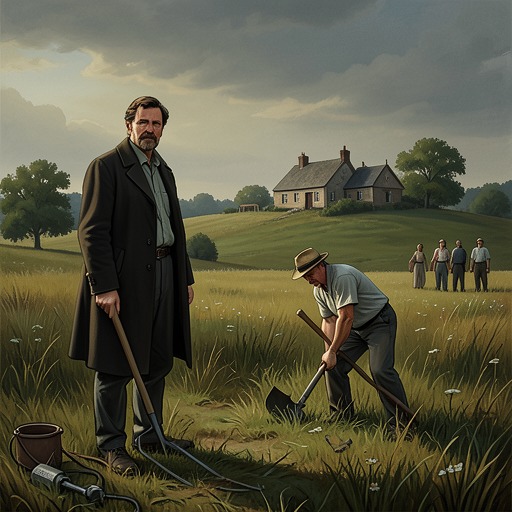
John Field
WaldenJohn Field is an Irish laborer whose encounter with the narrator turns an argument about poverty and simplicity into a particular, unresolved human scene. He works hard to support his wife and children, yet the narrator sees his labor and household as evidence that conventional striving can consume life without securing freedom. The episode’s force lies also in its limit: advice about living simply cannot by itself remove the inherited poverty and material constraints that shape Field’s choices.
Identity and Circumstances
Field lives in a small cabin with his wife and several children. The narrator’s account introduces the family through the children, from the broad-faced boy who helps his father at work to the younger members of the household. The boy’s cheerful assistance makes the family’s labor visible as something shared across generations, while the narrator’s attention to their domestic life places Field within the poor households whose condition the book asks readers to consider.
Field’s work is physically demanding and poorly rewarded. He tells the narrator that he has been “bogging” for a neighboring farmer, turning meadow with a spade or bog hoe. The arrangement pays ten dollars an acre and provides the use of the land, with manure, for one year. His little son works cheerfully beside him without understanding how poor a bargain his father has made. The terms suggest that effort alone does not guarantee a secure return: Field’s labor is tied to a temporary use of land and a payment the narrator considers inadequate.
The Visit and Its Advice
The narrator visits Field and speaks with him as if he were a philosopher, or wished to become one. This manner is part of the encounter’s design: instead of treating Field only as an object of pity, the narrator addresses him as someone capable of considering a different way to live. He presents his own life as a comparison, explaining that he too can appear idle while fishing, although he does not regard the appearance of idleness as proof of failure.
The narrator’s advice challenges the assumption that a household must keep working to acquire the ordinary comforts expected of it. He imagines Field and his family living simply enough to spend summer days huckleberrying for amusement. Field responds with a sigh; his wife stares with her arms akimbo, and the couple seem to wonder whether they have enough capital even to begin such a course. Their reaction gives the proposal a concrete economic edge. A life of leisure may appear available in principle, but the question of how a poor family could afford to choose it is not answered by the ideal itself.
Work, Poverty, and Social Position
Field’s circumstances connect the personal episode to the book’s broader criticism of economic life in Concord. The narrator contrasts well-off farmers, many of whom have spent twenty, thirty, or forty years laboring, with poor people whose outward circumstances may be worse than those of people living outside civilization. He points to shanties along the railroads as visible evidence of degraded poverty. Field’s cabin and his bargain for meadow work belong to this wider picture: poverty is not an abstraction but a condition expressed in housing, work, family dependence, and limited options.
That broader argument does not make Field’s individuality disappear, but it does reveal the narrator’s interpretive distance. Field is seen chiefly through the terms of labor, bargain, inherited condition, and the possibility of a simpler life. The narrator’s imaginative language describes him as a poor man born to be poor, with inherited Irish poverty and old-country ways. This framing emphasizes how deeply deprivation can shape a life, while also risking a fatalism that reduces a particular person to his origins. The encounter’s tension comes from holding both perceptions in view: Field faces material limits, and the narrator believes those limits are reinforced by habits and social expectations that might be questioned.
A Brief Reversal, Not a Resolution
As the narrator heads toward the pond, a fresh impulse brings Field out after him. Before sunset, Field has let go of bogging and comes to fish. The moment is a small reversal in the episode: the laborer who had seemed bound to exhausting work briefly turns toward recreation. Yet the narrator reports that Field disturbs only a couple of fins, and the scene does not claim that fishing has made him prosperous or that his family has adopted the proposed way of life.
The narrator’s account returns to the material and historical weight of Field’s position. Field fishes with shiners for perch, a practice the narrator associates with inherited old-country habits. He describes Field’s horizon as his own, yet still calls him poor and links that poverty to a life shaped by inheritance. The result is not a simple conversion story. Field’s appearance by the pond makes a moment of choice imaginable, but it leaves the conditions that constrain that choice in place.
Narrative Significance
Field gives the narrator’s celebration of voluntary simplicity a demanding test. The narrator can present his own fishing and modest needs as a route away from unnecessary labor; Field’s family, however, must reckon with work, a poor bargain, and the resources required even to begin living differently. Their exchange therefore complicates any easy claim that freedom follows merely from choosing fewer comforts. It asks whether an ideal of simplicity can speak equally to someone whose poverty is not voluntary.
The episode also belongs to the book’s recurring attention to people who live at the margins of conventional prosperity. Field is not developed through a long personal history or a resolved plot arc; instead, his brief visit and response become the means by which the narrator tests his social critique against a neighbor’s immediate circumstances. His sigh, his wife’s questioning posture, and his return to the pond keep the argument grounded in gestures rather than allowing it to remain a purely abstract doctrine.