Mowry's Escape from a Jaimec Security Police Street Search
WaspMowry's Escape from a Jaimec Security Police Street Search is an episode of improvisational evasion: confronted by a police cordon and Kaitempi agents, Mowry performs authority, keeps moving, and then diverts the chase onto someone else. The danger is real, but so is the scene's darkly comic turn: while others run from the police, Mowry enters a shop and places an order for cakes.
The Trap and the Cover
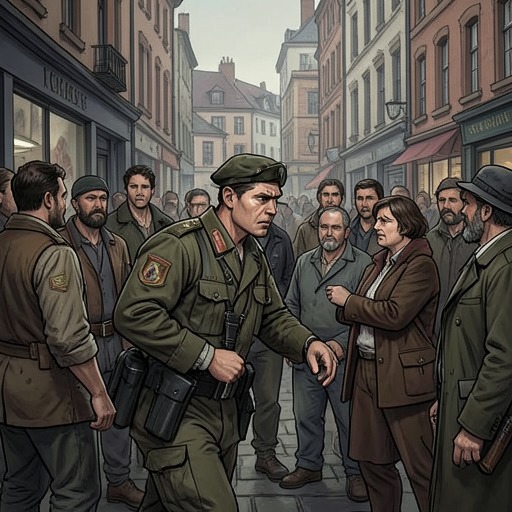
The episode opens with Mowry exposed, standing with his arms extended above his head as a sudden rush of thoughts passes through his mind. The scene describes the trap as having sprung again. A second line of people watches with apparent indifference, sharpening the sense that he has been caught in a public, already familiar machinery of inspection rather than a private confrontation.
Even in this moment, his thoughts turn to the consequences of losing contact with Terra: if no more signals come from him, William Wolf will select a successor and send that person into the same work. The thought places this search within a continuing operation, not an isolated personal escape. His vulnerability is immediate, but the work he has undertaken is designed to persist beyond him.
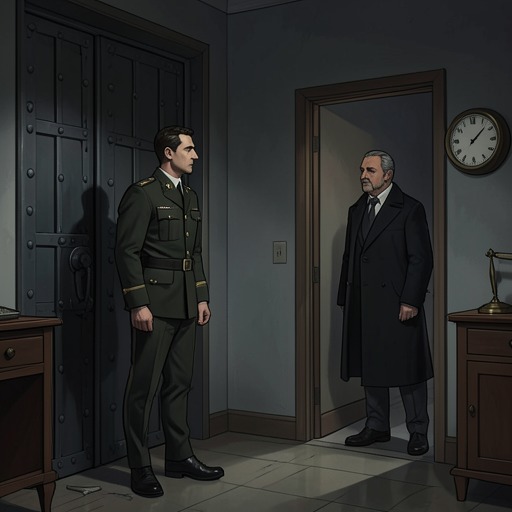
The searchers' attention shifts when a Kaitempi agent opens Mowry's wallet and notices Pigface's card inside. The agent's tough expression fades into surprise. Mowry seizes that hesitation and supplies an explanation: he claims to be an officer, newly arrived that day from headquarters on Diracta, and affects indignation at the reception he has received. The card gives his performance a prop; his practiced arrogance gives the agent a reason to treat the claim as plausible. The scene does not establish that the cover is accepted as genuine, but it shows Mowry using the brief uncertainty to regain room to move.
A Walk Becomes a Pursuit
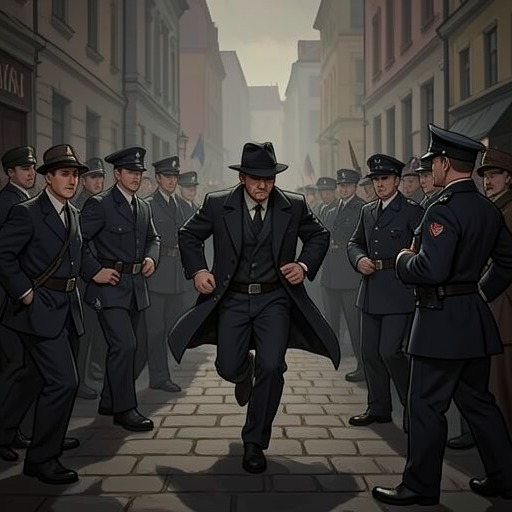
Mowry continues steadily, outwardly nonchalant. He gets six hundred yards and reaches the next corner before looking back. Police still block the road, while four Kaitempi agents beyond them confer. Their argument lasts about ten seconds; then someone orders them to stop him. The delay matters: Mowry has not simply outrun an immediate grasp. He has kept moving while the authorities decide what to make of him, and the command to stop him transforms that uncertainty into an open chase.
The scene does not spell out what the agents have concluded or why they issue the order at that precise moment. Instead, it makes the change visible through action: a discussion ends, a command is shouted, and the police turn toward a fleeing quarry. That abrupt shift is the episode's central reversal. Mowry has been the object of scrutiny; now he has only moments to make himself less conspicuous than the person being pursued.
Passing the Danger On
As people race with the police without knowing who is being chased or why, Mowry overtakes a youth strolling along and gives him an urgent shove in the back. He warns the youth that the Kaitempi are after him. The warning redirects the chase toward someone who had been sauntering without apparent concern, while the crowd's movement helps make the pursuit harder to read. Mowry's escape depends not on disappearing instantly, but on causing other people to misunderstand who the quarry is.
The action is both ruthless and resourceful. The youth becomes the focus of danger without any evidence that he was involved in Mowry's predicament; the narrative presents the shove as Mowry's expedient response to being pursued, not as a justified accusation. In a few seconds, a fabricated warning changes the direction of attention. The sudden pursuit also makes the surrounding crowd part of the confusion: they run along without knowing the reason for the chase.
An Ordinary Order in Wartime
Mowry enters an adjacent shop unhurriedly, looks around to see what it sells, and casually asks for ten small cakes topped with toasted nuts. The deliberate contrast with the chase makes his composure part of the evasion. The shop order is precise and mundane; it places him, at least outwardly, among customers rather than fugitives. The scene shows him inside the shop, but does not describe what happens to the youth or establish the precise moment at which the authorities abandon the pursuit.
Fatty, observing the commotion, concludes that the police are after someone and reflects on how constantly somebody is being pursued. His weary response enlarges the episode beyond Mowry's immediate trick: pursuit has become an everyday feature of a society at war. Against that background, Mowry's sudden diversion is not a resolution of the wider danger. It is a small, opportunistic escape from one search, achieved by turning official attention toward another person and resuming the appearance of ordinary life.