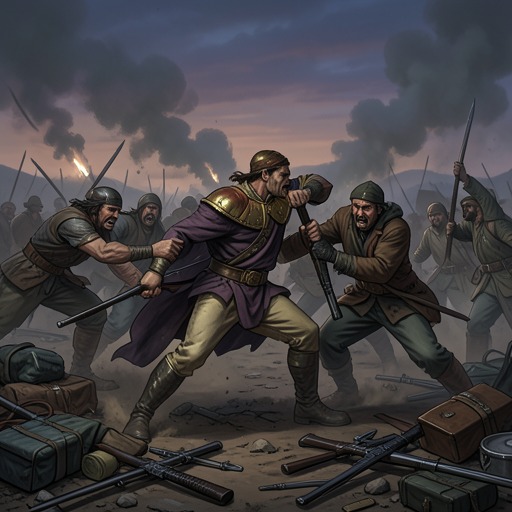
“Freedom or death”
WatchmenThe expression “Freedom or death” is the sharpest formulation of the Shinarian rebels’ refusal to exchange one form of domination for another. Spoken by Tarat during a debate with Merdon and Romal, it turns an uncertain political calculation into a declaration that freedom is worth risking life itself.
Political Context and Immediate Choice
The phrase arises after Merdon asks whether the Shinarian people, if given the possibility of independence, should fight for freedom or remain under the Empire. The question is deliberately practical as well as ideological: the alternatives are not simply victory and defeat, but the uncertain burden of self-rule on one side and continued imperial authority on the other. Romal has already made clear that life under the Komani is unacceptable, while the surrounding conflict has placed Shinar between competing powers.
Tarat answers without qualification. His “Freedom!” is not presented as a careful policy recommendation but as an immediate verbal commitment, followed by “Freedom or death.” The sentence compresses the entire dilemma into two mutually exclusive outcomes. It rejects both submission to the Komani and passive dependence upon the Empire, insisting that the value of freedom cannot be measured only by safety or material survival.
The Expression as an Act of Commitment
“Freedom or death” functions as more than a description of the rebels’ circumstances. Tarat uses it to commit himself and his companions to a course of action. The words give the group’s resistance a boundary: once they have begun fighting, returning is no longer treated as a neutral reconsideration but as a reversal of the purpose for which they have already sacrificed.
Merdon immediately agrees with Tarat, even while the discussion continues. His response shows that the slogan does not end the political problem; rather, it supplies the emotional and moral force needed to keep confronting it. The expression changes the value at stake from a contest over administration to a test of dignity. Its power lies in the fact that it names the cost plainly instead of disguising danger behind strategic language.
Freedom Against Submission
The phrase also establishes a three-sided contrast among the available futures. Romal refuses Komani rule; Merdon raises the possibility of remaining under the Empire; Tarat refuses to accept either condition as the final answer. His declaration therefore defines freedom negatively as well as positively. It means not living under the Komani, but it also means refusing to let fear of conflict make imperial rule appear automatically preferable.
That contrast gives the expression its existential intensity. Tarat does not claim that death is desirable or that the rebels are certain to win. He asserts instead that a life stripped of political freedom would fail to satisfy the standard by which the rebels judge their own existence. The expression presents mortality as the unavoidable measure of a decision already made under historical pressure: the rebels must choose whether to risk death openly or survive by abandoning their claim.
Narrative and Thematic Significance
Within the scene, “Freedom or death” is a value shift from hesitation toward resolve. Merdon’s question leaves the future open, but Tarat’s answer closes the space for comfortable compromise. The phrase supplies the rebellion with a memorable verbal emblem, one that can be repeated because it is brief, balanced, and absolute. Its structure makes the political conflict legible as a moral ultimatum.
At the same time, the expression reveals the cost of revolutionary certainty. By joining freedom to death, Tarat makes continued resistance appear authentic only when it accepts the possibility of destruction. The slogan is powerful because it refuses euphemism; it is dangerous because it leaves little room for gradualism, compromise, or a definition of freedom that might be pursued without immediate total sacrifice. In the exchange with Merdon and Romal, however, that severity is precisely its purpose: after the Shinarian struggle has gone too far to be casually abandoned, “Freedom or death” gives its participants the language with which to recognize what their choice demands.