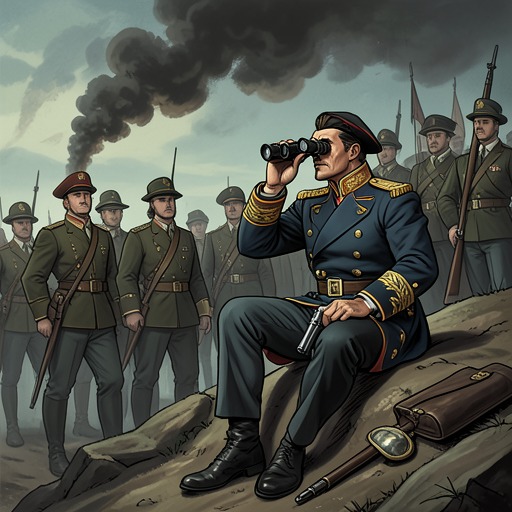
“Poles apart”
Watchmen“Poles apart” names the enduring antagonism between Brigadier Aikens and Emil Vorgens at the moment when military necessity forces them to work together. Aikens uses the expression to acknowledge that cooperation can exist without trust, affection, or agreement: the two men can serve the same operation while remaining separated by incompatible ideas of authority, responsibility, and command.
Immediate Context
The phrase arises after Emil Vorgens has taken command of the Mobile Force because he represents the authority of Star Watch Headquarters and because Aikens had refused to follow the policies expressed through Vorgens’s orders. Vorgens openly admits that his training as a Star Watch officer cannot equal Aikens’s experience as a field commander. He explains that he assumed command only because it was the sole means of getting the Force out of the Komani trap, while also conceding that the wider planetary action requires an experienced commander.
Vorgens therefore offers Aikens a carefully limited restoration of power. Aikens may resume tactical command of the Mobile Force, but only under Vorgens’s authority; Vorgens retains strategic control over all Terran forces on Shinar until a higher-ranking Watchman arrives. The offer is not a surrender of command but an attempt to separate tactical competence from strategic jurisdiction.
A Conditional Reconciliation
Aikens initially interprets Vorgens’s proposal as proof that the younger officer lacks the backbone required for responsibility. He expects command to be returned to him and presents the transfer as Vorgens’s inevitable retreat. Vorgens’s response reverses that expectation: he is not abandoning authority, but defining its limits and placing Aikens beneath it.
The distinction enrages Aikens. His face reddens, his anger appears to catch in his throat, and he nearly rises from the bunk before sitting down again. Vorgens then makes the pressure explicit: if Aikens refuses, the position will go to the executive officer instead. The choice is thus formally voluntary but practically constrained by the danger facing the Mobile Force and by Aikens’s professional obligation to the men.
Aikens finally accepts, declaring that he will pull Vorgens’s “little carcass” out of the fire and later call for a court-martial. Vorgens answers that a court of inquiry may indeed be necessary to settle their differences, but asks that both men rise above their personal feelings for the moment. Their agreement is consequently operational rather than personal. It restores a functional chain of action without removing the conflict that produced the crisis.
Meaning in Dialogue
Aikens introduces the expression after identifying himself as a soldier who can suppress his feelings for the good of his men. His statement gives “Poles apart” a double force. On the surface, it recognizes a difference in temperament and outlook; within the scene, it also marks the limits of the compromise just achieved. Aikens can discipline his resentment, but he does not relinquish it. He can obey the necessities of the campaign, but he does not accept Vorgens as an equal partner in judgment.
The image of opposite poles turns their disagreement into a structural distance rather than a temporary quarrel. Aikens is the seasoned field commander who values direct military experience and resents authority imposed from above. Vorgens is the Star Watch officer who assumes responsibility for the whole Terran operation and insists that tactical expertise does not erase strategic jurisdiction. Their conflict is therefore not simply generational or personal; it is built into the competing systems they represent.
The wording also creates an irony. The men are separated as completely as the expression suggests, yet they are physically and politically bound to the same Mobile Force, the same emergency, and the same campaign on Shinar. The farther apart their principles appear, the more necessary their temporary coordination becomes. “Poles apart” consequently describes both their incompatibility and the tense proximity imposed by war.
Aftermath and Narrative Function
After Aikens accepts the arrangement, Vorgens returns silently to the dreadnaught’s control center. His face remains immobile, but he feels empty and drained of emotion. That withdrawal gives the expression a final emotional resonance: the agreement has solved an immediate command problem while exhausting the officer who engineered it. The scene does not end in mutual understanding, but in controlled separation.
“Poles apart” therefore functions as a compact verbal emblem of divided authority. It anticipates continued friction even after the Mobile Force has regained an experienced tactical commander, because the underlying dispute over who has the right to decide has not disappeared. The phrase holds together the scene’s central paradox: for the good of the men, Aikens and Vorgens must act together precisely while acknowledging that they remain fundamentally opposed.