“The future is no more inevitable than the past”
Watchmen“The future is no more inevitable than the past” expresses the governing idea of Ben Bova’s reflection on the two future-oriented tales collected in The Dueling Machine. Its decisive significance lies in turning science fiction from passive prediction into an instrument of responsibility: possible futures are presented so that readers can judge among them and help bring about the one they would rather inhabit.
A Rejection of Historical Inevitability
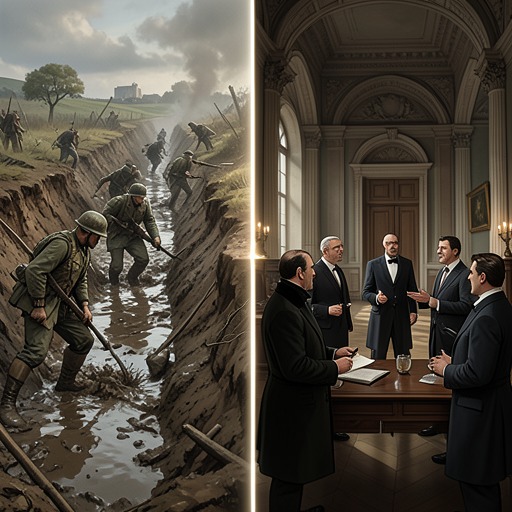
The expression appears in a discussion of war, especially the question of whether World War II was unavoidable. Bova frames the issue through a speculative contrast between Winston Churchill, described as a determined wartime leader, and Neville Chamberlain, described as pacifistic. The contrast does not establish a single guaranteed alternative history; instead, it exposes how political decisions can redirect events that later appear inevitable in retrospect.
Bova explicitly rejects the belief that any event in human history was inevitable. The claim therefore applies not only to the outbreak of World War II but to history as a whole. The past may look fixed because it has already happened, yet its apparent necessity is an effect of hindsight rather than proof that no other path existed.
Science Fiction as Decision-Making
The expression explains why Bova believes readers turn to science fiction. By looking forward into possible futures, people can begin deciding which futures they would like to live in. Speculation thus becomes a practical form of civic and moral thought: imagined outcomes provide a field in which present choices can be tested before their consequences arrive.
The formulation also assigns agency to both action and inaction. The future is created by what people do in the present and by what they fail to do. That addition prevents the idea from becoming a simple celebration of individual freedom. Responsibility includes neglected opportunities, delayed decisions, and the consequences of refusing to intervene.
Relation to the Collected Tales
Bova introduces the books as two tales of the future written thirty years earlier, while maintaining that they still have something to say to contemporary readers. Their continued relevance follows from the expression’s refusal to date political and technological speculation into mere prediction. The imagined futures remain useful because the choices that produce them belong to recurring human situations rather than to one historical moment alone.
The phrase also links entertainment with warning. Bova hopes the tales remain as entertaining as when they were first written, but their entertainment value does not cancel their argumentative purpose. Their fictional futures are occasions for recognition: readers are invited to notice what kinds of present conduct would make those futures more or less likely.
Ethical and Thematic Significance
As an expression, “The future is no more inevitable than the past” condenses a philosophy of historical agency. It denies fatalism without promising control over every consequence. Human beings cannot determine the future with certainty, but they participate in making it through choices made now, including choices made by governments and societies confronting war.
The statement’s deepest force comes from its double temporal movement. It asks readers to reconsider the past by imagining that it might have unfolded differently, then sends that insight forward as a warning about the present. If history was not predetermined, neither is the future. What seems inevitable may instead be the accumulated result of decisions that can still be changed—or failures to make decisions before alternatives disappear.