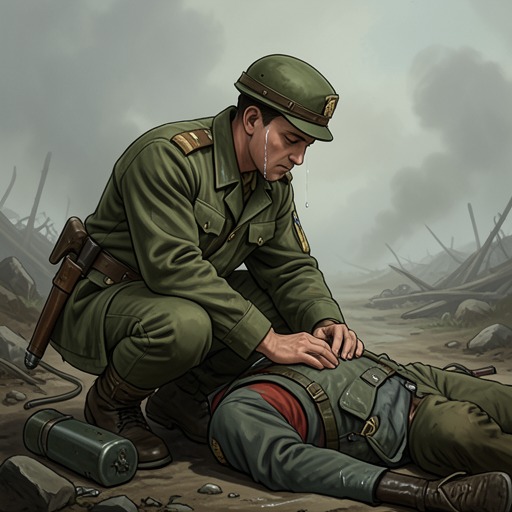
“They have souls”
Watchmen“They have souls” is Sittas’s decisive answer to the moral blindness of war. When Emil Vorgens sees a native priest accompanying the Komani raiders, he initially treats the association as a contradiction: the raiders are looting Sittas’s people and turning Shinar into a battlefield, yet Sittas remains with them. The priest’s brief declaration refuses to let violence erase the humanity of those who commit it, and it becomes the phrase through which Vorgens begins to recognize the enemy as fully human.
Identity and Immediate Context
Sittas is a priest of Shinar who travels with a Komani raiding group. His presence unsettles Vorgens because the Komani are attacking their own planet, making Sittas appear to stand beside the destruction of his people. The priest does not deny the looting or the battlefield around them. Instead, he answers the assumption that the raiders are beyond moral consideration with the compact explanation, “They have souls. I am a priest.” The two clauses connect his profession directly to his conduct: accompanying the raiders is not presented as approval of their violence, but as a refusal to abandon their humanity.
The phrase also establishes Sittas as a figure who can hold opposing truths together. The Komani are raiders, and their actions cause real devastation; they are nevertheless persons rather than monsters. Sittas’s religious identity gives the statement ethical force, but its language is notably plain. He does not argue through doctrine or political allegiance. He identifies an interior human value that remains present even in people acting destructively.
Challenge to Wartime Hatred
Vorgens responds that the Komani are looting their own people and turning Shinar into a battlefield. Sittas answers with a sequence of questions: whether such conduct makes them impossible to change, whether it condemns both sides to everlasting hatred, and whether the Komani of that clan could not again live in peace with the Terrans, as they had once been allies. These questions shift the issue from the raiders’ present crimes to the possibility of moral and political transformation. The enemy’s current behavior is treated as grave but not eternally defining.
The reference to the earlier alliance of the entire Komani nation with the Terrans complicates the apparent permanence of the conflict. Vorgens acknowledges that the alliance belonged to the Galactic War a century earlier, and his hesitation marks the distance between remembered cooperation and present killing. Sittas refuses to let that historical distance become proof that reconciliation is impossible. “They have souls” therefore carries an argument about time as well as morality: people and nations can become enemies, but their capacity to change need not disappear.
Effect on Emil Vorgens
The conversation changes Vorgens’s understanding of the people he has fought. After hearing Sittas, he realizes that the Komani warriors are sons and fathers who fear death as much as anyone. The recognition is not sentimental absolution. Vorgens does not forget that they attacked, that weapons were fired, or that men died. Instead, the human cost of the battle becomes harder to divide into “our” dead and an impersonal enemy.
That recognition returns to him during the funeral rites in the Komani camp. He hears women singing a slow, melancholy dirge for the men killed that day, including those killed by his own side. The campfire becomes a funeral pyre, and as it burns down, the phrase “They have souls” reappears in his mind alongside the memory of charging warriors, shouted orders, weapon blasts, and screams. Sittas’s words thus move from conversation into witness: the living voices and funeral fire provide concrete evidence of the grief and mortality that the battlefield had concealed.
The effect is also personal. Vorgens, who has spent years without speaking openly about his homeworld, finds himself telling Sittas many things as they walk through the afternoon beneath the cool trees along the nameless ridge. Their exchange creates an unexpected kinship between a young Star Watchman and an old priest caught on the opposite side of a war. Vorgens privately concludes that they may be the only sane men on Shinar, a judgment that reveals both his growing trust in Sittas and his alienation from the surrounding cycle of violence.
Ethical and Narrative Significance
As an expression, “They have souls” condenses the passage’s central ethical reversal. The Komani first appear to Vorgens through the visual and auditory grammar of combat: charging warriors, orders, weapons, and screams. Sittas’s sentence supplies a different grammar, one based on interior life and relation. Its meaning is then confirmed not by abstract proof but by the camp’s mourning women, the dead men remembered in song, and Vorgens’s realization that the fighters had families and feared death.
The phrase does not erase responsibility. Sittas’s questions specifically acknowledge killing, looting, and the transformation of Shinar into a battlefield. Its force lies in denying the conclusion that responsibility requires permanent dehumanization. By insisting that the Komani possess souls, Sittas opposes everlasting hatred and preserves the possibility of peace. For Vorgens, the expression becomes an anagnorisis: he recognizes that the people he has been trained to confront as enemies share the vulnerabilities that make his own side human. The sentence therefore marks the passage from military perception to moral vision, and from battlefield separation toward the difficult possibility of reconciliation.