Shinar
WatchmenShinar, identified in Imperial records as Oran VI, is the frontier world on which the novel’s central conflict over occupation, rebellion, alliance, and political legitimacy unfolds. It is not merely a setting for military action: its native name, colonial past, and competing authorities give material shape to the question of who has the right to rule.
Planetary Identity and Imperial Status
Shinar is one of eight planets orbiting the star Oran, located in a distant spiral arm of the Milky Way near the territory of the Komani nation. Imperial records describe Oran VI as a terrestrial planet with a radius of 1.04, a density of 0.91, and gravity of 1.025; its atmosphere is virtually Earth-normal, deviating by only 0.004. Three major continents divide a world whose surface is 80 percent sea, while its estimated native human population numbers 3.4 billion.
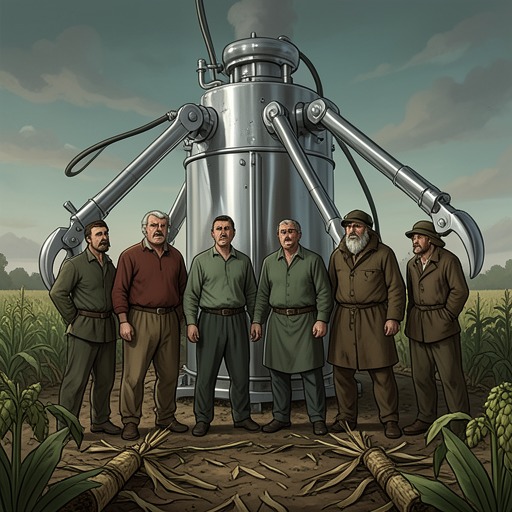
The planet’s economy is primarily rural and agricultural, with an underdeveloped industrial base. These classifications place Shinar under Imperial Development Plan 400R, with priority 3C. The bureaucratic language reduces a populated homeland to coordinates, production levels, and a development category, establishing the administrative perspective through which the Terran Empire initially understands the planet.
Shinar was formerly a colony of the Masters and was incorporated into the Terran Empire immediately after the Galactic War of the previous century. Its dual designation is therefore politically charged: Oran VI is the name of imperial administration, whereas Shinar is the native name that asserts the planet’s prior identity. The contrast turns nomenclature into a quiet struggle over historical ownership and political recognition.
The World as a Theater of War
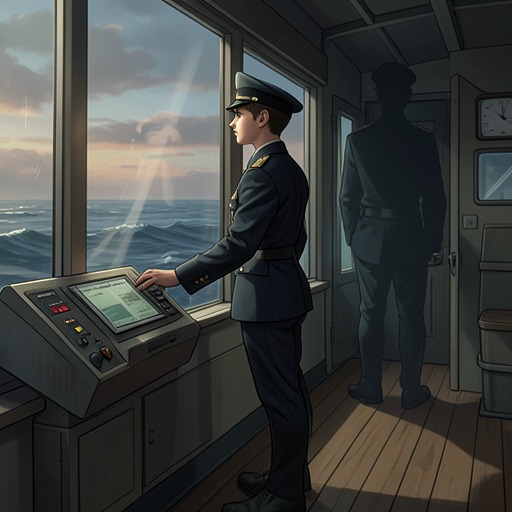
The Star Watch operates from Mars, while the Empire’s authority extends across half the Milky Way and maintains bases throughout its immense domain. Shinar lies at that domain’s edge, close to Komani territory, and its frontier position makes it vulnerable to both imperial neglect and external intervention. The Star Watch’s instructions to Emil Vorgens initially frame the crisis as a problem of Komani raiding: he is ordered to negotiate with the Komani chief, demand that the raiders return home, and invoke the Komani chieftains’ sworn loyalty to the Terran Council.
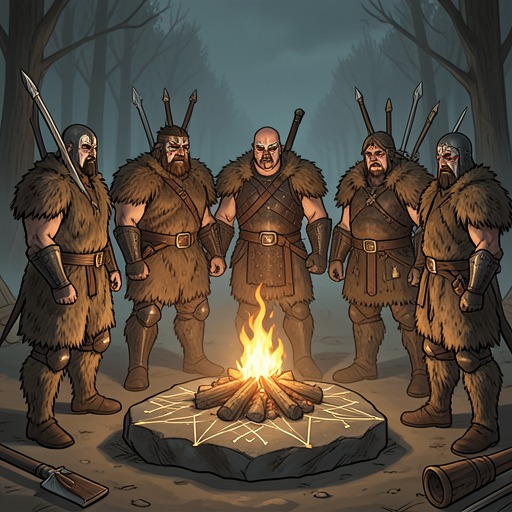
That interpretation collapses when Merdon explains that the Komani are in Shinar because the Shinarians invited them. They are described not as an invading force acting independently, but as guests and allies assisting the Shinarian fight against the Terrans. The revelation changes the meaning of the war. Imperial forces have treated the conflict as an attack on Imperial territory, while the local rebels understand it as a struggle in which an outside people has been enlisted to resist imperial control.
The planet’s countryside becomes an active military space rather than a passive backdrop. During the four days required to arrange a conference, the Mobile Force spreads across the countryside like a moving cloud of giant insects, covers more than three hundred miles, and fights six skirmishes with Komani attackers. One clash involves a full Komani battalion attacking a temporarily disabled light cruiser and two repair vans at dawn, with a broad, swift-running river and thick woods separating the isolated Terran units from the rest of the formation. Shinar’s terrain thus repeatedly shapes military vulnerability, movement, and communication.
Political and Legal Contestation
Shinar is governed simultaneously through several incompatible claims of authority. The Terran Empire invokes imperial jurisdiction, military orders, and the Star Watch’s chain of command. The Komani invoke their own customs and the authority of Okatar Kang. Shinarian rebels claim the right to choose their allies and resist a power that calls its occupation development. Religious sanctuary also becomes politically meaningful when Sittas refuses a Komani officer’s attempt, in Okatar Kang’s name, to claim Terrans sheltered as prisoners.
The conflict is especially stark in the treatment of prisoners. Okatar Kang tells Vorgens that he is the Terran prisoner who attempted to escape and declares that prisoners who reject Komani hospitality are traditionally executed. The statement places local custom against imperial assumptions about military custody, while the word “hospitality” itself becomes an unstable legal category: a guest who violates the host’s terms may be treated as a criminal, even when the guest believes himself to be a captive.
Sittas’s later defense of the sheltered Terrans demonstrates that Shinar’s political order cannot be reduced to a simple division between imperial soldiers and rebels. He resists the Komani claim in the name of the sanctuary he has extended, and Vorgens later acknowledges that Sittas helped save the lives of the entire Mobile Force. Sittas admits that he had taken authority into his own hands and that a future Star Watch court might judge whether he had the right to do so. Shinar therefore becomes a place where emergency action exposes the gap between formal jurisdiction and practical moral responsibility.
A Network of Imperial and Technological Power
Shinar is connected to the Empire through military databases, communications systems, development plans, and mobile forces. The first administrative response to the crisis is a request for the complete file on Oran VI from the Star Watch’s master computer. That act of retrieval turns the planet into an object of centralized knowledge before its people have spoken in the narrative. The resulting file contains physical measurements, population estimates, economic classifications, and colonial history, but not the political meaning of the name Shinar or the desires of its inhabitants.
The planet’s conflict also belongs to a wider technological system. Elsewhere in the narrative, the dueling machine projects thought patterns, personality, weapons, protective equipment, and environments into a shared experience. Its revised circuits psychonically isolate duelists from the outside world and record the entire duel so that a chief meditech can review possible rule violations. These developments are not located on Shinar itself, but they illuminate the novel’s broader treatment of power: machines redistribute agency among soldiers, scientists, bureaucrats, medical authorities, and the public. The same civilization that classifies Shinar through a computer also seeks to regulate violence through technical mediation.
Shinar’s military landscape and the later experimental environments of the dueling machine stand in productive contrast. The planet contains real rivers, forests, cities, armies, prisoners, and casualties, whereas the machine can reproduce jungles, cities, glaciers, and interplanetary voids without moving its users from their booths. Yet both spaces test the boundaries of control. On Shinar, imperial authority cannot fully command the people or terrain; in the machine, technical safeguards attempt to make violence controllable by isolating participants, monitoring conduct, and measuring power.
Narrative Significance and Transformation
Shinar’s decisive function is to convert an apparently straightforward imperial security operation into a crisis of political interpretation. At first, the Empire sees a frontier planet endangered by Komani raiders and sends Vorgens to negotiate according to explicit imperial instructions. The discovery that Shinarian rebels invited the Komani overturns that account and reveals the planet as an active political subject rather than a territorial possession caught between larger powers.
The repeated contrast between Oran VI and Shinar preserves two views of the same world. Oran VI is a coordinate, a set of planetary statistics, a development priority, and a jurisdictional unit. Shinar is a homeland whose inhabitants can invite allies, shelter enemies of the Empire, and contest the meaning of loyalty. The planet’s importance lies in the pressure between those descriptions: the Empire’s administrative map claims to make Shinar legible, while the rebellion demonstrates that legibility does not produce consent.
By concentrating military movement, diplomatic negotiation, prisoner claims, religious protection, and the possibility of future self-government on one frontier world, the narrative makes Shinar the testing ground for a broader imperial question. Its battles are immediate, but its deeper conflict concerns whether peace can be secured by orders alone. The world’s geography and population give the struggle physical scale; its competing names and authorities give it historical and moral depth.