Acquatainia
WatchmenAcquatainia is the capital planet of the Acquataine Cluster and the setting where the dueling machine’s local importance expands into a matter of interstellar politics. It contains the Cluster’s largest city and oldest university, yet its apparent wealth and institutional prestige coexist with a government so unstable that its future remains uncertain.
Definition and Setting
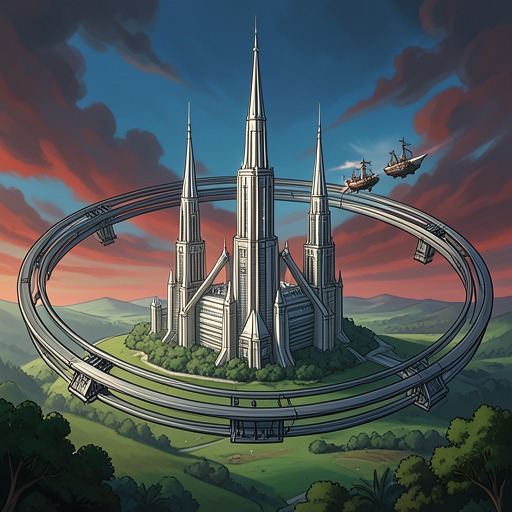
The Acquataine Cluster is described as a rich group of roughly three hundred stars lying just beyond the borders of the Terran Commonwealth, with more than a thousand inhabited planets in orbit around them. Acquatainia is the capital planet of that region and contains its largest city. The city’s oldest university houses the dueling machine in an antiseptic-white chamber, with a narrow gallery suspended high above the floor. This combination of political centrality, academic authority, and technological spectacle makes Acquatainia more than a background location: it is the institutional center of the Cluster’s crisis.
The university’s dueling machine converts conflict into a controlled public procedure. Its chamber is designed for observation as well as combat, and the gallery gives the encounter the character of a civic performance watched from above. When the duel involving Emile Dulaq reaches its limit, the machine announces that time has expired and that the duel is ended. The scene fixes Acquatainia as the place where personal violence is subjected to rules, machinery, and institutional judgment.
The Dueling Machine and Dr. Leoh
Acquatainia’s university is central to Dr. Leoh’s work. The dueling machines have succeeded, often performing as well as or better than he anticipated, but Leoh regards them as only a stopgap: a temporary support for a political order that is steadily eroding. He is searching for a more radical means of breaking the existing status quo and persuading people to leave the comforts of settled civilization for the unoccupied and unexplored stars.
News of Dulaq’s duel sends Leoh across light-years toward Acquatainia. His journey gives the planet a decisive place in the plot’s technological and political trajectory. After a two-week flight, his starship enters parking orbit around the capital planet, and he transfers with the other passengers to the surface. The arrival is not private or anonymous. An official delegation headed by Fernd Massan, the Acting Prime Minister, meets him at the landing disk, while other passengers hurry past, curious and puzzled. Acquatainia therefore receives Leoh simultaneously as a scientist, a public figure, and a potential answer to a crisis its leaders can no longer contain.
Political Institutions and Crisis
The planet’s government is already nervous when Leoh is contacted. In the president’s office, a communicator causes the far wall to glow and dissolve into a view of another office in distant Acquatainia, crowded with anxious civilians and military officers. The scene presents the capital not as a calm administrative center but as a place where business, armed power, and political authority have been forced into the same room.
Acquatainia’s instability remains unresolved even after the immediate crisis surrounding the dueling machine. The government is described as wobbly, and elections for a new Prime Minister are imminent, with half a dozen candidates competing without any clear majority. Fernd Massan’s acting position consequently carries both authority and fragility: the capital has a government capable of receiving Dr. Leoh, but not one secure enough to guarantee a stable political settlement.
Wider Interstellar Connections
Acquatainia’s troubles cannot be separated from the broader contest involving the Terran Empire, the Kerak Worlds, and the Szarno Confederacy. The Kerak Worlds have annexed the Szarno Confederacy and are rearming in earnest, while the political situation on Acquatainia remains unsettled. The capital is thus placed between institutional weakness at home and military expansion beyond its immediate sphere.
The planet also belongs to the same interstellar political system that makes resistance and alliance matters of calculation rather than simple loyalty. On Shinar, Emil Vorgens argues that the choice facing its people is whether to fight for their world with Terran forces against the Komani or allow the Komani to seize the planet as a springboard for galactic war. The leaders of Shinar later agree to work against the Komani, and Vorgens obtains the transport capacity needed to move a squadron of vans and troop carriers within an hour. These developments do not occur on Acquatainia, but they clarify the scale of the political world to which its capital belongs: local governments, imperial forces, military technology, and threatened planets are all connected by rapidly shifting alliances.
Narrative Significance
Acquatainia concentrates the book’s opposition between regulated civilization and the pressure of expansion. Its university embodies knowledge and controlled technological progress; its dueling machine imposes limits on violence; its capital government, by contrast, is visibly unstable. Dr. Leoh’s arrival links these elements, because he sees the machine’s success as insufficient and seeks a transformation large enough to redirect the future.
The planet’s significance is therefore double. It is a concrete place—the wealthy capital of a cluster with hundreds of stars and more than a thousand inhabited worlds—but it is also a threshold between an old political order and an uncertain one. The dueling machine can delay collapse, and formal government can receive delegations and hold elections, yet neither guarantees stability. Acquatainia’s role in the narrative lies in making that contradiction visible: advanced institutions exist, but the wider system remains vulnerable to technological disruption, military expansion, and political uncertainty.