Komani nation
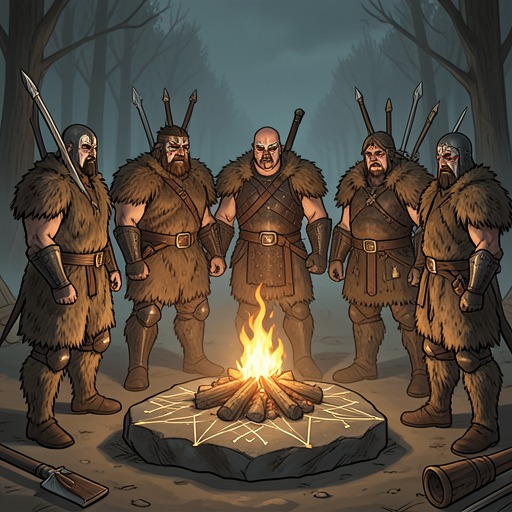
WatchmenThe Komani nation is a collective power rather than a unified state in the conventional imperial sense: its clans possess enough military independence to raid, negotiate, and make war on their own initiative, yet their chieftains are also said to have sworn allegiance to the Terran Empire. That tension drives the Komani’s role in the Shinar crisis. They arrive as raiders and occupiers, but their presence quickly becomes the test of whether Shinar will remain an imperial possession, gain a path toward self-government, or serve as the opening move in a galactic revolt.
Confederated Warrior Society
The nation’s political structure is defined by the autonomy of its clans. When Komani warriors land on Shinar, Emil Vorgens is instructed to warn their leader that the raiders may return safely to their homeworld if they immediately abandon the planet. The proposed settlement rests on the claim that all Komani clans have sworn allegiance to the Empire and that the wider Komani nation will not assist the clan attacking Shinar. The distinction between one rebellious clan and the nation as a whole is therefore central to imperial diplomacy: Terran authorities treat the raiders as a dangerous exception, while Okatar Kang presents them as the beginning of a collective awakening.
The Komani also carry a historical relationship with the Terrans that complicates the language of betrayal. Vorgens explains that the entire nation fought on the Terran side during the Galactic War, but that alliance belongs to a century earlier. The Komani were once allies; in the present, their old military identity has become available for reinterpretation as either a broken friendship or a suppressed source of power. The past is not merely background history. It is the argument by which the Empire demands obedience and the argument by which Okatar seeks to summon the other clans to war.
Intervention on Shinar
The Komani enter the immediate crisis after unrest has already shaken Shinar. Clanthas organizes farmers and demonstrations against imperial rule; riots follow, civilians are killed, the Terran governor is murdered, Imperial Marines land, and Komani warriors arrive to exploit the resulting disorder. Their intervention is therefore both opportunistic and transformative. They do not create Shinar’s grievances, but they turn a rebellion against imperial government into a battlefield with consequences extending far beyond the planet.
Okatar’s forces prove capable of humiliating the Terran garrison and trapping the Mobile Force. He argues that a single Komani clan has already humbled the imperial troops and that the Empire’s distant Star Watch fleets cannot arrive for at least a month. His confidence depends on speed, spectacle, and coordination: if the Komani demonstrate that Terran power can be defeated, other clans may join them before the Empire can recover. The military situation on Shinar thus becomes a political signal intended for the whole galaxy.
The Komani threat is also governed by its own customary authority. Okatar tells Vorgens that prisoners who reject Komani hospitality are traditionally executed, and a Komani officer later attempts to claim Terran prisoners sheltered under Sittas’s protection in Okatar’s name. Sittas answers with an emphatic refusal, establishing a direct clash between Komani authority, religious sanctuary, and the prisoners’ status under imperial or local protection. The episode shows that Komani power operates through more than battlefield strength: it carries rules and claims of jurisdiction that compete with every other legal order on Shinar.
Okatar Kang’s Expansionist Program
Okatar presents the invasion as the first stage of a campaign against the Terran Empire. He predicts that the Komani will leave Shinar within weeks, after wiping out the Terrans, and then strike elsewhere, closer to the heart of imperial power. He insists that Shinar will be freed permanently, but Merdon recognizes the contradiction: Shinar is being used as a stepping-stone. Okatar accepts that description and dismisses the Komani’s motives as more important than the planet’s own future, revealing that local liberation is subordinate to his larger pursuit of war and glory.
His political vision depends on converting inter-clan division into common action. For too long, he says, the Komani have fought one another while the Terrans profited from their weakness. A victory on Shinar would reverse that history. Other clans, seeing that the Empire could be humbled in battle, might rally to Okatar’s clan; the imperial system would then be ripe for seizure. This is not a defensive revolt limited to Shinar. It is an attempt to manufacture a pan-Komani coalition by giving scattered clans a common enemy and a visible victory.
Vorgens warns that such a campaign would plunge the galaxy into another period of chaos and that Okatar would not survive to see its conclusion. Okatar accepts the possibility of his own death, but his immediate concern remains the destruction of his prisoner before sunset. His willingness to sacrifice both himself and Shinar to the momentum of a larger war exposes the distance between the Komani nation as a people and the ambitions of the leader claiming to act for it.
Conflict with the Empire and Shinarian Resistance
The Empire’s first response is coercive containment: military forces are sent to restore order, while Vorgens is told to negotiate safe conduct and remind the Komani of their pledged allegiance. Yet the Komani’s success makes that policy precarious. The Mobile Force cannot defeat them alone, and reinforcements will arrive too late to prevent extensive devastation unless Shinar itself joins the defense.
Vorgens therefore reframes the choice for the Shinarians. They can fight alongside the Terrans against the Komani or allow the Komani to seize the planet and use it as the springboard for a galactic war. He cannot guarantee that imperial cooperation will produce self-government, but he acknowledges that it might. The Komani invasion consequently forces an unstable alliance between an occupied population and the empire that occupies it: Shinarian autonomy becomes imaginable not through immediate separation, but through cooperation against a power that threatens to replace imperial domination with clan conquest.
This appeal eventually gains practical support. Clanthas and other Shinarian leaders decide to take Vorgens at his word and work against the Komani in whatever way possible. In a later emergency, Vorgens offers to bring a squadron of vans and troop carriers within an hour, enabling an assault that local forces could not reach quickly enough on their own. Merdon, who has previously distrusted Vorgens, admits that he has been wrong about him and agrees to tell his people to follow the Watchman’s orders. Their handshake and joint descent toward the waiting population mark the formation of a working alliance in which the Komani threat helps create cooperation between former opponents.
Narrative Significance
The Komani nation embodies the danger of treating a people’s military history as a single political will. The Empire invokes the nation’s former alliance to demand present loyalty, while Okatar invokes the same history to claim that the clans can unite and overturn imperial rule. Between those two uses of the past stand the individual clans, the people of Shinar, and leaders who must decide whether participation, neutrality, or resistance offers the least destructive future.
The nation’s presence also exposes the difference between liberation and conquest. Okatar promises to free Shinar, but his own plan requires the planet to function as a disposable platform for attacks elsewhere. Against that logic, Vorgens’s strategy treats Shinar not as a symbol or military asset but as a population whose survival and political choice matter. The Komani are therefore both an external invading force and a mirror of imperial power: they oppose Terran domination while reproducing the practice of deciding another world’s fate without its consent.
The Komani’s collective identity remains tied to inherited memory. Their alliance with the Terrans during the Galactic War, like the older Terran victory over the Masters recalled in Shinarian political argument, continues to shape present loyalties. Even the military imagery associated with Komani society is filtered through generational experience: in the fusion of Hector H. Hector’s and Major Par Odal’s minds, Hector witnesses cadets marching under heavy packs and Odal remembers a boy’s first sight of a starship, while another memory shows teenagers in brown uniforms attacking people marked by a special symbol. These images do not describe a single Komani action, but they place the nation’s violence within the book’s broader pattern of inherited militarism, political mobilization, and memories that can be turned toward either solidarity or atrocity.