Katan
WatchmenKatan is a small port city on Shinar, curving around a crescent-shaped harbor and overlooking bright waters from a hillside of white-roofed houses. Although it lacks a Terran garrison, its position as a commercial hub makes it strategically and politically decisive: it gathers farm produce from a vast surrounding region, becomes the home of the merchant Clanthas and the earliest organized protests against Terran rule, and ultimately prepares to defend itself against the Komani while coordinating with the Terran forces.
Setting and Commercial Life
Katan stands at the crest and slopes of a hill above its harbor. Clanthas’s home overlooks the water, while equally prosperous houses flank it; the residence is neither especially large nor lavishly decorated, but its elevated balcony provides a commanding view of the city and port. Across the harbor lies the busy commercial center where produce from a thousand miles around is collected and loaded onto large sea-going transports capable of crossing Shinar’s oceans and land routes with equal ease.
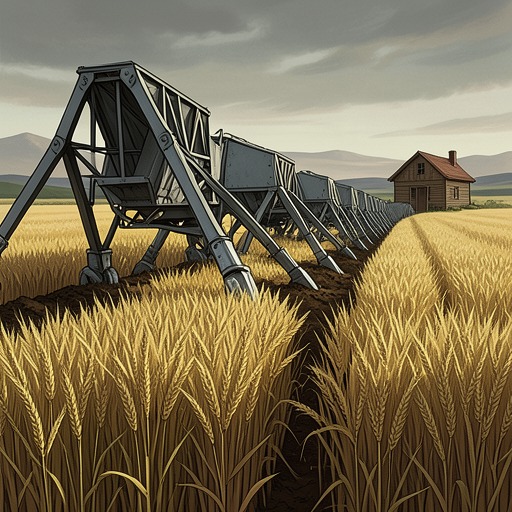
The city’s economy is closely tied to the farmers who supply that trade. Before the rebellion against the Terran Empire, Clanthas could spend warm, sunny summer afternoons on the balcony spanning his house, relaxing or conducting business. That ordinary rhythm is broken when farmers begin arriving in Katan after Terran authorities drive them from their land to make way for factories producing synthetic foodstuffs. Because Clanthas’s business depends on buying and selling agricultural produce, the displacement threatens both the farmers’ livelihoods and the commercial system on which Katan depends.
Political Center of Resistance
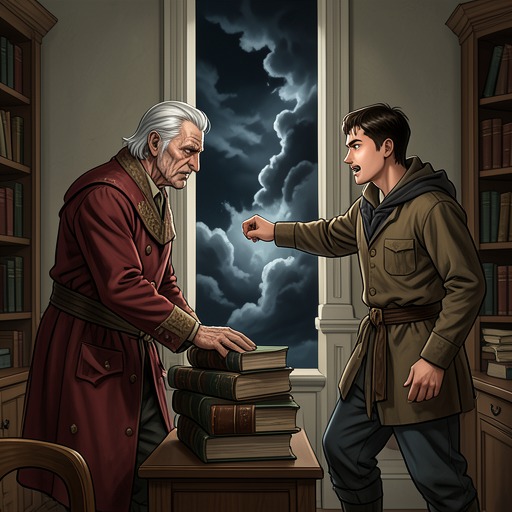
Unlike the four major cities of Shinar, Katan is not occupied by a Terran garrison. Its relative freedom from direct military occupation allows political opposition to gather there, and Clanthas becomes distinguished from other merchants not merely by intelligence or luck but by action. He appeals to the Terran governor over the expulsion of the farmers and, refusing to accept the official claim that the nutrient processors are necessary, recalls an argument about freedom that his son had encountered in galactic history. The principle that people must possess both the intelligence and courage to stand independently, and must be strong enough collectively to resist enslavement, becomes a justification for resistance in Katan.
Clanthas subsequently organizes the first protests and demonstrations against the Terrans. His reputation reaches Sittas, who recognizes him as Clanthas of Katan, the merchant associated with those initial public challenges. The city therefore functions not only as a marketplace but as a political incubator: grievances produced by imperial economic policy are converted into organized opposition through the initiative of a commercially established local leader.
Alliances and Strategic Stakes
Katan’s position makes its allegiance important to every faction. When Vorgens asks the Shinarians to fight alongside Terran forces against the Komani, he presents the choice in planetary terms: either they defend their own world with the Terrans or allow the Komani to seize Shinar and use it as a springboard for a wider galactic war. Katan embodies that dilemma particularly clearly because its prosperity depends on the surrounding agricultural districts, while its harbor makes it valuable as a transport and military objective.
The city’s leaders do not immediately accept the alliance. Their willingness to cooperate develops through negotiation, as the Shinarians weigh the danger of Komani conquest against their demand for self-government and the uncertainty of Terran promises. Clanthas and the other leaders eventually decide to accept Vorgens’s proposal and work against the Komani in whatever way possible. Their decision transforms Katan from a center of protest against imperial rule into a participant in a temporary military coalition with the Terran forces.
Defense and the Race to Katan
The defensive plan explained to Clanthas calls for Terran Marines to establish small task units around armored vehicles in villages, towns, and cities. They are to arm local people, teach them to fight, patrol the farmlands until the inhabitants can guard their own land, and then move to another district. Katan is thus placed within a broader strategy of transferring responsibility from imperial troops to the population itself, even as the city’s leaders remain uncertain whether military cooperation will bring the self-government they seek.
When the Komani advance threatens Katan, the city becomes the immediate focus of military coordination. Vorgens offers to bring a squadron of vans and troop carriers there within an hour, giving the defenders a means of reinforcing the city quickly. Merdon, who has previously misjudged Vorgens, responds by telling his people to follow the Watchman’s orders and offers to fight beside him. Their handshake marks a practical alliance at the moment when Katan’s survival depends on rapid cooperation rather than political certainty.
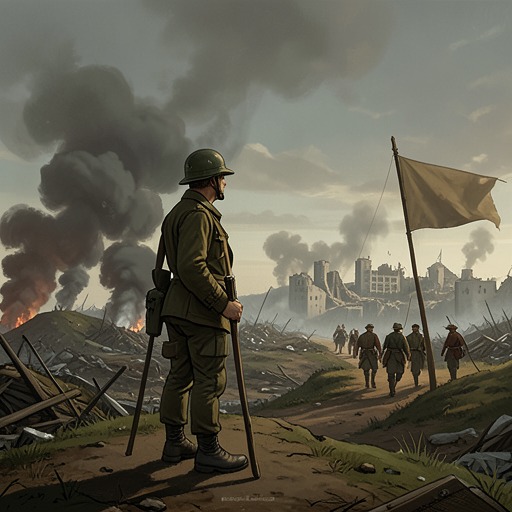
Through the long night before the expected attack, the entire population prepares. The arsenal is opened, and every citizen—male or female—old enough and strong enough to handle a weapon receives one. People organize themselves building by building and block by block, select windows and rooftops from which guns can be mounted, and pray. By dawn, commercial activity has vanished: shops and offices are closed, doors and windows are bolted, and only a few police patrol the empty streets. The familiar sunlight, harbor water, and ocean breeze continue unchanged, but the city’s inhabitants remain indoors checking weapons and ammunition, converting a peaceful port into a fortified community awaiting battle.
Narrative Significance
Katan concentrates the book’s tensions between commerce and war, imperial administration and local autonomy, and individual protest and collective defense. Its harbor represents circulation, trade, and connection across Shinar; its emptied streets and armed rooftops show how quickly those functions can be suspended when survival is at stake. The city’s lack of a Terran garrison initially distinguishes it from the occupied urban centers, but that absence does not make Katan politically neutral. Instead, it gives Clanthas and the other leaders room to organize, while its economic and geographic importance ensures that both the Komani and the Terran forces must take it seriously.
Katan’s transformation is therefore the clearest measure of the wider crisis. It begins as a prosperous port whose merchant can conduct business from a sunlit balcony, becomes the birthplace of organized protest after farmers are dispossessed, and ends the available account as a city mobilized for collective defense. Its people do not simply choose between imperial obedience and rebellion; they confront a harder calculation in which cooperation with the Terrans may be necessary to prevent Komani conquest, even while the hope of governing themselves remains unguaranteed. Katan’s significance lies in that unresolved bargain: resistance, alliance, and self-determination meet in the same harbor city.