United States Postal Service
WomenThe United States Postal Service represents both Henry Chinaski’s former wage-earning life and the practical security he gives up to become a writer. His departure from a twelve-year postal job precedes an intensely disciplined attempt to write a novel, while a later encounter with a former coworker reveals a persistent gap between Chinaski’s literary identity and the clerical work others associate with him. By the end of the episode, he recognizes that the Postal Service will not take him back, leaving writing as the trade he must pursue.
Employment and Departure
Before trying to make a living as a writer, Chinaski worked for the United States Postal Service. He says he quit after twelve years, a significant break from regular employment that coincides with fear about becoming a writer and an escalation in his drinking. The novel does not describe the details of his postal duties, but the length of his service establishes that writing follows an extended period in a conventional job rather than a brief or casual change of direction.
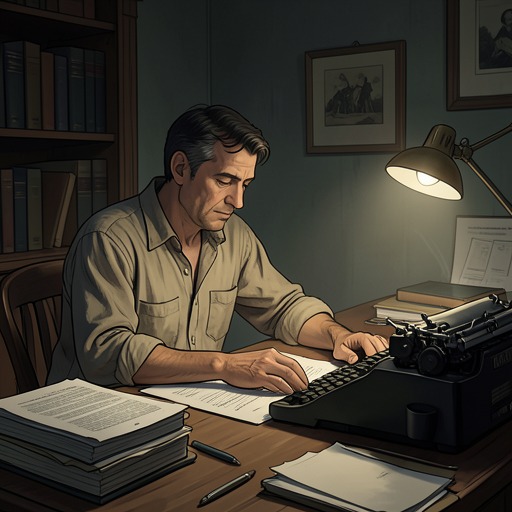
Leaving the Postal Service does not immediately produce a settled literary career. Chinaski begins work on his first novel under punishingly repetitive conditions: at night, he types to classical music, smokes inexpensive cigars, and drinks whiskey and beer until dawn. He sets himself a ten-page goal, then discovers the following morning how much he has written. The drafts may run to seventeen, eighteen, twenty-three, or twenty-five pages, but each night’s output must be revised or discarded. It takes twenty-one nights to complete the novel. Against this nocturnal, self-imposed regimen, his former postal work stands as the earlier occupation he has left behind, while the uncertain process of writing becomes a new form of labor.
A Former Coworker’s Recognition
Later, while Chinaski is with Tanya, a man around fifty approaches him and says that people at the P.O. miss him. The former coworker remembers Chinaski as one of the funniest people who worked there, making the recollection personal and warm rather than merely administrative. Chinaski responds politely, asking him to pass along his greetings to the other workers.
The exchange turns on a question of occupational identity. When asked what he does now, Chinaski first describes himself as someone who pounds a typewriter, accompanying the phrase with a gesture of his hands tapping the air. The coworker takes this to mean that he is a clerk-typist. Chinaski corrects him: he writes poems, short stories, and novels, and says that he is paid for them. The former coworker looks at him and walks away. In a brief encounter, the postal workplace’s remembered identity for Chinaski collides with his account of himself as a professional writer; the correction is clear, but it does not create understanding between the two men.
Work, Identity, and Economic Insecurity
The Postal Service remains consequential after Chinaski has left it because it offers an imaginable alternative to the uncertain work of writing. His former colleagues still place him within the shared world of postal employment, while he insists on a different occupation and on the fact that his writing earns money. The encounter demonstrates that his professional change is not automatically legible to people who knew him as a postal worker: even the physical act of typing can be read as clerical labor rather than literary production.
At the end of a later visit with Tanya, Chinaski kisses her goodbye and travels home alone. He considers getting some writing done or going back to being a janitor, then concludes that the Postal Service will never take him back. This thought makes the institution more than a point in his biography: it is a closed route back to familiar employment. With that option unavailable, the book frames writing not simply as an artistic preference but as the trade he has to ply, despite its insecurity and the loneliness that accompanies his return to work.