Bison
WoodwalkersBison is the powerful second form Brandon inhabits, and its role in the story is defined by a persistent tension: the strength that makes Brandon formidable also makes him fear causing harm. In the woods, that strength can break through obstacles almost effortlessly; in a school combat trial, it becomes useful only when Brandon finally dares to act. The form’s episodes make physical power visible while showing that control, rather than force alone, is the harder skill to acquire.
Identity and Physical Presence
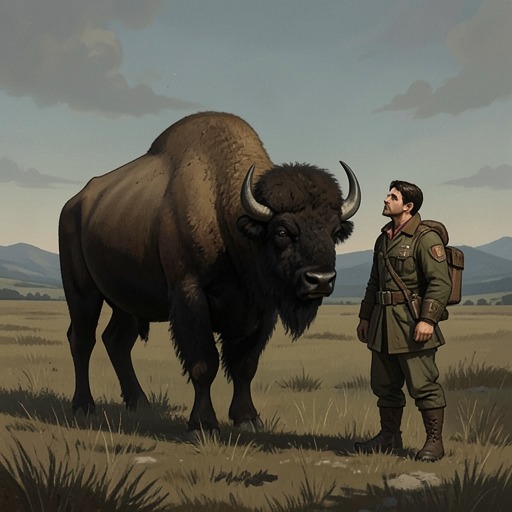
The text presents Bison through Brandon’s transformation rather than through a separate animal character. In this form, Brandon stands on four hooves, lowers his muzzle to charge, and moves with a heavy, forceful gait. The body changes what he can do: logs and brush become things he can smash through, while his size and strength make even a practice attack feel potentially dangerous. His physical presence is not merely a disguise. It shapes his movement, the risks around him, and the way he understands what an attack might do.
That presence is strikingly different from the cautiousness Brandon brings to using it. When Bill Brighteye urges him to attack during an exercise, Brandon remains where he is, hooves planted, because he fears breaking something or hurting someone. His hesitation makes the contrast central to the portrayal: the Bison form supplies force, but it does not decide how that force will be used. Brandon’s restraint is a real concern, not an inability to recognize the form’s power.
Strength, Movement, and Woodland Encounters
On a woodland outing, Brandon’s Bison form proves awkward in some circumstances and overwhelming in others. He becomes caught in a thorn bush and apologizes for being stuck. Holly tells him to push forward, and he frees himself, though the thorns pull away enough of his coat to make a substantial sweater’s worth of fur. The episode turns a small obstacle into a practical demonstration of his bulk: he can force a way through, but the environment still catches and marks him.
Once free, Brandon appears to lose himself in the pleasure of moving through the woods. He smashes into a partly rotten log and continues onward, leaving his companions behind. His passage has ordinary physical consequences too: he drops large piles of dung, and flies soon settle on them. The scene places exuberant movement beside the less graceful traces of an animal body. The Bison form is not presented as a polished instrument; its weight and habits affect the landscape around it.
The outing becomes more dangerous when Carag hears a motor approaching the road. Brandon, still absorbed in the destruction of woodland obstacles, does not respond to the warning. The sight of the headlights at the forest edge heightens the danger: Carag remembers that a car and a Bison could meet with disastrous results. Brandon nevertheless trots onto the asphalt, lowers his head, and charges. The driver reverses in a zigzag and accelerates away while Brandon follows the Chrysler. Holly tries to calm him and Carag calls for him to stop, but the immediate scene is one of uncontrolled escalation, not a settled confrontation. The encounter shows how force that is harmlessly exhilarating against a rotten log can become a threat when carried onto a road among people and vehicles.
A Hidden Form in a Human School
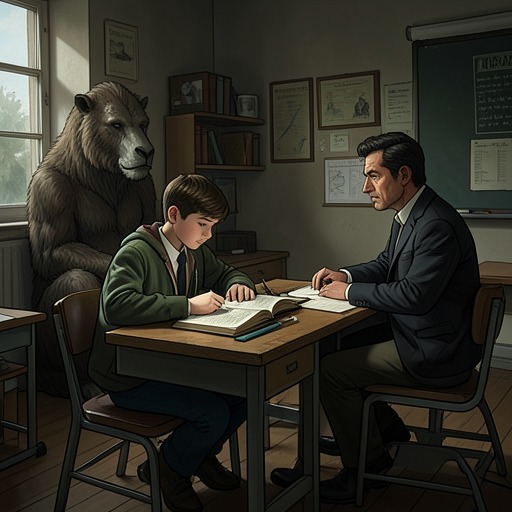
Brandon’s transformation also exists within a school community that must conceal the existence of animal shapeshifters from humans. That secrecy becomes precarious when Donald Ralston encounters what appears to be a Bison inside the school. He challenges the headmistress, asking what a Bison is doing there and worrying that his son Jay cannot be safe if such an occurrence is common. The headmistress remains composed and explains the presence of live animals as part of stimulating Biology lessons and students’ contact with nature. Her explanation protects the school’s secret in the moment, while Donald’s alarm reveals how easily an unfamiliar animal presence could expose or disrupt the school’s carefully maintained account of itself.
The school’s rules also define the circumstances in which Brandon can learn to use his form. Bill Brighteye reminds him that students may transform during school hours only with a teacher’s permission, and that student fights are allowed only during the designated class in combat and survival. These rules place transformation and physical confrontation inside an institutional structure: the Bison’s strength is not simply an individual matter, but something the school must regulate for the safety of students and the protection of its secrecy.
Training and the Use of Force
Brandon’s first response to combat training is refusal. Even when Bill Brighteye takes his wolf form, stands in front of him, and invites him to knock him down, Brandon cannot bring himself to do it. The obstacle is not a lack of strength but his fear of what that strength could do. His planted hooves turn the scene into an image of power held in check.
Later, the combat trial gives that restraint a consequential test. Brandon is selected first, and Carag sees that he is visibly nervous. At Bill Brighteye’s command, Brandon lowers his muzzle and gallops forward. Carag recognizes the advance as a breakthrough: Brandon has attacked, and the next challenge is keeping his anger under control. Bill Brighteye moves rapidly around him, trying attacks at his hind legs and nose and forcing him to turn. Brandon defends himself each time. As the exchange continues, Carag notices that the teacher is deliberately giving ground and allowing himself to appear vulnerable. Brandon takes the opening and charges again, coming close to goring him before the gong ends the bout.
The trial does not establish that Brandon has mastered his temper or fully controlled the Bison form. It does show a change from the earlier refusal: he can now make the attack he once could not attempt, and he can respond effectively to an opponent. The near injury also keeps the cost of that progress in view. Bison signifies both Brandon’s capacity to act and the responsibility that accompanies it; its defining dramatic question is not whether it has strength, but whether Brandon can put that strength to deliberate use.