Spiders
WoodwalkersSpiders enter the story not through a broad account of their biology but through Juanita, a spider Woodwalker at Clearwater High. Usually present in her small spider form, silent in a corner of the classroom, she is easy for others to forget. Yet her ability to listen while unnoticed gives her knowledge that matters: she warns Carag that Jeffrey’s wolves intend revenge. Her brief appearance in human form turns an overlooked presence into a consequential ally.
Juanita at Clearwater High
Juanita is identified as a spider Woodwalker whom Lou Ellwood had managed, with difficulty, to persuade to take human form. Carag had seen her that way only once before. When she approaches him in the corridor, she is wearing a yellow dress supplied by the school. The scene makes the contrast between her forms concrete: the girl standing before Carag is recognizable to him only after he first registers a stranger, while her usual spider form has become so familiar and unobtrusive that he has nearly forgotten she is there.
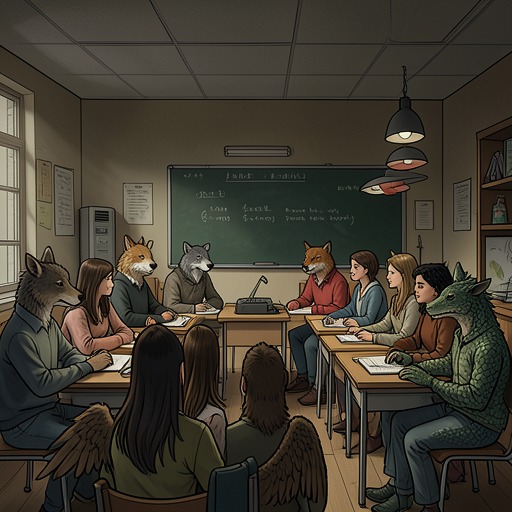
Her ordinary place in school is a corner of the classroom, where she remains in spider form and does not speak. The teachers do not require her to complete written assignments. These details establish a markedly different mode of participation from that of the students who move through lessons as humans: Juanita is present and attentive, but her quietness and form make her easy to overlook. The text does not explain the school’s reasons for its arrangement or describe spider Woodwalkers as a group, so Juanita’s circumstances are the clearest evidence of how one spider student experiences school.
A presence others fail to notice
Juanita gives that invisibility its own words when she tells Carag that nobody notices her. He recognizes the truth in the complaint and feels guilty: he, too, has momentarily forgotten her because she is generally a silent spider in a corner. Her next point is brief but changes how he understands her: although people do not notice her, she listens. The distinction is central to her role. Her apparent lack of participation is not a lack of attention; the same inconspicuousness that excludes her from notice lets her hear what others say.
Carag immediately wonders whether Juanita is the spy who has been reporting his actions to Andrew Milling. He recalls seeing a spider on the ceiling when Milling visited the Ralston home. This is Carag’s suspicion, not a confirmation that Juanita was the spy. Her own disclosure establishes that she listens, but does not establish that she has been spying for Milling. The scene preserves that uncertainty even as it shows why Carag connects a spider’s unobtrusive presence with hidden observation.
The warning and its consequence
At first Juanita struggles to speak, meeting Carag’s eyes only briefly before beginning to explain. Carag realizes that a predator like him might not listen to a tiny spider, so he turns his back and leans against the corridor window frame, looking toward the woods. By acting as though he is unhurried and not watching her, he makes room for her to continue. Her warning is direct: the wolves want revenge on Carag for losing their duel. She has heard their intention, though not how they plan to carry it out, because they have already moved away.
Carag thanks her and offers to help if he can. Juanita answers in a voice as light as a breath, then changes back into a small black spider and slips into a crack in the window frame. Her yellow dress remains on the floor. The quick return to spider form ends the encounter as quietly as it began, but the information she carries has altered Carag’s understanding of the danger around him. Her warning does not reveal the wolves’ plan; it does give him reason to take their threat seriously.
Narrative significance
Juanita’s scene makes being overlooked both a vulnerability and a source of knowledge. Carag’s first response to her complaint is guilt, because his own attention has reproduced the neglect she describes. He corrects that failure by changing how he behaves: instead of pressing her while facing her, he turns away and lets her speak. Her warning then demonstrates the practical value of listening to someone whose form and silence have made her easy to dismiss.
The episode also gives the spider form a precise narrative function without making claims about all spiders. Juanita can remain unnoticed, hear a conversation, approach Carag in a human body when she needs to address him, and retreat through a narrow crack after she has spoken. The movement from silent classroom presence to informer and back to spider form is brief, but it makes Juanita’s attention consequential. She is not shown as the confirmed source of Milling’s surveillance; she is shown as a student who listens, recognizes a danger to Carag, and takes the difficult step of telling him.