coyote
WoodwalkersThe coyote appears in two connected roles: as a wild animal whose numbers and hunting behavior can make an encounter dangerous, and as the animal form of Bill Brighteye, a woodwalker and Clearwater High teacher. Brighteye’s experiences as a coyote inform his lessons in judgment and survival; his personal history also reveals how living between human and animal worlds can strain family bonds and identity. Through him, the coyote is not simply a disguise, but a way of moving through the world that carries both practical knowledge and personal cost.
Wild Coyotes and Their Risks
In a lesson at Clearwater High, Brighteye recalls visiting the Grand Canyon at about twenty-five. A daytime visit had been crowded and oppressively hot, so he returned at night in coyote form. The night visit also spared him the thirty-dollar park entrance fee, a meaningful saving for a student who had to earn what little money he had at rodeos. He descended into the canyon, but halfway down heard other coyotes howling. Their numbers and apparent hunting formation led him to conclude that they could not be woodwalkers; he feared they would reach him before he could get away.
Brighteye does not initially finish the story. Instead, he asks his students what they would have done, turning the danger into a lesson about encountering members of one’s own species. When Holly identifies the nearby person as a researcher studying the pack, Brighteye explains that the researcher was too close to coyotes while they were hunting. He stayed nearby in case the man needed help. The class then considers what woodwalkers should do if researchers study them: act convincingly like ordinary animals so that they do not expose their nature. The episode links the coyote’s wild behavior to the woodwalkers’ need to protect their secret.
The coyote’s hunting environment is also associated with physical hazards. In another classroom story, Brighteye describes a trap snapping shut on his front paw. He could not pull free and knew that some coyotes sever a trapped limb to escape, but the pain made that prospect terrible. His belongings were hidden about two kilometers away, leaving him without immediate access to them. The story presents survival as a problem of constrained choices rather than effortless animal prowess: even an experienced coyote can be immobilized, injured, and cut off from help.
Brighteye’s Coyote Form and Teaching
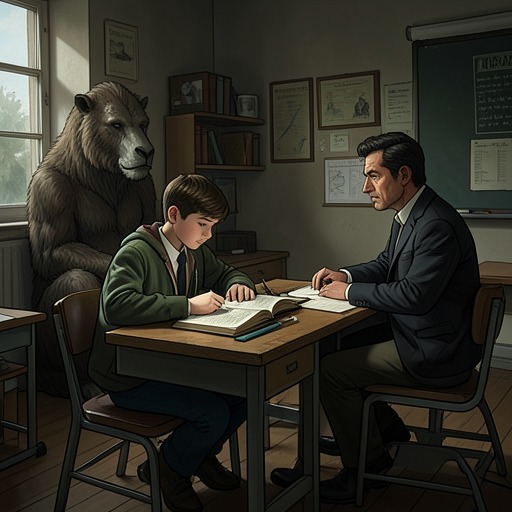
Brighteye teaches Special Cases, as well as physics, chemistry, and mathematics. His coyote experiences give his classroom instruction a distinctive practical emphasis. He tells stories about danger and then asks students to judge what should be done, as in the Grand Canyon encounter and the trap incident. Rather than merely giving rules, he invites students to reason through the circumstances that make an action wise or risky.
His own form also enacts the school’s distinction between human and animal life. During a nighttime encounter near the school’s treehouse, Carag first mistakes a nearby figure for a lone wolf, then notices that it is smaller and has a more pointed muzzle and ears. The animal is a coyote, and the conversation that follows takes place while Brighteye and Carag move through the vegetation together. Brighteye’s easy movement between discussing computers and traveling as a coyote makes his double existence seem ordinary to him, even as Carag recognizes that the conversation is more personal than the stories told in class.
The coyote form is also connected to Brighteye’s account of a period of collapse. After his son disappeared and his marriage failed, Brighteye abandoned his previous life and spent much of his time as a coyote on the edge of a city. He scavenged from garbage and drank from puddles, letting himself drift through a life stripped of its former attachments. The account gives his animal form a setting beyond school or wilderness: it can also be the shape in which he endured grief and dislocation.
Family History and Private Mentorship
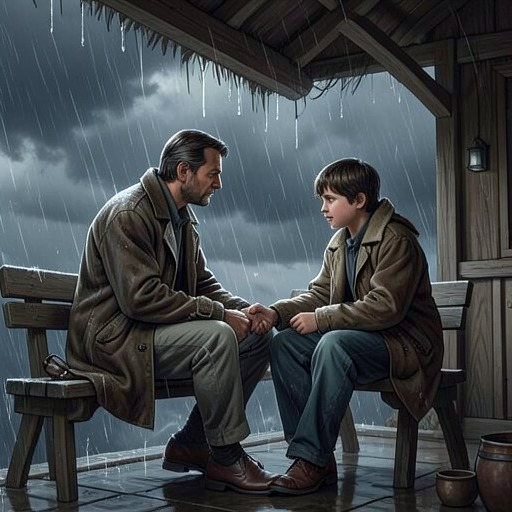
Brighteye tells Carag that he was once married to a Navajo woman. She was human, not a woodwalker, but knew what he was and did not react with disbelief. They had a son, Joseph, who was also a woodwalker. At seventeen, Joseph had disappeared, and Brighteye did not know where he lived or what had happened to him. He recalls that Joseph struggled with the stress of being caught between opposing worlds, said he no longer knew who he was, and began taking drugs at a young age. The repeated crises eventually overwhelmed the marriage as well.
Brighteye’s response to that loss differs from the anger Carag associates with Andrew Milling. He describes his devastation without turning it into a call for vengeance. A pickup truck eventually pulled him out of his drifting life, though the account does not specify further what followed. The contrast matters to Carag: painful experience does not lead every woodwalker toward the same response or purpose.
Brighteye recognizes that Carag is struggling to control his transformations and offers to help him. He asks Carag to keep the arrangement secret because he does not want to offend Isidore Ellwood. The next morning, after learning of Carag’s nighttime foray, Brighteye takes him toward a river with a bucket of icy water, making the training an immediate, physical test rather than an abstract promise. He then arranges to meet Carag half an hour before breakfast. His coyote identity thus connects his own difficult history to a concrete act of support: he uses what he knows to help a student avoid the same vulnerability.
Survival Knowledge and Significance
Brighteye’s advice draws on the coyote’s exposure to traps, predators, and changing terrain. When Carag is later pursued by hunting dogs, he remembers Brighteye’s counsel to lead them toward a river. The instruction turns the coyote’s survival experience into knowledge that can be carried into another animal form and another crisis. Carag’s escape attempt also depends on his puma body: he crosses a deep, muddy ditch on a fallen pine trunk, using feline balance where the dogs struggle to follow. The sequence makes survival a matter of adapting to the capacities and limits of each body, not simply possessing strength.
The coyote therefore gathers together several strands of the story’s treatment of woodwalkers. As a wild species, it represents the danger of encountering a pack while it hunts; as Brighteye’s animal form, it enables movement through both human and animal environments; and as the form associated with his years of grief, it bears the history of a life that nearly came apart. Its most important narrative function is practical as well as symbolic: coyote knowledge becomes a lesson, and the lesson becomes help that Brighteye can offer Carag when he needs it.