wapiti
WoodwalkersWapiti occupy a shifting place in Carag’s world: they are animals he imagines hunting, fellow woodwalkers at Clearwater High, and people whose lives expose the limits of treating prey as merely quarry. The contrast becomes especially important through Lou, whose identity as a wapiti complicates Carag’s attraction to her and sharpens his awareness of the school’s rules about predator and prey.
Wild Wapiti and the Predator’s View
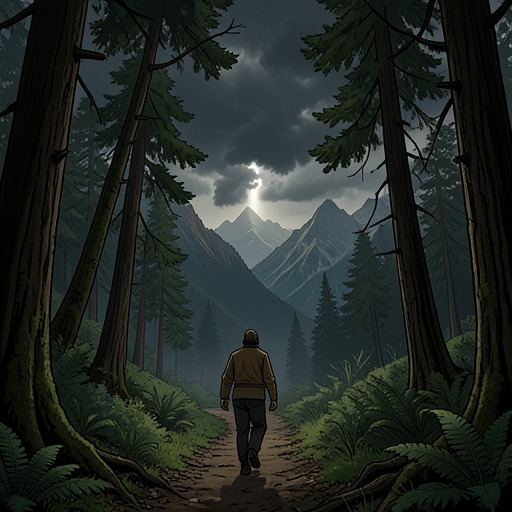
On his first night outside in his puma form, Carag waits for the household to fall asleep, slips from his second-floor bedroom to the garden, and enters the woods. His feline eyes make use of the starlight in the moonless dark; a distant, piercing call tells him that many wapiti are nearby. He soon spots three in a clearing, two females and a male, grazing. They are close enough to a campground to make him uneasy, though he jokes to himself that polite campers might receive a piece of meat.
Carag approaches as his father taught him, moving carefully with his body low and his attention fixed on the animals. His excitement at being a puma—his muscles ready to spring, his ears forward—makes the scene an attempted return to a predator’s life. When one wapiti raises its muzzle, Carag wonders whether he has made a mistake, but the encounter does not establish what the animal has detected or what happens next. The scene instead makes clear how readily he imagines wapiti through the immediate terms of pursuit and food.
That perspective is not the whole story’s account of wapiti. They are also among the ungulates human hunters pursue, a fact that gains force when Carag later finds himself endangered in the woods. During cougar hunting season, he remembers that hunters use dogs to track predators; the danger reverses the initial arrangement. The puma who once pictured wapiti as prey is now an animal trying to escape human pursuit.
Wapiti at Clearwater High
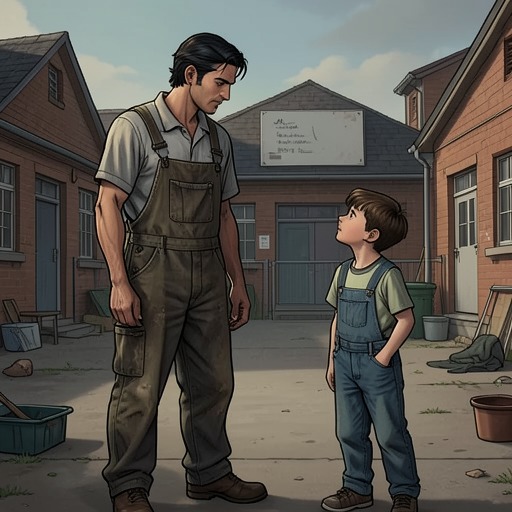
The school’s metamorphosis lesson takes place outdoors, with students seated in a circle and hanging sheets marking an area for changing back into human form. Its teacher, Isidore Ellwood, wears a brown suit and a signet ring bearing a stag’s head. Carag recognizes the emblem as evidence that Ellwood is a wapiti, and the discovery makes the teacher’s cold welcome feel more pointed: the new puma student is told to take the front row and catch up.
Ellwood’s identity is not simply a visual detail. His position as a teacher brings a wapiti into the authority structure of a school where students have predator and prey forms, and where managing transformation is part of the work of learning. Later, he appears in wapiti form, displaying antlers with ten points while warning Carag that he must work hard before the midyear examinations or risk not advancing with the others. In this setting, the animal form is both bodily reality and a visible expression of a student’s or teacher’s place in the shared community.
The connection becomes personal when Carag learns that Lou is Ellwood’s daughter. He had wanted to speak with her, but the news unsettles him: she belongs to the family of the severe teacher he already finds intimidating. He also learns that Lou’s mother was once attacked by a puma and still limps. That injury gives the predator-prey distinction a lasting consequence within Lou’s family, rather than leaving it as an abstract school category.
Lou and the Meaning of Prey
Carag’s interest in Lou grows through small observations rather than any change in their formal roles. During a run, Lou stays beside Viola, who is struggling, although Lou herself does not appear tired. She encourages Viola to keep going. Carag notices her kindness and finds his heart beating strangely; her care for another student matters more to him than her appearance. Lou’s wapiti identity therefore becomes attached to a particular way of acting, not just to the category of prey.
Their encounters also remain uncertain. Carag once sees a young female wapiti grazing beside a river and recognizes Lou. He wonders why she is alone, whether she wants company, and whether he should approach, but Dorian distracts him by playing with the tip of his tail. By the time Carag looks back, Lou has disappeared. The missed conversation preserves the distance between his interest and any knowledge of what Lou herself wants.
The school’s rules give that distance a social context. Nimble invokes the third rule when Jeffrey insults him: predators must not mistreat prey. Jeffrey responds by partially transforming to display his teeth, and Nimble retreats. Carag recognizes the wolf students’ behavior through his own earlier experiences of wolves driving his family away from food and chasing them. The rule is thus both a stated protection and a reminder that bodily power can make prey students vulnerable even within the school.
Lessons, Examinations, and Continuing Contact
The school regulates transformation as well as aggression. When Carag nearly transforms during a confrontation, Bill Brighteye holds him by the shoulder and asks whether he was about to break the rule requiring a teacher’s permission for students to change during school hours. He also reminds Carag that student fights are permitted only during the class on fighting and survival. These limits frame the predator-prey relationship as something the school tries to govern through explicit rules, not as a license for stronger students to act on instinct.
Wapiti identities remain present during examinations and ordinary student life. In the fighting exam, Lou faces Viola in human form and loses, but earns a passing grade for defending herself well. Carag’s feelings do not alter the result or give him access to Lou; he is left watching her performance and admitting to himself that nothing may ever develop between them. Ellwood’s earlier warning about the midyear exams also makes clear that students must meet academic expectations regardless of their animal forms or family connections.
Across these scenes, wapiti are never confined to one narrative function. They begin as possible quarry in Carag’s imagined hunt, appear in the school’s lessons and rules, and become individually recognizable through Ellwood, Lou, and Lou’s injured mother. The repeated shifts in viewpoint—hunter, student, teacher, potential friend—make the predator-prey divide consequential without making it absolute: it shapes danger and authority, but it cannot account for the individual actions and relationships that Carag observes.