NHK
1Q84NHK, Japan’s public broadcaster, enters the novel not only through its programming but through the recurring demand for a license fee. Its collectors bring the institution to people’s doors, making it a force in private life as well as a national media organization. For Tengo, that reach begins in childhood: his father’s work turns Sundays into compulsory rounds, and the fee becomes entangled with shame, obedience, and the boy’s struggle to claim a life of his own.
The broadcaster and its collection system
After the war, a former acquaintance helped Tengo’s father obtain work collecting NHK fees. The father had struggled to find regular employment after returning to Tokyo; the recommendation led to training, a uniform, and a collection quota. As radio expanded among people seeking inexpensive entertainment in difficult postwar conditions, NHK needed a large workforce to visit listeners’ homes and collect the charge.
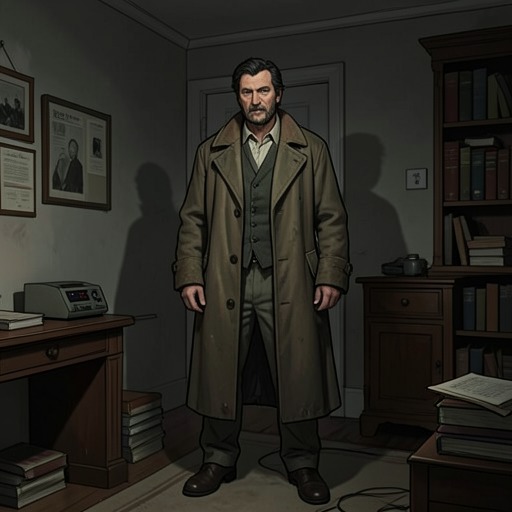
The father excelled at the work. NHK first employed him on a piece-rate basis without job security, then gave him the unusual status of a permanent, authorized collector after about a year. His difficult territory, strong results, and conduct helped him win a fixed salary with bonuses, a company residence, and health insurance—marked advantages over ordinary collectors, whom the narrative describes as nearly disposable employees. For him, the job offered a secure place within a large system, even at its lowest level.
Sundays in Tengo’s childhood
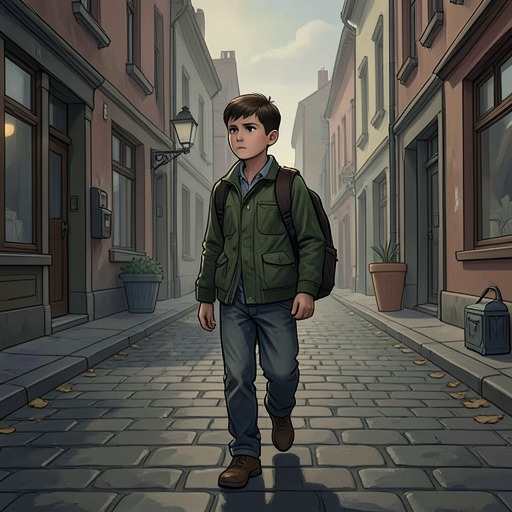
The fee-collection rounds became a standing feature of Tengo’s childhood. From before kindergarten until his fifth year of primary school, he accompanied his father almost every Sunday. They rose at seven; his father carefully washed his face, checked his ears and nails, dressed him neatly, and promised him a good meal afterward. The preparations made the child part of the workday before the first household was visited.
His father gave Tengo several reasons for bringing him: he could not leave the boy alone while schools and childcare were closed; he wanted his son to understand that life rested on labor and hardship; and, most painfully for Tengo, a child made it easier to collect from reluctant households. A resident was less likely to refuse payment in front of a small boy looking up at the collector. His father therefore took Tengo on Sundays to visit the households most resistant to paying. Tengo understood that he was expected to perform a role for his father’s benefit, like a trained act, and that pleasing him meant being treated kindly for the rest of the day.
The boy’s assigned part in the rounds was humiliating, but the route at least stayed away from his own neighborhood. His father worked in central Ichikawa, while the family lived in a suburban area of detached houses. If Tengo happened to see a schoolmate in the city, he hid behind his father rather than be recognized. Years later, the adult Tengo’s own Sunday mornings could still carry a bodily heaviness—sometimes nausea—despite the childhood routine having ended.
Work, estrangement, and inheritance
As an adult, Tengo’s life stood in striking contrast to his father’s rounds. He taught mathematics at a Yoyogi cram school, where successful student evaluations could raise teachers’ pay, and valued the freedom the work left him to write. He lived alone in a small Kōenji apartment and spent much of his time writing with a blue-ink Montblanc fountain pen on four-hundred-character manuscript paper. When an NHK collector came to his door, Tengo politely said he owned no television and invited the visitor to check; the collectors never entered. The institution associated with his childhood had become a brief encounter he could manage on his own terms.
That distance did not erase the past. Tengo’s father had once told him stories of poverty, harsh labor, and survival, and his careful, colored-pen map of his collection routes was almost his only sustained intellectual interest. Tengo, who had excelled at mathematics and read widely, saw a gulf between his own curiosity and his father’s narrow world. As an adolescent, he concluded that they could not share the same blood. NHK’s collection work was one of the clearest ways that difference took shape: to his father, the rounds represented discipline, livelihood, and belonging to a system; to Tengo, being made to accompany them was an imposed performance that denied him an ordinary childhood.
In his fifth year of primary school, Tengo finally told his father he wanted to stop accompanying him on Sundays. He wanted time to study, read, go out, and enjoy himself, and said that, just as his father had his work, he had things of his own to do. His father erupted, insisting that their household had its own rules and threatening not to feed him if he refused obedience. Tengo stayed silent, already convinced that no answer would make his father understand. The demand to leave the NHK rounds thus marks a decisive early attempt at separation, even though the evidence here does not describe what immediately followed the threat.
Public trust and institutional pressure
The novel also places NHK within a wider contest over information and authority. Aomamé reads that, on October 12, an NHK collector in Itabashi argued with a student who refused to pay and stabbed him in the stomach with a knife carried in his bag. The collector, a 56-year-old man with six years on the job and a record described by a colleague as excellent, remained at the scene holding the bloodied knife and offered no resistance when arrested. The report unsettles Aomamé because she is a meticulous reader of the newspaper and cannot recall seeing an incident that received such substantial coverage.
The stabbing is discussed alongside the Lake Motosu confrontation, whose sustained coverage crowded the student’s injury out of public attention. The narrative suggests NHK may have privately welcomed that displacement: scrutiny of the collector and the collection system could have intensified otherwise. That possibility gains force from an earlier controversy over a NHK special on the Lockheed corruption scandal. The broadcaster had altered the program’s content after previewing its substance to ruling Liberal Democratic Party politicians and asking whether the proposed broadcast would suit them. Because NHK’s funding required approval from the Diet, senior staff feared political retaliation; some within the governing party treated the broadcaster as an information organ under their control. Once the arrangement became known, public doubts about NHK’s political impartiality and editorial independence strengthened resistance to paying the fee.
A recurring presence in private life
NHK’s significance extends beyond the broadcaster’s institutional disputes. In the novel, its fee is collected at the threshold of the home, where the visitor’s presence can turn a public system into an intimate demand. Tengo’s father enlisted his child to make that demand harder to refuse; adult Tengo, by contrast, could decline payment by stating that he had no television. The difference captures a shift in agency without making the institution disappear: it remains present as a memory, an inherited routine, and an unsettled question of public trust.
NHK also echoes in Tengo’s recollection of a classmate who accompanied her mother on Jehovah’s Witnesses preaching rounds. The two children recognized one another when their parents’ Sunday errands crossed, though they barely exchanged glances. Hearing the girl’s prayer for God’s Kingdom, Tengo privately wondered whether there would be an NHK there—and, if there were no NHK, whether there would be no fee either. The fleeting joke folds the broadcaster into a child’s imagined escape from adult obligations. Across these scenes, NHK is at once a workplace that rescued Tengo’s father from insecurity, a collection system that conscripted Tengo into an unwanted role, and a media institution whose dependence on political approval complicates its claim to impartiality.