Police japonaise
1Q84The Police japonaise are a public institution whose uniforms and firearms become an unusually precise measure of altered reality. When Aomamé encounters an officer carrying a modern automatic pistol, she recognizes a change that other people insist happened years before. The discrepancy is not resolved as a police mystery: it exposes the widening gap between Aomamé’s recollection and the world everyone else describes.
Familiar uniforms, unfamiliar weapons
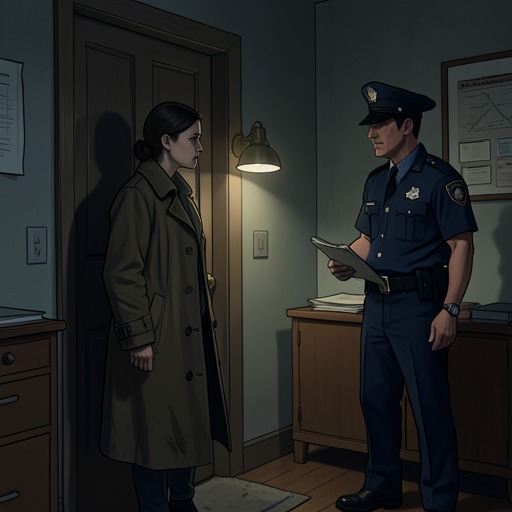
At the station in Sangenjaya, Aomamé crosses paths with a young, tall officer moving quickly through the concourse. She is briefly nervous, but he looks straight ahead and pays her no attention. What arrests her is his equipment: the uniform is still navy blue, yet its jacket is looser, more comfortable, and made from softer fabric; its collar is shorter and its color lighter. His sidearm, too, is unlike the old revolvers she expects Japanese officers to carry. It is a large-caliber automatic pistol.
The contrast matters because the older weapons had seemed suited to the country’s circumstances. Armed crime was rare, and officers seldom faced gunfights, so a basic six-shot revolver—with a simple mechanism, easy maintenance, and a low tendency to jam—was considered sufficient. The new pistol, by contrast, could hold as many as sixteen nine-millimeter rounds. Aomamé wonders whether the uniforms and weapons have been changed without her noticing, but that possibility clashes with her close attention to police appearance and her memory of seeing officers in their customary uniforms only hours earlier.
A change with two incompatible dates
Aomamé later asks an older man whether police uniforms and weapons have changed recently, specifying roughly the past week. He initially recognizes that the changes happened, but places them many years in the past: fitted jackets had been replaced by more comfortable blousons, and revolvers by small automatic pistols. When Aomamé presses him on whether officers used to carry old-style revolvers until the previous week, he first denies it, then searches his memory and becomes uncertain.
The hotel bartender supplies a more definite chronology. The replacement, he says, took place in the spring two years earlier. His confidence comes from a family connection: his younger brother is a police officer who disliked the cut of his new uniform and still complains that his weapon is too heavy. The brother’s pistol is a new nine-millimeter Beretta automatic, manufactured under license in Japan by Mitsubishi, with a switch that can change it to fully automatic fire. The bartender adds that Japan has little armed conflict and does not need such powerful weapons for ordinary policing; the government’s stated aim was to make the police more effective.
The exchange turns an apparently simple question into a collision of timelines. Aomamé remembers a police officer in the old uniform, carrying an old revolver, that very morning. The bartender says all the old weapons were collected and disposed of, and recalls seeing their destruction on television; they could not be exported because the Constitution forbade arms exports. He and the older man give accounts that reinforce one another. Aomamé therefore cannot explain the difference by assuming that both are mistaken or lying. She asks whether Japanese police have used no old revolvers for two years, receives confirmation, and leaves the inquiry wondering whether her own recollection is wrong.
Institutional change as evidence
The police equipment does more than mark a modernization of uniforms and firearms. Its ordinary, verifiable details—jacket cut, ammunition capacity, a particular Beretta, the date of the replacement, and the destruction of the former weapons—make the contradiction concrete. Aomamé is not confronting a vague impression that the world feels strange: she can identify exactly what differs, and she tests her observation against other people’s recollections and an account tied to the bartender’s brother.
That test makes the institution a kind of public record. The police have changed in a way that, in the bartender’s account, was announced in newspapers, disputed by citizens’ associations as an excessive improvement in firepower, and visible in the disposal of the old revolvers. Yet Aomamé’s memory contains a different version of the same public past. The more definite the other characters’ explanation becomes, the less easily she can treat her own observation as a harmless mistake.
Beyond the equipment
Elsewhere, the police appear in the history of the Pioneers community. The Master recalls being barred from its grounds when he tried to speak with Fukada about Éri: a high fence had been built, outsiders were forbidden to enter, and the community’s earlier openness had given way to isolation. The police do not resolve what was happening inside; from outside, even the Master could not discover what had become of the Fukadas during the seven years he cared for Éri.
The institution’s presence also figures in the Pioneers’ public history. In 1979, the group received approval to form a religious corporation. Later, according to Professor Ébisuno, police investigated possible links between the Pioneers and the armed clash involving L’Aube, but concluded that the community had no connection to that affair. The episode underscores the limits of what official scrutiny can establish: the Pioneers grew more secretive, selectively recruited capable and motivated people rather than seeking mass membership, and maintained ascetic practices alongside their official agricultural activity. When journalists were eventually invited to visit, they saw a clean, orderly settlement, spoke with its leaders, and reported under agreed restrictions on the use of images to protect members’ privacy.
A measure of altered reality
The Police japonaise are not presented through a sustained account of their organization or its internal structure. Instead, the institution’s importance lies in the authority attached to its public, tangible signs. A uniform and service weapon ought to be observable facts, and their replacement ought to belong to shared history. For Aomamé, however, the officer at Sangenjaya belongs to a present that no longer matches the one she remembers from that morning.
This discrepancy gives the police equipment a narrative function beyond its practical use. The automatic pistol does not explain how reality changed, and the institution itself is not identified as the cause. It does, however, establish the change in terms that can be checked: an officer’s sidearm, a nationwide replacement, a remembered date, and the disappearance of the old revolvers. What begins as an attentive observation becomes a crisis of memory, with the Police japonaise serving as one of the clearest measures of the distance between Aomamé’s remembered world and the one she now inhabits.