Tokyo Metropolitan Police Department
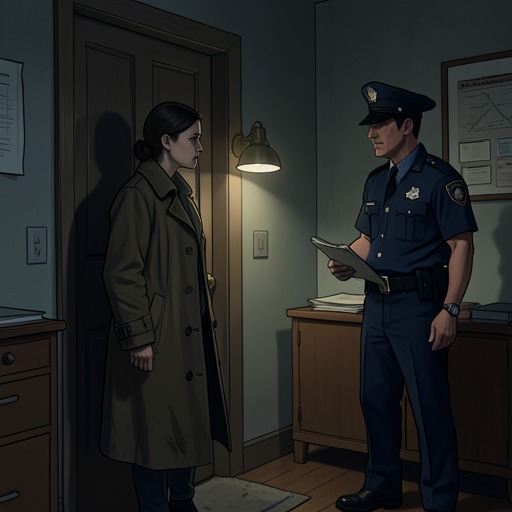
1Q84The Tokyo Metropolitan Police Department is the institution Ayumi joined hoping for active police work, but her experience exposes a stark division between that promise and the duties assigned to women. Her account makes the department more than a professional backdrop: it illustrates how formal authority and equal-opportunity principles can coexist with everyday restrictions that leave women officers sidelined, while the novel’s parallel account of the Dowager’s refuge shows vulnerable women relying on a separate, privately organized system of protection.
Identity and Institutional Entry
Ayumi identifies herself as a police officer working for the Tokyo Metropolitan Police Department. She entered the department after taking its examination in her fourth year at university. Policing was not her first ambition; she wanted to avoid an ordinary office job and did not believe she had any particular talent that would open another path. Her family already included several police officers—her father, older brother, and an uncle—and she says that this family connection helped her gain priority in admission to an institution that largely operated within its own closed circle.
The gap between the work she imagined and the work she was given becomes clear when she describes what drew her to the profession: a uniform, a gun, a police car, and patrols through the streets. In practice, she says, she is allowed to do none of those things in the substantive sense. The contrast between the visible symbols of police authority and her limited remit introduces the department through Ayumi’s frustrated experience rather than through an abstract account of its organization.
Women’s Duties and Restrictions
Ayumi describes her assignment as largely ceremonial and routine. She wears a uniform and drives a miniature police car to check improperly parked vehicles, but has no pistol or other weapon. Her daily work includes chalking the time and registration number onto the asphalt beside traffic violations. She also names the wider set of duties to which women officers are confined: monitoring traffic, handling paperwork at desks, teaching elementary-school children road-safety rules, and searching female suspects.
Her frustration is sharpened by a specific contradiction. Ayumi says she performed well in firearms training, yet that ability is disregarded; even access to a weapon is denied because she is a woman. When she discusses the Beretta, she demonstrates familiarity with the standard semi-automatic pistol and notes that it weighs nearly a kilogram when loaded, while finding it somewhat heavy for her. The exchange makes the restriction concrete: the issue is not that she has never trained or lacks knowledge, but that the institution does not let her put those capacities to use.
Ayumi characterizes women in the police world as second-class citizens. Men whom she considers less competent are allowed to advance into positions of responsibility, while official declarations of equal opportunity fail to describe what happens in practice. She argues that being kept in uninteresting work drains women officers’ enthusiasm. Her account locates the disparity not in an isolated task but in a career structure: women are directed toward low-authority duties while men move upward.
The Department in the Wider Story
Ayumi’s experience gives a personal measure of the gendered limits attached to police service, but the novel also places the department’s formal authority beside forms of protection operating outside it. The Dowager has established a private safe house for women fleeing domestic violence, using a vacant one-story building near her Azabu residence. Women and children in immediate danger are referred there through a telephone consultation service organized by lawyers and counselors, and the Dowager personally pays the costs of food, clothing, and shelter. Residents support one another while they seek a more secure place to live.
The refuge offers practical care as well as temporary safety. Lawyers and counselors visit to discuss future options with the women; the Dowager listens to them individually and helps them find work and permanent housing. When a husband discovers where his wife is staying and tries to force her home, Tamaru intervenes. The arrangement is not presented as a police department program: it is a privately maintained network addressing needs that the characters believe the law and ordinary institutions cannot always meet.
That institutional gap becomes especially urgent when a girl who has escaped sexual abuse has nowhere else to go. The Dowager insists that the child will be cared for and will not be sent back, even if her parents or someone else comes to claim her. She also argues that the man responsible must eventually be removed before he can harm others, while insisting that the response requires caution and patience. Set against Ayumi’s account, this episode distinguishes the department’s presence as a public institution from the protection the Dowager and her associates undertake themselves; it does not establish that Ayumi participates in the refuge or its actions.
Narrative Significance
The department’s portrayal rests on a tension between appearance and access. A woman may wear the uniform, drive a police vehicle, and possess demonstrated firearms skill, yet remain excluded from the work and authority associated with those signs. Ayumi’s conversation exposes that mismatch in everyday terms—chalk, parking violations, paperwork, and the gun she is not permitted to carry—rather than through a formal policy statement.
The contrast with the Dowager’s refuge broadens the question from who holds institutional power to who actually provides protection. The refuge responds to domestic violence with shelter, advice, employment help, and physical intervention, including care for children, while the Dowager acknowledges that some cases exceed what she and Tamaru can resolve. The novel therefore presents public authority and private protective action as distinct and imperfect structures: Ayumi describes gendered restriction inside policing, while the refuge demonstrates both the necessity and the risks of taking protection into private hands when existing remedies seem inadequate.