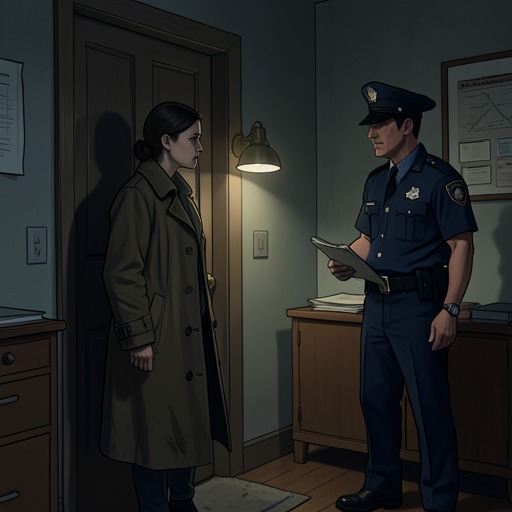
Yamanashi Prefectural Police
1Q84Yamanashi Prefectural Police are the prefectural law-enforcement body investigating the armed confrontation involving L’Aube, a radical group that originated within the Pioneers. Their involvement extends from responding to violence around L’Aube’s settlement to scrutinizing the Pioneers’ possible connections, while later accounts emphasize the practical limits of their inquiries and the difficulty of assessing conditions inside a closed community.
The confrontation and its origins
After moving to new territory, L’Aube’s members practiced agriculture and trained with weapons. Tensions with neighboring farmers grew over access to a small river on L’Aube’s land, which had traditionally served as a shared irrigation source. L’Aube denied the neighbors access. The dispute continued for years before residents who came to complain at the settlement’s barbed-wire boundary were met with violence.
Yamanashi Prefectural Police obtained an arrest warrant on an assault charge and sent officers to the settlement. A gunfight broke out when they arrived. The confrontation placed the police at the intersection of a local land dispute and a much larger concern: whether the separatist group’s break with the Pioneers had truly ended their association.
Inquiry into the Pioneers
Several days after a public statement about the separation, the police entered the Pioneers’ extensive grounds and spent a full day inspecting buildings and documents. Investigators questioned several senior members. Because exchanges between the two groups had continued despite their formal split, authorities considered whether the Pioneers had secretly commissioned L’Aube’s action. The inspection, however, produced no evidence to support that theory.
The investigation did not establish a direct connection between the Pioneers and the gunfight. That finding did not erase the group’s historical relationship to L’Aube, but it limited what the authorities could substantiate. Later, Ayumi recalls the confrontation as an incident in which three prefectural officers were killed, and distinguishes the Pioneers from L’Aube’s participation in the violence.
Institutional limits and renewed contact
A later effort to learn more about the case shows how slowly information moved through the police system. The national police had not yet sufficiently computerized their records, so a request for the Yamanashi file required a written application, an explicit explanation of its purpose, and approval from superiors. The prefectural police therefore held information that could not be retrieved through a quick search; obtaining it depended on formal procedures and a personal chain of contacts.
That chain eventually reached the officer responsible for the investigation. Through an uncle in Yamanashi, a caller connected Aomamé with that officer, who discussed details of the case with her by telephone. The route from inquiry to answer was personal and indirect, in contrast to the official permissions required for a file request.
The community beyond the case file
The police inquiry is also set against concerns about what outsiders could know of life inside the Pioneers. The group had fenced its grounds with a high barrier and prohibited outsiders from entering; even Professor Ébisuno, trying to speak with Fukada about Éri after letters and phone calls had become ineffective, was turned away. The Pioneers had meanwhile received authorization to form a religious association, a status that required authorities to proceed cautiously.
Information from teachers added a separate source of concern. Many children in the community reportedly stopped attending the local primary school, despite compulsory education. The Pioneers said that children who found school difficult were educated within the community. Teachers, however, described a recurring pattern: children who seemed cheerful when young grew quieter and more withdrawn as they got older, and eventually stopped attending school. Since outsiders were denied access to the grounds, teachers could not see what happened to those children afterward. These reports do not resolve what was occurring within the community, but they clarify why a police finding about the past gunfight could not settle broader questions about the group.
Continuing scrutiny and significance
Aomamé’s account of her telephone conversation with the investigating officer suggests that Yamanashi Prefectural Police continued to monitor the Pioneers’ movements to some degree. The officer’s comments also left open unresolved questions about the weapons associated with L’Aube, including the possible origin of Chinese-made Kalashnikov rifles; that possibility had not been fully clarified. The community’s registered religious status, together with the earlier inquiry’s failure to establish a direct link to the gunfight, made further action delicate.
The police are thus presented neither as having proved a hidden conspiracy nor as having answered every concern. Their inspection found no evidence that the Pioneers had directed L’Aube’s attack, while the group’s origin, continued exchanges, restricted grounds, and reports concerning its children sustained public and private unease. The gap between what investigators could establish and what outsiders feared or suspected is central to the episode’s account of institutional scrutiny.