First Red Scare
1919The First Red Scare is presented as a political climate in which labor organizing and radical dissent could be answered by police force, federal surveillance, arrest, and vigilante violence. Rather than treating repression as an abstraction, the novel shows it operating at meetings, picket lines, court proceedings, and logging camps—and measures its pressure against the persistence of the workers it targets.
Labor Conflict and Street-Level Repression
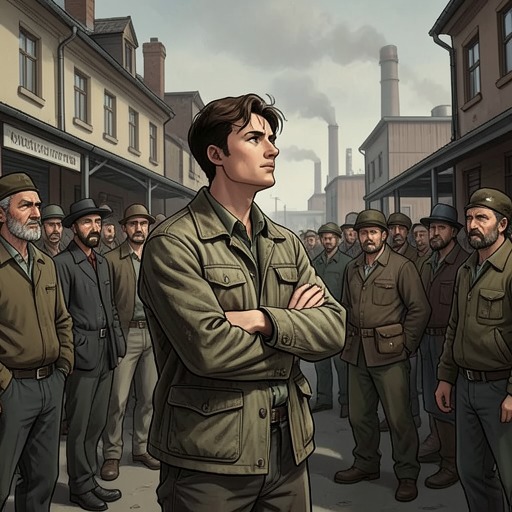
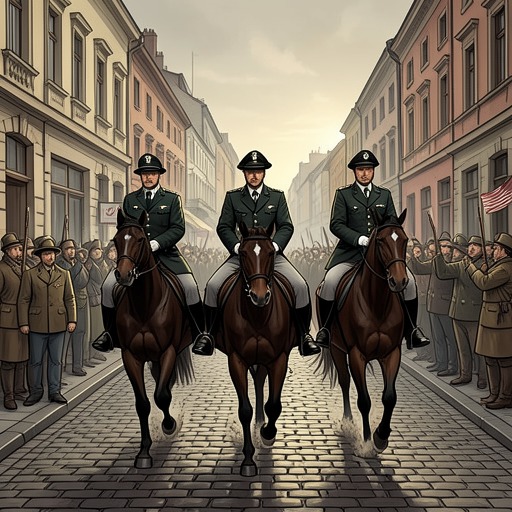
The novel establishes the material setting for this conflict in a New Jersey textile town where the mills dominate the landscape and, in the workers’ account, the town itself. At a strike meeting held in a neighboring town because the mill owners controlled access to local halls, mounted police blocked the entrance. Ben Compton tried to address the crowd from a lamppost, but police dragged him away as the strikers were pressed back toward the trolley tracks. Webb Cruthers climbed onto a hydrant to protest their exclusion. The scene makes repression immediate and physical: control of meeting space, backed by police, can silence a crowd before it has assembled indoors.
The picket line gives that coercion a more intimate cost. Before dawn, Anne Elizabeth Trent joined Webb among shivering workers outside the mills. When police broke up the line, a young woman fell; an officer kicked her in the face as Anne Elizabeth watched. Anne Elizabeth struck at the policeman and was hit from behind, then pushed into a police wagon. The episode links the suppression of collective action to violence against individual bodies, and shows Anne Elizabeth crossing from uneasy witness to direct participant in the confrontation.
Organizing Under Surveillance
The novel later places Ben Compton and Bram Hicks within the wider network of the Industrial Workers of the World, whose members traveled between jobs and organizing campaigns. After working in a fruit cannery on the Columbia River, they read about a free-speech fight in Everett and went to help. At the Everett dock, armed deputies arrested the arriving workers, struck them with rifle butts and clubs, and loaded them into trucks. The arrests and beatings are not presented as an isolated clash: the armed presence at the dock anticipates the planned intimidation of the organizers beyond it.
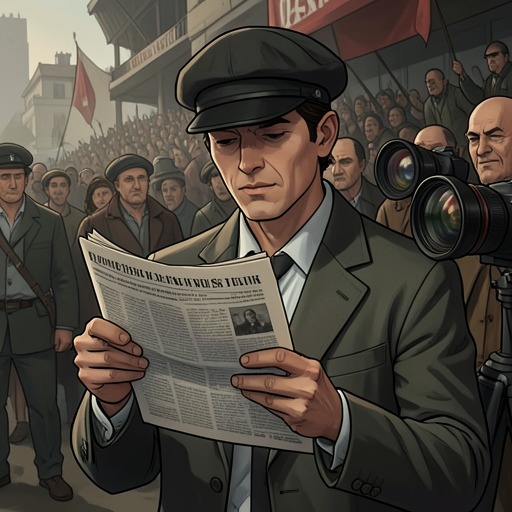
Federal scrutiny also surrounds a Bronx meeting called to send greetings to Russia’s workers’ government. Two federal agents sat in the front row with a stenographer, police shut the doors after the hall had filled, and soldiers and sailors watched from the gallery. Ben Compton spoke against a war he described as serving bankers and munitions makers, and warned that workers were learning to use guns. The authorities broke up the meeting and arrested him and others; men of conscription age had to show their registration cards before leaving. Political speech, surveillance, military registration, and arrest converge in the same room.
Ben Compton’s Case and Confinement
After the meeting, Ben Compton was offered release if he would promise to report for military training. He instead said he would continue opposing the capitalist war until arrested again. He was released on fifteen thousand dollars’ bail, with Morris Stein assuring the authorities that Ben Compton would not agitate until trial. The amount of the bail and the condition attached to it make the constraint concrete: he was outside jail, but his political activity was restricted while his case remained unresolved.
The appeal dragged on. Morris Stein warned that the First Red Scare might subside when the war ended and sought a light sentence; he brought Ben Compton lawbooks and proposed that he study for the bar, with the possibility of joining Stein’s office if he passed and regained his citizenship. Yet this offered future did not relieve the immediate confinement. Ben Compton slept badly, suffered from kidney trouble, and eventually tried to leave the apartment because he felt he had to return to the movement, even if doing so meant being arrested. His case shows repression working not only through custody, but through the prolonged uncertainty and enforced inactivity of a pending prosecution.
Anti-Radical Mobilization in 1919
The novel widens its account from state action to organized anti-union violence. It declares that being a red in the summer of 1919 was worse than being a German or a pacifist in the summer of 1917. Timber owners, sawmill operators, and shingle manufacturers cast themselves as patriots who had won the war, while the narrative sets that claim beside the wartime rise in lumber prices: from sixteen dollars to 116 dollars per thousand feet, with some government payments reaching 1,200 dollars per thousand for spruce.
Employers formed the Employers Association and the Legion of Loyal Loggers, making it profitable for groups of ex-soldiers to raid Industrial Workers of the World halls, beat or lynch organizers, and burn radical literature. In Centralia, Washington, on Memorial Day 1918, American Legion members led by a group from the Chamber of Commerce wrecked an Industrial Workers of the World hall, assaulted those inside, jailed some, and drove others across the county line in a truck. They burned papers and pamphlets and auctioned the hall’s fittings for the Red Cross; the union’s desk remained in the Chamber of Commerce. The detail leaves the violence embedded in civic space and its aftermath, rather than confining it to a passing street clash.
Persistence and Narrative Significance
The novel does not equate repression with the end of organizing. After the destruction of the Centralia hall, the loggers hired another hall and the union continued to grow. That ending gives the First Red Scare its central tension: authorities and employers could close rooms, break up meetings, jail speakers, and attack organizers, but the narrative repeatedly returns to workers gathering again. By joining individual arrests to corporate alliances and public campaigns against radicals, the account presents anti-radical repression as a struggle over who could speak, assemble, and organize—not simply as a response to isolated acts of dissent.